Russia's Bridge Blitz Is a Test — Will the West Blink?
Three Kyiv bridges hit in one night marks a qualitative shift in Russia's war against civilian infrastructure. The strikes aren't just revenge — they're an experiment in whether the West tolerates escalation or finally draws a line.
Three Bridges Down, One Question Ahead
The overnight strike on Kyiv was unusual in its concentration, even for a war that has normalized nightly missile barrages.
Three major bridges spanning the Dnipro River — Podilsko-Voskresenskyi, Darnytskyi, and the Southern bridge — were damaged in a single Russian attack Friday, according to Mayor Vitali Klitschko. At least six people were killed and 15 injured, Prime Minister Serhii Koretskyi confirmed. Two more died in separate regional strikes across nine Ukrainian oblasts.
This is not merely retaliation. It is logistics warfare with a psychological payload.
Kyiv’s left and right banks have always been connected by a handful of critical river crossings. Since early October, Russia has systematically targeted two of them — the Southern and Northern bridges — causing repeated closures, metro disruptions, and gridlock that made daily life for millions of residents feel besieged without bullets ever crossing the border.
Friday’s attack changed the calculus. For the first time, Russia damaged three main road crossings over the Dnipro in a single night, leaving most of the capital’s primary east-west arteries compromised at once.
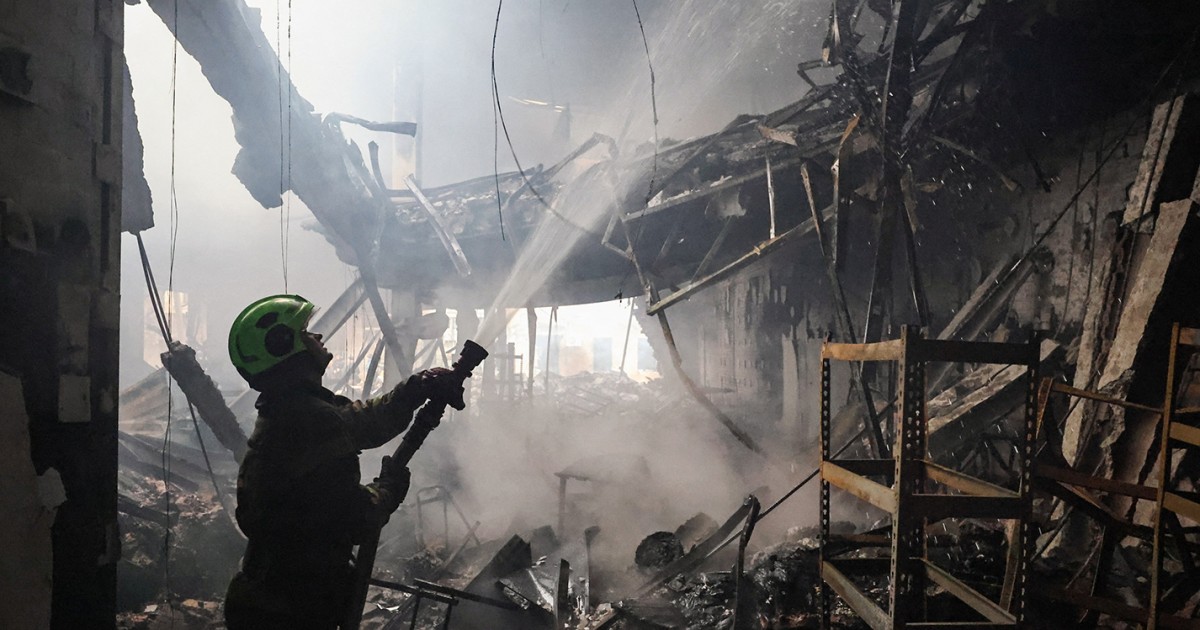
An NBC News team stationed in Kyiv reported air raid sirens going off every few minutes throughout the night, punctuated by loud explosions. By dawn, under rain and fog, firefighters were still battling blazes from a strike on an industrial area in central Kyiv.
Klitschko’s message to residents was blunt: do not drive into the city unless absolutely necessary. Employers should allow remote work. Even the government itself is starting to operate remotely when feasible.
The bridge destruction is functional. But it is also deeply symbolic — a message about what kind of city Moscow is trying to make Kyiv unable to sustain.
The Revenge Sequence
The strikes came hours after Vladimir Putin returned from the APEC summit in Shenzhen, where he stood beside President Donald Trump and Chinese President Xi Jinping for photographs that his propaganda machine immediately circulated domestically.
Within hours of those images, Putin told reporters that Russia would respond “far more painfully” to Ukraine’s third strike on the Kerch Bridge this week — the structure he personally opened in 2018, the longest bridge in Europe, the centerpiece of his claim that Crimea is forever Russian.
The Kerch Bridge collapse on Thursday was not minor damage. Satellite imagery from Vantor showed a complete section of the roadway caved into the sea. Russia has repeatedly claimed the bridge is an “exclusively civilian facility,” even as Ukrainian President Volodymyr Zelenskyy called it “the main military crossing from Russian territory into our Ukrainian Crimea.”
Whether you accept Russia’s civilian framing or Ukraine’s military reality, the bridge’s destruction matters strategically. It severed a critical supply route for Russian forces and civilians moving between the mainland and occupied Crimea.
Putin clearly believed that answering in kind — targeting Kyiv’s civilian infrastructure — would demonstrate resolve both at home and abroad. Instead, it may have done the opposite.
Zelenskyy’s response that afternoon cut through the moral equivalency that Western diplomats often default to when neither side accepts responsibility:
Putting Russia and Ukraine on on equal footing is fundamentally wrong. This week, Putin posed for photographs with world leaders. But the photograph he deserves is one of him in the dock, where he stands trial for crimes against Ukrainians and Ukraine.
Russia’s air force confirmed Friday that the attack on Kyiv involved ballistic missiles, cruise missiles, and more than 400 drones targeting 23 locations across the country. Ukraine’s energy authorities said strikes on power plants and substations — part of a sustained campaign since early fall — left residents in Kyiv and ten other regions without electricity.
The pattern is unmistakable. Russia is escalating the tempo and geographic spread of its attacks while simultaneously refining a legal narrative: that Ukrainian strikes on infrastructure like the Kerch Bridge justify reciprocal targeting of Ukrainian civilian infrastructure.
It is a dangerous argument because it is designed to dull the West’s reflexive outrage. If Moscow can frame its bombing of Kyiv bridges as equivalent to Ukraine’s sabotage of a Crimean supply route, then Western governments face a moral dilemma each time something explodes in a Ukrainian city — does support remain unwavering, or does fatigue set in?
Who Wins, Who Loses
The immediate winner of Friday’s strikes is Russia’s domestic audience. Putin needed to look strong after a humiliating weekend in which Ukraine struck the Kerch Bridge twice more — once Monday, again Thursday, each time inflicting damage that cost billions and took weeks to repair.
The photographs from Shenzhen were meant to project normalcy. Putin wanted the world to see a Russian president standing shoulder-to-shoulder with Trump and Xi, unbothered by a war that has consumed hundreds of thousands of lives and drained Russia’s economy.
The bridge strikes offered a cheaper way to deliver the same message. Six dead and fifteen injured in Kyiv will not move global markets or shift policy debates. But inside Russia, where state media controls the narrative, the images of fire over Kyiv’s industrial district will reinforce the story that Moscow holds the initiative.
The losers are the civilians trapped between these calculations.
Kyiv’s bridge closures already complicated emergency services, commercial delivery, and the daily commute of workers who have no choice but to endure whatever remains of the road network. Destroying three crossings in one night meansambulances take longer routes, freight trucks are rerouted through neighborhoods not built for them, and the city’s economic rhythm stalls further.
Ukraine’s energy grid faces compounding stress. Power outages in Kyiv and ten additional regions mean hospitals, water treatment facilities, and heating systems are all operating under strain heading into winter.
But the broader loser — and this is the point that escapes too many Western analyses — is the norm that distinguishes between military targets and civilian infrastructure in modern conflict.
Russia has been eroding that distinction deliberately and publicly. The Kerch Bridge is dual-use by any objective measure. So are Kyiv’s commuter bridges. When Putin declares that Ukraine’s strikes on one justify Russia’s strikes on the other, he is not simply making a legal argument. He is attempting to normalize a standard: civilian infrastructure anywhere is a legitimate target if your adversary has attacked civilian infrastructure anywhere else.
That standard, if accepted, changes everything about how wars are fought — and how they end.
What Happens Next
The most important question is not whether Russia will strike Kyiv’s bridges again. It will. The second most important question is what the West does next.
Trump attended APEC alongside Putin and Xi. The meeting produced no public statement on Ukraine. No new sanctions package was announced. No commitment to additional weapons deliveries emerged from Shenzhen.
That silence is itself a signal. The Trump administration’s posture has grown increasingly conditional on Ukraine’s willingness to negotiate, and each Russian escalation against civilian targets gives Moscow leverage to argue that continued Western support is futile — that Ukraine cannot win, and the West should accept a frozen conflict on Russia’s terms.
Putin appears to be counting on that exact dynamic. The Kerch Bridge strikes were precision operations carried out with weapons that Ukraine obtained from Western suppliers. The bridge bombings in Kyiv are Russia’s answer, delivered using Soviet-era stockpiles and domestic missile production that no embargo has meaningfully constrained.
Every kilometer of damaged bridge in Kyiv is a tacit endorsement of Russia’s strategy by omission — because no new weapon system, no sanctions announcement, no rhetorical escalation has followed.
Zelenskyy knows this. His demand that Putin stand trial is not performative. It is an attempt to reframe the conflict in legal terms at a moment when the moral framing keeps slipping away.
The three bridges destroyed overnight are more than physical obstacles. They are test cases for what kind of war Russia is willing to fight and what kind of response the world is willing to tolerate.
So far, the tolerance threshold keeps rising.