Russia's Secret Missile Deal Is Rewriting Iran's Anti-Carrier Playbook
Moscow has been quietly sending missile engineers to Iran since 2023 to help build ramjet-powered hypersonic cruise missiles — a capability that could finally let Tehran threaten US Navy carriers in the Middle East. The project, code-named C43oL, marks the most consequential military-technology transfer in the Iran-Russia relationship.
The Missing Piece in Iran’s Anti-Access Arsenal
Iran has spent years building a credible threat against US military installations in the Middle East — but there has been one glaring gap. Shahed drones and precision-guided missiles have inflicted real damage on US bases across Iraq and Syria. They have not come close to threatening the US Navy’s carrier strike groups that operate in the Persian Gulf and Arabian Sea.
That may be about to change. According to a report by the Financial Times, Russia has been secretly supporting Iran’s development of ramjet-powered hypersonic cruise missiles since 2023. The program, code-named C43oL, represents the most significant military-technology transfer between Moscow and Tehran to date — and it targets precisely the capability Iran has lacked most: the ability to engage moving naval targets at long range.
What Ramjet Technology Actually Changes
Ramjet engines are air-breathing jet propulsion systems. Unlike solid-fuel rockets, which burn all their propellant at ignition and then coast, ramjets continuously draw in atmospheric air, compress it, mix it with fuel, and ignite it. The result is an engine that is structurally simpler and significantly lighter than an equivalent rocket motor — while delivering two to five times the range.
A ramjet-powered missile can fly at altitudes of 18 to 21 kilometers and maintain adjustable thrust mid-flight. Those characteristics make it substantially harder to intercept than a ballistic missile or a conventional cruise missile. Ballistic trajectories are predictable. Ramjet-powered cruise missiles can fly low, adjust speed, and maneuver — all of which degrade the effectiveness of layered air-defense systems like the Aegis Combat System and the standard NATO sea-air defense architecture built around US carriers.
Experts cited by the FT concluded that the technology was clearly being developed for anti-ship and ground-attack roles. That is not speculative. It is the logical endpoint of everything Iran has been trying to build since the 2022 escalation.
How Deep the Russian Involvement Goes
The scope of Moscow’s involvement goes well beyond providing blueprints. According to the FT, Rosoboronekspert — the Russian state defense-export agency — facilitated multiple visits by senior missile engineers from NPO Mashinostroyeniya, one of Russia’s oldest and most prominent design bureaus. These engineers traveled to Iran repeatedly to assist directly with the program.
Negotiations over the project continued at least through the summer of this year. Iran has reportedly completed its ramjet propulsion system development and conducted test flights. Whether the resulting missile has reached operational deployment remains unclear — no public evidence of deployment has emerged. But the developmental milestones are significant enough to shift the strategic calculus.
The Reciprocal Relationship
This technology transfer did not happen in a vacuum. The Iran-Russia military relationship has been deepening systematically since the onset of the war in Ukraine. Iran became one of Russia’s most important suppliers of Shahed loitering munitions — drones that have been used extensively against Ukrainian cities and military targets. Russia, in turn, has gained a combat-proven platform and has used Iranian technical assistance to build out its own domestic drone production capacity.
The exchange has gone both ways. Reports indicate that Iran has received satellite imagery, drones, and weapon components from Russia during its confrontation with the United States and Israel. The Iranian Revolutionary Guard Corps has also secretly acquired Chinese high-resolution reconnaissance satellites, which it has used to monitor US military bases throughout the Middle East.
What the ramjet program adds is a qualitative leap in strike capability — not just more drones, not just longer-range ballistic missiles, but a new class of weapon that fundamentally changes what Iran can threaten at sea.
Why Carriers Are the Target
The FT noted that while Iran has caused substantial damage to US land-based installations through drone and missile attacks, it has not achieved comparable effects against US Navy assets. That asymmetry is exactly what the ramjet program is designed to correct.
A hypersonic cruise missile with adjustable thrust, extended range, and the ability to fly at high altitude and maneuver mid-flight would force the US Navy to rethink its carrier deployment patterns in the region. Carrier strike groups currently operate at distances that provide a buffer against most Iranian missile systems. A ramjet-powered weapon with two to five times the range of an equivalent rocket motor could push that effective strike envelope far deeper into approaches that carriers currently consider safe.
That does not mean US carriers are vulnerable today. It means the margin of safety is narrowing — and the trend line runs in the wrong direction for Washington.
The Broader Strategic Picture
Nicolas Glorieux, a professor at Sciences Po Paris, told the FT that the project demonstrates Russia’s intent to expand the Ukraine war into additional theaters and to draw the United States into new strategic confrontations. The logic is straightforward: if Iran can threaten US naval forces more effectively, American force posture in the Middle East becomes more constrained, more expensive, and more politically fragile.
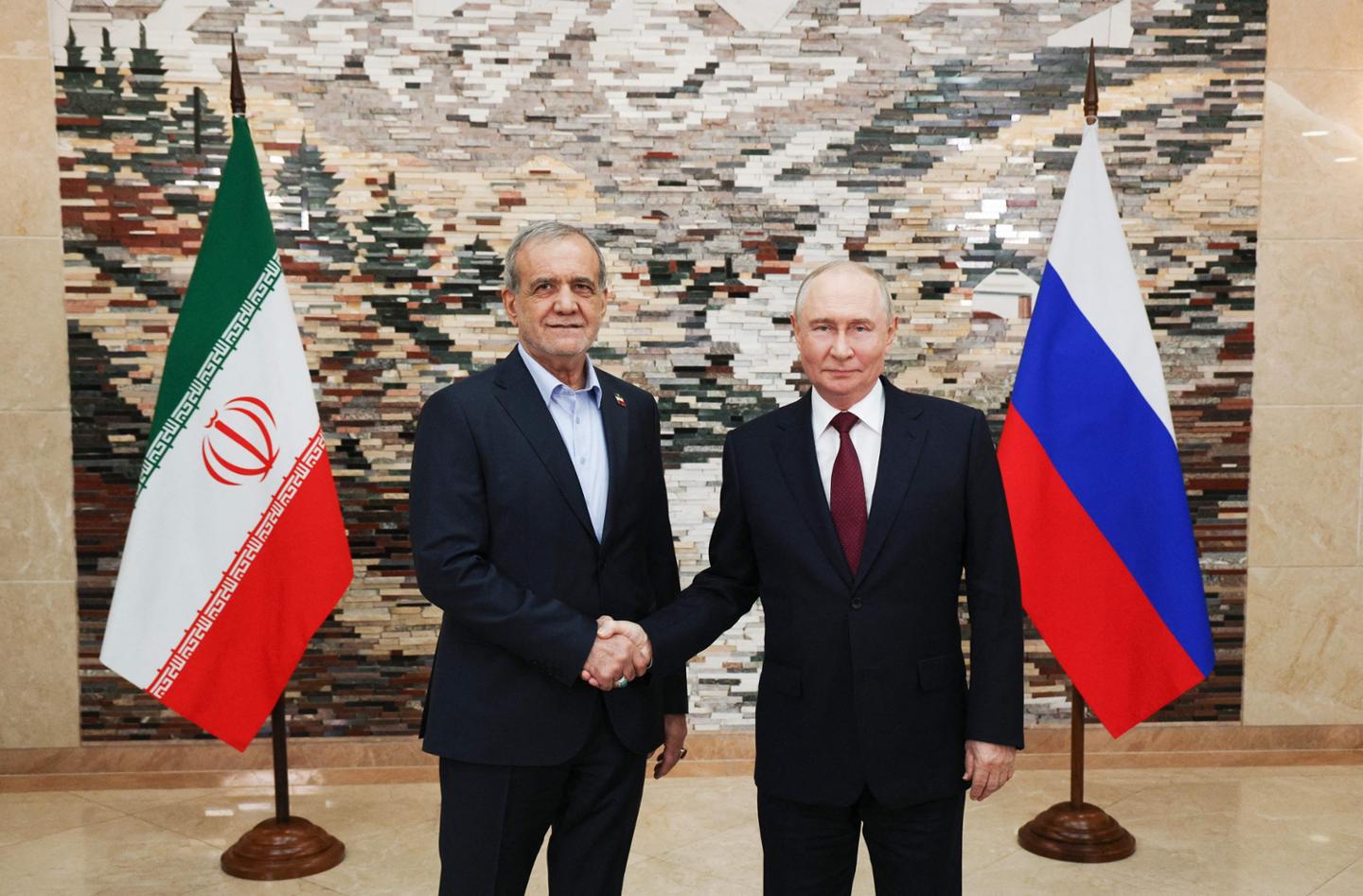
The meeting between Iranian President Masoud Pezeshkian and Russian President Vladimir Putin at the Shanghai Cooperation Organization summit in Bishkek on September 1 — captured in photographs showing them clasping hands before their bilateral talks — was itself a signal. It reinforced what the FT’s reporting now makes explicit: the strategic military alignment between Tehran and Moscow is hardening into something durable and increasingly sophisticated.
China’s role as a satellite supplier adds a third dimension to this axis. The IRGC’s access to Chinese reconnaissance capability means Iran already has eyes on US base locations. The ramjet program would give it a far more lethal way to use that intelligence against mobile naval targets.
What Comes Next
No deployed hypersonic cruise missile has yet appeared publicly from Iran. Test flights are one thing; operational deployment is another. But the developmental progress documented by the FT, combined with the direct involvement of Russian design-bureau engineers, suggests the program is further along than most Western assessments have assumed.
The US should expect a period of accelerated testing and possible limited deployment within the next 12 to 24 months. Russian engagement of this depth does not stall. If the ramjet system reaches maturity, the geographic scope of threats to US forces in the Middle East expands dramatically — and the cost of maintaining carrier presence in the region rises accordingly.
For now, the missile exists primarily on paper and in test flights. But the technology transfer is real, the partnerships are institutionalized, and the strategic direction is clear. The question is not whether Iran will eventually field a ramjet-powered hypersonic cruise missile. It is when — and what US force posture looks like by then.