Russia's War of Attrition Moves to Kyiv's Sky
Moscow has swapped high-intensity missile barrages for relentless drone swarms over Kyiv — a tactical pivot designed to exhaust Ukrainian defenders and break civilian morale. The strategy tests Ukraine's air-defense stockpiles and forces a reckoning with how long Western industrial capacity can keep pace.
A Strategy Worn Like a Knife
Russia has stopped trying to overwhelm Kyiv in a single brutal swipe. Instead, it is cutting at the city with small, repeated strokes — waves of one-way attack drones sent through the sky for hours at a time, forcing sirens to wail, people into shelters, and air-defense crews to reload again and again.
On a recent Thursday, Kyiv logged 872 minutes of air raid alerts. That is nearly 15 hours. Ukrainian officials called it a record since the full-scale invasion began. The previous benchmark fell on March 1, 2022, when the city endured 12 separate alerts in a single day. By the morning of August 28, eight more had accumulated.
This is not a barrage. It is something more deliberate, and in some ways more dangerous: a campaign of persistent nuisance aimed at grinding down a population that has already survived two years of total war.
Amplitude to Frequency
For most of the conflict, Russia’s standard approach against Ukrainian cities has been amplitude — launch as many missiles and drones as possible in a compressed window, hoping to saturate air-defense systems and cause maximum damage before interceptors run dry. It is a strategy built on volume and shock.
What Moscow is attempting now is different. It prioritizes frequency. Smaller groups of drones are dispatched repeatedly throughout the day, each wave triggering an alert, each alert pulling civilians from work and schools, each interception consuming a missile that may not be replaced quickly enough.
The effect is less about any single strike and more about the cumulative toll. Commerce stalls. Transport ground to a halt. Public services are disrupted on repeat. Air-defense batteries, already stretched across a wide front, must rotate crews with exhausting regularity. And the psychological weight of living under near-constant threat — even when most drones are intercepted — erodes something harder to measure.
The Calculus of Despair
Iryna Terekh, CEO of Fire Point, a Ukrainian defense company producing the FP-1 and FP-2 attack drones as well as the Flamingo cruise missile, did not mince words about Moscow’s intent.
“The enemy has long employed this tactic in frontline cities, scorching the earth and any chances of normal life,” she said. “Its goal is to make our hands drop in despair. To make us search for culprits among ourselves. To make us snap at our own. To let exhaustion win.”
That assessment aligns with a broader Russian doctrine of psychological warfare that has been visible in places like Bakhmut, Avdiivka, and Mariupol — cities where sustained bombardment was meant to make life untenable. The difference now is that Kyiv, the capital and symbolic heart of Ukrainian resistance, has become the target.
A former senior Ukrainian military officer offered a counterpoint: the strategy could backfire. “They want to plant fear, demoralize the population, plant panic,” he said. “My belief is that they won’t achieve such strategic objectives. It is too late. It could have the opposite effect: more hate, more aggression and anger toward Russians.”
Whether that holds remains an open question. Ukraine has demonstrated remarkable resilience through periods of far worse bombardment. But resilience is not infinite, and a war of attrition against civilian morale is a long game — one measured in months and years, not days.
The Logistics of Survival
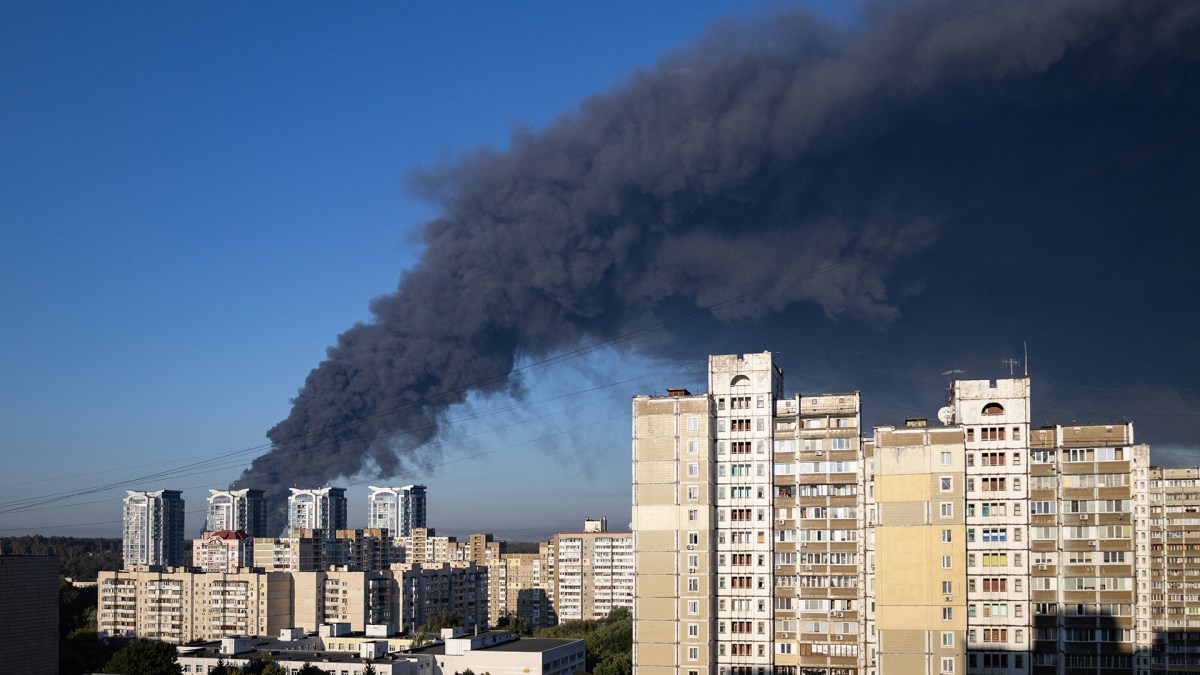
The Myla incident — a Russian drone strike on a warehouse in a Kyiv suburb that triggered secondary explosions and killed at least 37 people — exposed a brutal operational reality. Ukrainian weapons were stored near residential areas, a consequence of a defense industry forced to disperse production and storage to survive Russian bombing.
Fire Point operates 90 separate facilities, not a single factory. Critical components are duplicated, triplicated, quadruplicated across hidden sites. “The logistics are hell, to be frank,” Terekh said. “We do not have the luxury to have the factory in a classic way.”
President Volodymyr Zelensky called the Myla storage a crime of negligence. The Defense Ministry demanded a full audit of all weapons storage locations. Two Ukroboronprom directors were fired after a similar incident in Vyshneve the previous month.
The underlying problem is structural, not incidental. Russia’s sustained campaign against Ukraine’s defense industry has made centralized production impossible. Ukraine’s response — dispersion — makes the industry harder to target but also harder to manage, slower to scale, and more vulnerable to accidents like the one in Myla.
The Industrial Race
This tactical shift toward drone swarms is not occurring in a vacuum. It is part of a broader industrial competition between Russia’s mass-production capabilities and the West’s ability to replenish Ukraine’s air-defense inventory.
Russia has been ramping up drone output for months, leveraging Iranian-designed Shahed platforms and its own domestic FPV production. Each additional drone is cheap — some cost only tens of thousands of dollars. Each interceptor missile fired to stop one costs hundreds of thousands, sometimes millions.
Western air-defense systems, particularly the Patriot and NASAMS batteries supplied by allies, are effective but limited in number and ammunition stockpiles. The question is not whether they can shoot down individual drones but whether they can sustain fire against waves sent over 15-hour periods, day after day, week after week.
European defense production lines are expanding, but timelines stretch into 2027 and beyond. Ukraine cannot wait. The pressure on Kyiv is immediate and unrelenting.
The Broader War
While Kyiv endures this new phase of aerial harassment, the ground war continues to grind forward in eastern Ukraine. Russian forces have been probing around Kupyansk in Kharkiv Oblast and Slovyansk in Donetsk, making limited gains against Ukrainian counterattacks. The Institute for the Study of War reported no confirmed Russian advances in late August, but the fighting remains fierce and costly.
Ukraine’s military intelligence chief, Kyrylo Budanov, stated plainly that the country needs to mobilize 30,000 soldiers per month just to maintain current force levels. “Unfortunately, we have to accept it as it is,” he said. “We cannot do otherwise.”
That number underscores the broader strain. Ukraine is fighting a war of attrition on multiple fronts — on the ground, in the sky, and now, increasingly, against the psychological endurance of its capital.
The AI Edge
One area where Ukraine is attempting to leapfrog its disadvantages is through artificial intelligence. The Defense Ministry has launched platforms like Brave1 Dataroom and Avengers Labs, providing Ukrainian developers with real battlefield data to train AI systems that can detect and intercept aerial targets faster than human operators ever could.
“In the past, coordinating a fire mission could take 15 to 20 minutes, or even longer, when done manually,” the ministry noted. “In modern warfare, such a delay is effectively unacceptable.”
Over 100 Ukrainian companies are now using these platforms. The dataset includes 5 million annotated frames of battlefield imagery, covering everything from tanks to Shahed-type drones. If AI can shrink the time from target detection to interceptor launch from minutes to seconds, it could tip the balance in cities like Kyiv where every second counts.
What Comes Next
Moscow has signaled that the recent spike in strikes may be only the beginning, tying it to threats made by President Vladimir Putin about escalation. Whether this becomes a sustained strategy or a one-off intensity push will become clear in the coming days and weeks.
What is already visible is a Russia that has adapted its tactics to exploit Ukraine’s vulnerabilities — not just military ones, but the fatigue of a population living under near-constant alarm. The strategy is not designed to win a battle. It is designed to make the battle feel unwinnable.
How Kyiv responds — militarily, politically, and psychologically — will say more about the trajectory of this war than any territorial gain or loss on the eastern front.