A Drone Missed a Train Carrying Western Leaders. The Message Is Clear.
A Russian strike within two kilometers of Poland damaged a locomotive and nearly hit a train carrying former UK and Swedish prime ministers — a strike that signals Moscow is now willing to operate dangerously close to NATO territory.
A Near-Miss With Real Weight
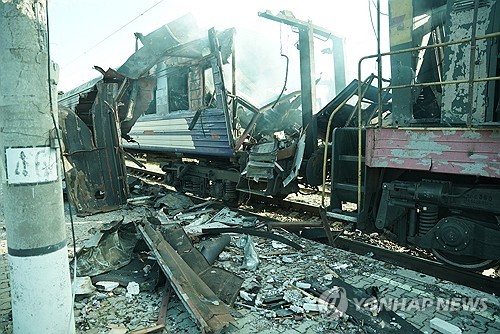
A Russian drone strike landed within two kilometers of the Poland-Ukraine border on September 13, damaging a locomotive on a passenger train and igniting a fuel depot fire that spread to a freight truck. On board a nearby train were former British Prime Minister Boris Johnson and former Swedish Prime Minister Carl Bildt — not on the struck train itself, but close enough that Bildt described it as a direct hit on the convoy behind them.
The incident sounds like a terrifying accident. It is not.
Russia’s Defense Ministry confirmed the strike in a statement, saying it targeted “railway infrastructure facilities in western Ukraine” that were transporting military cargo from European countries. The same arsenal — air-launched precision-guided weapons and attack drones — also hit logistics centers and substations in Odesa and Mykolaiv. This was not a stray munition. It was a coordinated strike on supply routes that feed western Ukraine and, by extension, the front lines.
The Border Is No Longer Sacred
The Volyn region hit in this attack sits just outside the Yavoriv-Dorohusk border crossing — one of the busiest rail checkpoints between Ukraine and NATO territory. When the air raid alert sounded at the checkpoint, operations halted. Travelers evacuated. The checkpoint itself was not physically damaged, but the message was unmistakable: Moscow can strike where Western aid crosses into Ukraine and make a point about it.
Two kilometers from Polish soil is not far. It is close enough to rattle capitals that have spent months treating the border as a buffer zone insulated from the violence. It is close enough that a different wind, a different drone trajectory, and a different passenger manifest could have produced a dramatically worse headline.
Ukraine’s Foreign Minister Andrii Sybiha put it bluntly: “Putin’s terrorism is now directly targeting the doors of the EU and NATO.” Whether that is rhetoric or diagnosis depends on who you ask in Brussels and Warsaw. But the physical evidence — a damaged locomotive, a burned fuel depot, a train of former Western leaders barely spared — suggests the line has been redrawn.
Who Wins, Who Loses
Russia wins by forcing NATO to recalibrate its risk calculus. Every shipment of Western arms moving through western Ukraine now carries an implicit question: how close is too close? If Moscow can strike within two kilometers of a NATO border with drones and air-launched missiles, then the entire logistics chain — rail, road, warehouse — deserves a higher threat premium. That raises costs, slows throughput, and creates political friction in host countries that never signed up for their territory becoming a target zone.
Ukraine loses by having its critical supply routes sit in the open and remain vulnerable. The Odesa logistics center and Mykolaiv substations hit alongside the Volyn strike suggest a systematic effort to degrade the channels through which Western military aid reaches Ukrainian forces. This is not just about today’s supplies. It is about disrupting the rhythm of reinforcement before the next phase of the war.
NATO loses credibility if it treats this as an isolated incident. The alliance has long relied on the principle that Article 5 protects member states and that strikes near borders are warnings, not invitations. But warnings only work if they change behavior. If Moscow concludes that operating this close to Poland carries no real consequence, the deterrent value of the alliance’s eastern flank erodes with every drone that lands within shooting distance.
What This Means for Kyiv’s Drone Strategy
Kyiv has spent months developing a drone warfare doctrine that prizes precision, cost efficiency, and asymmetric impact. Russia’s response — striking deep into western Ukraine with the same drone and missile toolkit — suggests Moscow is adapting to a war of logistics as much as territory. The Ukrainian Army has grown accustomed to using drones to hunt Russian supply lines; Russia is now doing the same to Ukrainian ones.
This is a dangerous symmetry. When both sides are weaponizing drones against each other’s infrastructure, the battlefield stops being just the front line. It becomes the entire country — and increasingly, the countries that support it.
The near-miss with Johnson and Bildt’s train should accelerate European defense planning, not just on paper but in practice. Poland and the Baltic states are already spending more on defense. This strike makes the case louder. But spending is only half the equation. Command-and-control integration, border airspace defense, and mutual protection agreements for supply routes are the kinds of mundane details that determine whether NATO’s eastern flank holds under pressure.
What Happens Next
Expect Russia to keep testing how close it can operate to NATO borders without triggering a formal response. Expect Poland and the Baltic states to push for hardened logistics nodes and layered air defense around border crossings. Expect Kyiv to reroute some supply chains through less vulnerable corridors, raising transit times and costs.
The strike was not aimed at toppling governments or starting a wider war. It was aimed at something more insidious: normalizing the idea that NATO-adjacent territory is fair game. The train carried former leaders, not sitting heads of state. That may have been deliberate — a way to draw outrage without giving Moscow a pretext for accusing Ukraine of provoking a NATO response by hosting active leadership.
Former leaders are easier to threaten than current ones. The implication is that Russia is mapping out the escalation ladder one rung at a time, looking for the point where the West blinks. So far, the ladder is holding.