Samsung's Foundry Play Through AMD Could Reshape AI Chips
Samsung is exploring a foundry partnership with AMD beyond memory supply — a move that could shift the balance against TSMC and redefine AI chip manufacturing.
Samsung’s Foundry Play Through AMD Could Reshape AI Chips
Samsung Electronics is trying something it has rarely achieved at scale: using its dominance in memory chips to crack open the foundry market. The target is not a small customer testing the waters. It is Advanced Micro Devices, the American chip designer that is increasingly dependent on Taiwan’s TSMC for its most advanced production.
At a meeting in Seoul on October 9, 2026, Lisa Su, AMD’s chief executive, sat down with Jeon Young-hyun, who runs Samsung’s device solutions division. Their conversation extended an existing cooperation into unfamiliar territory. Samsung wants to supply not just high-bandwidth memory for AMD’s AI accelerators but to manufacture the chips themselves.
This may look like a routine supplier relationship expansion. It is not. The move signals a structural shift in how AI chip giants source memory and could reshape the Korea-US technology alliance.
The Turnkey Gamble
Samsung’s pitch to AMD is built around what the company calls a “turnkey” model. Rather than having AMD source memory from one vendor, fabricate chips at TSMC, and arrange packaging separately, Samsung offers all three under one roof. Memory. Foundry. Advanced packaging.
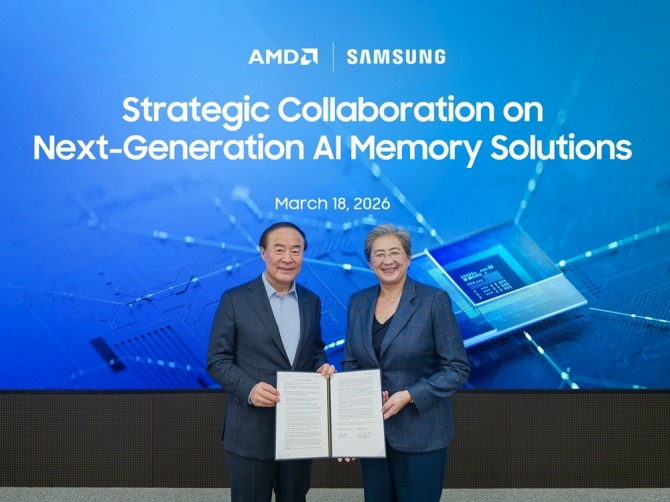
Jeon made the case explicitly when the two companies signed a memorandum of understanding in March 2026 at Samsung’s Pyeongtaek facility. “Samsung has a unique turnkey capability that can support AMD’s AI roadmap,” he said at the time, emphasizing that the cooperation would extend beyond memory to include foundry and packaging technologies.
Samsung has quantified the benefit. The company claims that using its integrated AI solution approach — combining memory, fabrication, and packaging — can reduce the time from chip design to production by roughly 20 percent compared with managing separate suppliers. In the AI race, where months of development time translate directly into market share, that margin matters.
AMD’s Supply Chain Anxiety
For AMD, the calculus is equally strategic. Su made her position clear in early October, telling reporters in Taiwan that AMD plans to significantly increase its semiconductor supply next year. She cited expected sustained high demand over the coming years and stressed the need for additional advanced wafer production capacity.
The implication is straightforward: AMD cannot rely on TSMC alone. The company needs options. Samsung’s memory relationship gives it a foothold.
Su confirmed during the October 9 meeting that her company is actively exploring cooperation opportunities beyond foundry, including in multiple areas. “We are continuously looking at opportunities in various areas including foundry,” she said, responding to questions about Samsung foundry cooperation at an AMD gaming event earlier that day.
Already, Samsung holds a privileged position. It was designated as the priority supplier of HBM4 memory for AMD’s Instinct MI455X AI accelerator, the company’s next-generation training chip. The partnership also covers high-performance DDR5 memory for AMD’s Helios AI server platform and sixth-generation EPYC server processors.
Notably, Su acknowledged during the same discussions that both Samsung and SK Hynix support the MI455X shipment. That dual-supplier reality underscores AMD’s determination not to concentrate risk in any single memory provider — let alone a single foundry.
Why Samsung Needs This Win
Samsung’s foundry business has struggled to close the gap with TSMC. The Taiwanese giant dominates the leading edge, producing chips for Apple, NVIDIA, and now AMD at process nodes where Samsung has faced yield challenges and missed customer deadlines. Foundry revenue has consistently trailed TSMC’s, and the gap has widened in recent years rather than narrowed.
A major foundry contract with AMD would change the narrative. It would demonstrate that Samsung can deliver at the cutting edge, potentially attracting other customers who have been watching from the sidelines. More practically, it would provide the revenue volume needed to sustain Samsung’s advanced fabrication investments.
The memory-to-foundry bridge is deliberate. Samsung already supplies HBM to AMD. Converting that relationship into foundry business means leveraging an existing trust relationship rather than starting from zero. It is a gradual play, not a leap.
The Broader Implications
What happens next depends on whether this cooperation moves from discussion to signed contracts. As of October 2026, foundry cooperation remains in the review stage. No production volume has been committed publicly.
But the direction is clear. Samsung is betting that its memory strength can become a gateway into foundry. AMD is betting that diversification strengthens its position against both TSMC and its own supply constraints. The overlap in interests creates genuine momentum.
For the global AI hardware ecosystem, the shift could be meaningful. If AMD successfully blends Samsung and TSMC production while sourcing HBM from both Samsung and SK Hynix, it creates a more resilient supply chain — one less vulnerable to geopolitical disruption in the Taiwan Strait. That resilience comes at a cost: managing multiple fabrication partners is complex and expensive. AMD is willing to pay that price.
For Korea, the stakes are equally high. Samsung’s foundry ambitions have long been tied to the broader question of whether South Korea can maintain its semiconductor leadership as China intensifies its own capabilities and Taiwan’s geopolitical position grows more uncertain. A successful foundry partnership with AMD would validate Korea’s strategy of competing on integrated semiconductor services rather than memory alone.
The memory market itself is also at a turning point. HBM demand is surging alongside AI training and inference workloads. Samsung and SK Hynix are locked in fierce competition for supply contracts with AMD, NVIDIA, and Intel. Samsung’s attempt to bundle memory with foundry services is partly an effort to differentiate itself from SK Hynix, which currently holds a slight edge in HBM market share but does not operate a foundry business at all.
SK Hynix’s response to Samsung’s foundry pivot will be telling. Without a foundry option, SK Hynix must compete purely on memory performance and price. That may strengthen its position with customers who prefer specialized suppliers. Or it may leave SK Hynix exposed if customers value integrated solutions increasingly.
The Road Ahead
Lisa Su has said AMD is planning its supply chain three to five years out. That horizon aligns with the timeline for Samsung’s advanced process nodes to reach competitiveness. If Samsung can deliver reliable yields on its next-generation fabrication processes while supplying HBM simultaneously, the partnership could scale quickly.
The alternative is that foundry cooperation stalls at the discussion stage. Samsung’s foundry track record makes caution understandable on AMD’s side. Turning agreements into volume requires proof points — and those take time to build.
What is certain is that the conversation itself represents a shift. Samsung no longer sees itself as just a memory supplier to AMD. It sees itself as a full-spectrum partner. And AMD, for its part, is openly considering whether to trust that partner with its most critical production needs.
In the race to build the next generation of AI chips, supply chain strategy is becoming as important as chip design. Samsung’s bet on AMD is a bet that integrated semiconductor services will matter more than ever — and that the company best positioned to offer them will shape the industry’s future.