SK Moves Fast on Gwangju Fab Amid China Semiconductor Push
SK Chairman Choi Tae-won personally inspected a Gwangju site earmarked for a new semiconductor cluster, signaling an accelerated push that could rival Samsung's plans. The move comes as SK grapples with slowing HBM demand and China's expanding chip ambitions.
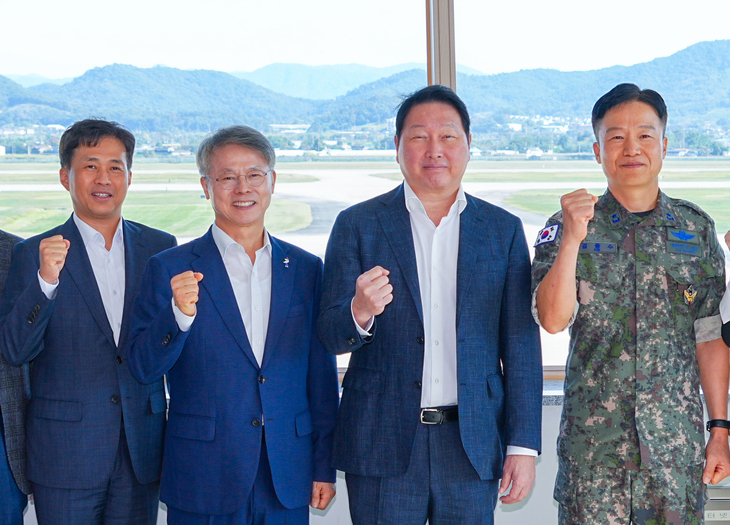
SK Is Betting Big on Gwangju — and It’s Not Just About Chips
South Korea’s semiconductor geography may be about to shift. SK Group chairman Choi Tae-won visited the Gwangju site this week — a former military airbase and ammunition depot slated for relocation — and made his intentions clear: SK wants to build a fab here as fast as possible, potentially running parallel construction alongside its already-accelerated Yongin project.
The visit was not a photo opportunity. Choi inspected the land conditions firsthand, reviewed power and water supply readiness, and discussed transportation links with local officials. That level of CEO-level ground truthing from someone who typically runs SK from Seoul signals urgency — or at least a desire to project it.
The special city established around Gwangju has committed 6 trillion won (roughly $4.3 billion) in integrated fiscal support for the cluster. That money is meant to cover the heavy lifting: relocating military infrastructure, building substations, securing water intakes, recruiting workers, and improving housing so engineers actually want to live there. SK and SK Hynix executives have held 10 rounds of talks with the special city administration already. The process has been deliberate; this week’s visit suggests it is no longer.
The Timing Is Unusual
Choi did not mince words about demand. He said semiconductor demand is growing faster than expected and that even the Yongin project — which he has already pushed forward by 12 years — may not be enough. That framing is notable. SK’s Yongin fab was already a response to surging AI-driven demand for high-bandwidth memory (HBM). Now SK is treating Gwangju as a possible second line of offense.
This is not the same posture SK has occupied publicly in recent quarters. SK Hynix reported a sharp slowdown in HBM demand heading into late 2025 and early 2026, and SK Group faced scrutiny over its aggressive capital spending. Two consecutive years of operating losses across the broader SK conglomerate had led some analysts to question whether the group could sustain this pace. The Gwangju announcement reads as a recalibration — perhaps desperate, perhaps strategic.
Why Gwangju Matters Beyond SK’s Balance Sheet
Gwangju sits in South Korea’s Honam region, historically the political and economic periphery of the country. It has never been a semiconductor hub. The nearest existing cluster is in Pyeongtaek, home to Samsung’s massive Memory Business Unit — and SK’s chief rival. Placing a new fab in Gwangju is an attempt to create a second pole of semiconductor gravity in Korea, one that could attract suppliers, talent, and follow-on investment that would otherwise flow toward Samsung’s ecosystem.
For SK, the geographic diversification is also a risk-mitigation play. A single-point-of-failure concentration in Pyeongtaek or Yongin is a strategic vulnerability — whether from natural disaster, water scarcity, or geopolitical escalation. Gwangju offers distance from those concentrations without leaving the country.
For the Honam region, it is the kind of industrial anchor that politicians have chased for decades without delivering. If SK actually breaks ground, the symbolic and economic effects could reshape regional politics inside South Korea.
The China Factor
All of this unfolds against the backdrop of China’s relentless expansion in advanced semiconductors. Chinese firms are investing tens of billions in domestic foundry and memory capacity, driven by export controls and a strategic imperative for self-sufficiency. Samsung — not SK — is the company most directly exposed to Chinese market loss, having lost its foundry dominance in part because Huawei’s HiSilicon shifted orders away from Samsung toward TSMC and domestic Chinese alternatives.
SK’s calculus is different but not irrelevant. HBM is the most critical component for AI training clusters, and China is investing aggressively in domestic HBM alternatives through CXMT and other state-backed players. Every month of delay in scaling SK’s HBM output is a month China gets closer to catching up. The pressure to build fast is structural, not discretionary.
That pressure helps explain why Choi is personally driving this timeline. The 6 trillion won public commitment from the special city is a signal that the Korean government views SK’s Gwangju project as strategically aligned with national interests — not just corporate expansion. In practice, that means administrative fast-tracking, streamlined permitting, and likely continued fiscal subsidies beyond the initial commitment.
Who Wins, Who Loses
SK wins if Gwangju comes online on schedule. It gains a second fab campus, diversifies its supply chain risk, and repositions itself as a leader in the AI memory race — a space where it has been trailing Samsung in market share. The Yongin acceleration already put SK ahead of schedule on HBM4E production. Gwangju could extend that lead or at least provide a fallback.
Samsung loses if Gwangju becomes a credible second cluster. The Pyeongtaek advantage — proximity to suppliers, talent pools, and logistics — erodes when a rival builds comparable capacity elsewhere in the country with heavy state support. Samsung’s own expansion plans in Pyeongtaek and the planned complex in Seonggi would face a competitor that no longer operates on a single geographic axis.
The Honam region wins even if SK stumbles. The 6 trillion won in infrastructure investment — roads, power, water, housing — does not evaporate if the fab timeline slips. Those are long-lived assets that improve the region’s attractiveness for other industries. The political payoff for the special city administration and its supporters is real regardless.
Local resistance is the unknown variable. Military base relocation is always politically friction-heavy. Residents near the former airbase and ammunition depot may oppose the transformation on safety, environmental, or cultural grounds. SK and the special city have not yet addressed these concerns publicly.
What Comes Next
SK needs to answer three questions publicly in the coming months. First: what is the target operational date for Gwangju? “As fast as possible” is not a schedule. Second: what product mix will the fab produce? HBM remains the default assumption, but SK could allocate capacity across multiple memory and logic products. Third: how much of the 6 trillion won is actually committed versus aspirational? South Korean local governments frequently announce ambitious fiscal packages that exceed their borrowing capacity.
The special city administration should release a transparent timeline for military relocation, infrastructure construction, and fab groundbreaking. Without that, the enthusiasm from this week’s visit will dissipate into the noise of Korean industrial policy announcements, which are numerous and often unfulfilled.
For international readers, the story is not just about SK or Gwangju. It is about how South Korea is restructuring its semiconductor industry in real time — diversifying geography, accelerating timelines, and deploying public money at a scale that reflects the strategic stakes. The race against China’s semiconductor self-sufficiency is not fought in boardrooms alone. It is fought on empty lots that used to house fighter jets and ammunition depots.
If SK delivers on Gwangju, it changes the equation for everyone watching Korea’s chip industry — investors, competitors, and governments crafting their own industrial policy responses.