Samsung's Buyback End Is a Canary for Global EM Tech Sentiment
Samsung Electronics and SK Hynix are winding down a combined 35 trillion won buyback program ahead of schedule — removing the last major institutional buyer propping up the KOSPI. What happens next reveals how much confidence really exists in Korean semiconductor stocks.
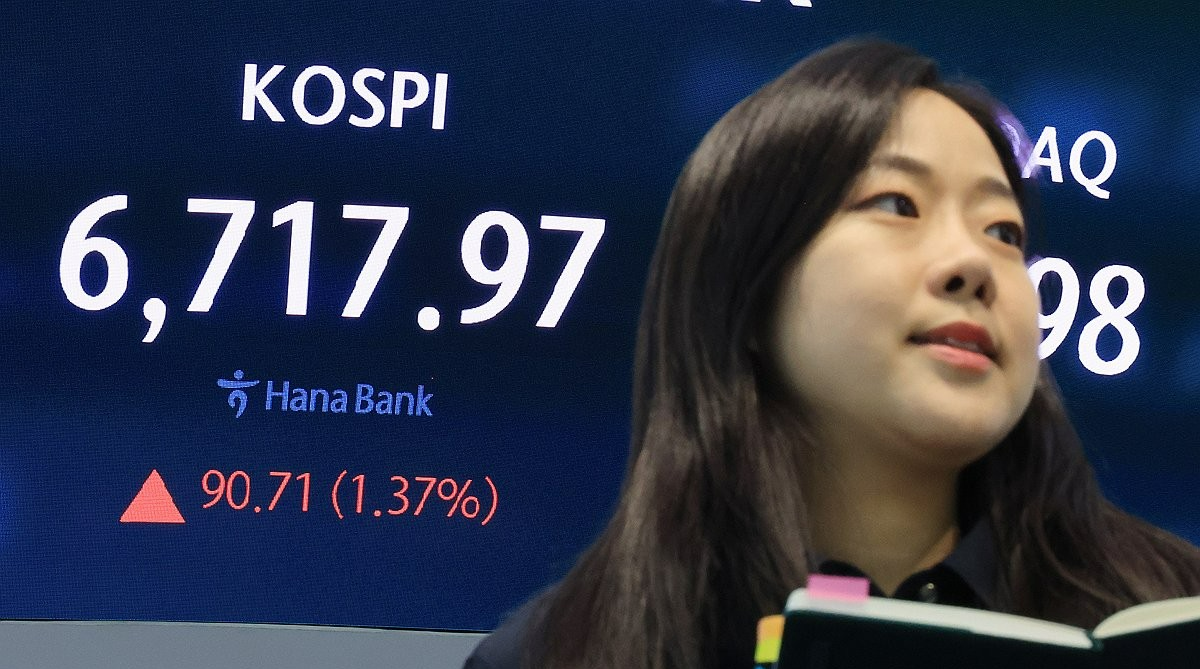
The 35 Trillion Won Floor Disappears
Samsung Electronics and SK Hynix were the last two buyers standing in a Korean market that has spent months searching for support. Now both are wrapping up their share buyback programs faster than anyone expected — and the KOSPI is about to lose its most reliable demand side.
Samsung began buying back shares on October 24, purchasing 39.8 million shares over 20 trading sessions at a cumulative cost of 10.3 trillion won. That represents 74.7 percent of its authorized 53.3 million-share program. At the current pace of roughly 2 million shares per day, the remaining 13.5 million shares will be absorbed in about six or seven trading sessions. SK Hynix, meanwhile, has spent 24.4 trillion won buying 14.15 million shares — 58.8 percent of its 24.07 million-share authorization — at an average of 650,000 shares daily, with roughly 15 to 16 sessions left.
Combined, the two semiconductor giants have deployed 34.7 trillion won into the domestic market. Under original timelines set by the Korea Exchange’s disclosure channel, Samsung would have concluded on November 21 and SK Hynix on November 19. But accounting for the upcoming holiday stretch — Chuseok, the substitute holiday for National Foundation Day, and Hangul Day — both programs are likely to close out by mid-November, a full month early.
That acceleration matters more than the headline number.
How the Buybacks Kept the KOSPI From Falling Off a Cliff
For months, the Korean market has been buffeted by a checklist of headwinds that no single investor or institution could absorb on its own: a protracted war in Eastern Europe draining capital from risk assets, persistently high interest rates, central banks in key economies signaling further policy tightening, and growing chatter that artificial intelligence investment spending might decelerate. Through all of it, the domestic buyback programs from Samsung and SK Hynix functioned as a mechanical cushion.
The evidence is striking. Since late October, the KOSPI has not triggered a circuit breaker — known in Korean markets as a sidecar — despite repeated downward pressure. Analysts at Shinhan Investment point out that the buybacks absorbed sell pressure that would otherwise have pushed indices into forced trading halts. In effect, Samsung and SK Hynix became the market’s designated buyer of last resort, filling a void that foreign investors largely abandoned and domestic retail participants never fully occupied.
Now that role is ending.
The Liquidity Cliff Ahead
What makes this moment structurally significant rather than routine is the emptiness that remains once the buybacks conclude. The KOSPI has already been compressing into a narrow range with declining turnover, a textbook sign that institutional flow has dried up. Outside of the corporate buyback programs, there is barely any other identifiable demand side to the market. Major foreign fund flows have turned negative, and domestic individual investors — traditionally the most active retail participants in Korea — have pulled back rather than stepped in.
Kang Jin-hyuk, a researcher at Shinhan Investment, stated plainly that any sustained recovery will depend on whether foreign investors and domestic individuals return, both of whom remain sidelined.
That return is far from guaranteed. Foreign institutional investors have demonstrated a structural rebalancing away from Korean equities over the past two years, favoring India and Vietnam for growth exposure and U.S. large-cap technology for yield-adjusted returns. Korean semiconductors, despite their global competitiveness, now sit in a market where the primary buyer has been a pair of domestic companies buying their own stock — not foreign capital chasing earnings upside.
Why This Matters Beyond Seoul
International investors often treat Korean semiconductor names as a direct proxy for global memory-chip demand, which is technically accurate but strategically incomplete. The buyback programs were never about corporate finance optimization. They were a market stabilization tool deployed during a period when no other institutional force was willing to provide downward support. Their early termination signals something subtler than a simple change in share count: it reflects an environment where even the deepest-pocketed domestic corporations are concluding that further buybacks would not move the needle on valuation.
Consider the timeline. Samsung announced its original buyback authorization well before the current round of macro uncertainty peaked. SK Hynix’s program was structured similarly. Both completed their purchases aggressively, but both are now deciding — ahead of schedule — that the marginal benefit of additional repurchases no longer justifies the capital deployment. That is a forward-looking judgment, not a reactive one.
For global emerging-market technology investors, this is a data point. When the two largest Korean semiconductor companies, flush with cash and operating in one of the most capital-intensive sectors on earth, decide that buying their own stock is no longer the optimal use of capital, it suggests that even at depressed valuations, the market lacks the institutional momentum required for a sustained re-rating.
Who Wins, Who Loses, and What Comes Next
The immediate losers are KOSPI-index funds and any portfolio with meaningful Korean equity allocation. The index has no natural buyer to replace the 35 trillion won that Samsung and SK Hynix were injecting weekly. The next earnings seasons for both companies will be closely watched for guidance on whether additional buyback authorizations are possible, but given the macro backdrop — dollar strength, rate uncertainty, and China demand questions — the bar for renewed commitment is high.
Domestic retail investors who entered Korean semiconductors during the buyback period may find themselves on the wrong side of a liquidity contraction. Foreign funds that exited Korean equities during the buyback window avoided the coming pressure entirely. And Korean semiconductor stocks that trade at a discount to their U.S. and Japanese peers may see that discount widen further if the market confirms that the buyback floor was the only thing preventing a deeper decline.
The canary has stopped singing. The question for international investors is whether they interpret the silence as a buying opportunity or as confirmation that the Korean market’s institutional supports have simply evaporated.