Samsung's New Chip Sidesteps Nvidia's AI Stranglehold
Samsung's LPDDR5X-PIM chip performs calculations inside memory instead of shuttling data back and forth—a move that could undercut Nvidia's dominance in edge AI. Here's what the chip means for phones, PCs, and the entire AI hardware race.
A chip that computes where data lives
Samsung just did something most semiconductor companies consider impossible without reinventing the system: it put processing logic inside a standard-looking memory module and made it run real AI models faster than the alternatives. The product is called LPDDR5X-PIM, and it was unveiled at Hot Chips 2026 at Stanford University.
PIM stands for Processing-In-Memory. The idea is straightforward but hard to execute. Traditional architectures move data back and forth between separate memory chips and processors—a process engineers call the von Neumann bottleneck. Every time an AI model needs a weight, that weight has to travel across buses, through controllers, into compute units, and back. The energy cost of that movement often exceeds the cost of the actual calculation.
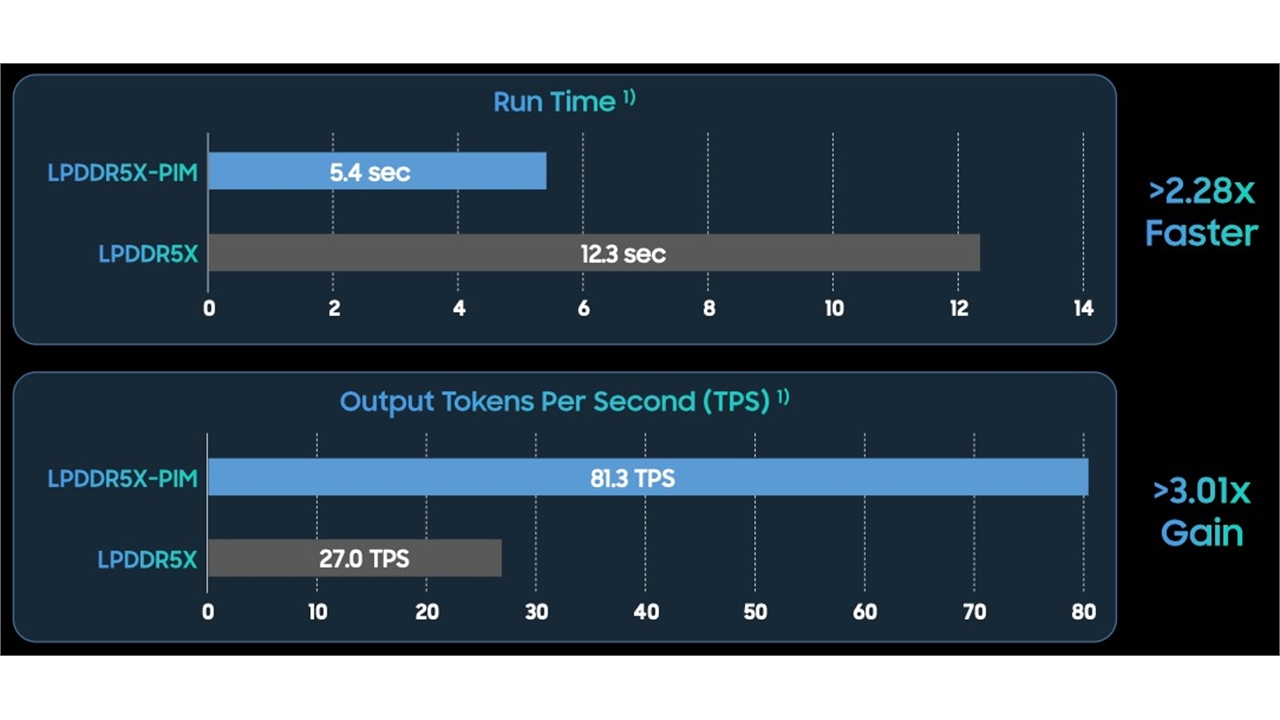
Samsung’s approach folds computation directly into the memory die. Data stays put. Calculations happen where the data already is. The result, by Samsung’s own measurements, is roughly 2.3 times faster inference on Meta’s Llama 3.1 model compared to conventional LPDDR5X. Token throughput hit three times the rate of standard memory. Those are not marginal improvements. They are the kind of gains that reshape system architecture decisions.
Why this is not just another memory launch
Memory is Samsung’s legacy business. DRAM and NAND Flash are revenue anchors. But memory alone has become a commodity battlefield, with Chinese manufacturers like ChangXin and Yangtze Memory pushing prices down and margins thin. Moving up the stack—into compute—protects Samsung from that squeeze.
More importantly, PIM positions Samsung at the exact point where the AI hardware war is heading: the edge. Nvidia’s dominance rests on data-center GPUs. The H100, the Blackwell platform, the NVLink fabric—these are built for training massive models and for serving them at scale. They are also power-hungry, expensive, and physically large. You cannot fit a data-center GPU inside a phone.
On-device AI is the next frontier. Apple runs on its own neural engine. Google pushes Tensor chips. Qualcomm and MediaTek design AI-accelerated mobile processors. None of them want to depend on Nvidia for the inference workload that will define the next generation of smartphones, laptops, and IoT devices. Samsung’s PIM chip offers a path that does not require adopting a rival’s accelerator architecture.
The compatibility detail matters here. Samsung designed LPDDR5X-PIM to match the footprint and pinout of existing LPDDR5X modules. A phone maker can swap the memory without redesigning the motherboard. That lowers the barrier to adoption dramatically. Nvidia’s GPUs require new PCB layouts, new cooling solutions, new software stacks. Samsung’s chip asks for almost nothing but a replacement part.
The strategic implication for the AI hardware race
This is where Nvidia should be paying attention. The company’s moat has always been software—CUDA—and the sheer performance of its GPU cluster. But CUDA runs on GPUs, not on memory chips. If device makers start deploying compute-in-memory at scale for inference workloads, they are building a parallel AI stack that bypasses Nvidia entirely. Samsung is effectively racing to turn memory into a general-purpose AI accelerator without forcing customers to throw out their existing designs.
Samsung is also laying the groundwork for the next generation right now. The company confirmed it has begun standardization work on LPDDR6-PIM, which means it is not just shipping a product—it is shaping the specification that the industry will follow. Standard-setting is a form of power in semiconductors. Whoever defines the interface owns the ecosystem. Intel learned this the hard way with CPU sockets. AMD learned it with PCIe. Samsung is attempting to learn it with memory.
The SDK and simulator Samsung released alongside the announcement signal the same instinct. PIM is not useful without tools. Developers need to know how to map AI layers onto memory-resident compute. Samsung is building that toolchain in parallel with the hardware, which is the only way this architecture becomes practical beyond lab demos.
Who wins, who loses, and what comes next
Phone and PC makers win first. They get a performance boost for on-device AI without committing to a new accelerator vendor. That is leverage in negotiations with Qualcomm, Apple, and MediaTek. It is also an insurance policy if GPU supply tightens again or pricing shifts unfavorably.
Samsung wins second. It moves from being a components supplier to being an AI-platform participant. Margins improve. Brand positioning strengthens against SK Hynix, which has no equivalent PIM product in the commercial pipeline as of this announcement.
Nvidia loses least in the data center but faces a long-term erosion risk at the edge. The company still dominates training and high-end inference. But if LPDDR-PIM becomes the default for mobile and laptop AI by 2027–2028, Nvidia’s relevance in those segments shrinks. That is not an existential threat today. It is a strategic drift.
The practical test will be adoption. Hot Chips demos are one thing. Volume production inside consumer devices is another. Samsung says the product is ready for deployment, but the real question is whether major OEMs will integrate it into next-generation flagships. The Llama 3.1 benchmark is promising, but real-world workloads—mixed precision, variable sequence lengths, multi-modal routing—are harder to optimize.
One thing is clear: Samsung is no longer playing defense in memory. It is attacking the bottleneck that has defined AI hardware for decades, and it is doing so using the one component every AI system already contains.