Samsung's HBM Leap Signals a New Semiconductor Power Balance
Samsung's HBM market share jumped to 33%, nearly closing the gap with SK Hynix in a single quarter. As Micron doubles capacity and China's CXMT cracks double digits in DRAM, the memory industry is entering a four-way fight with major implications for AI supply chains.
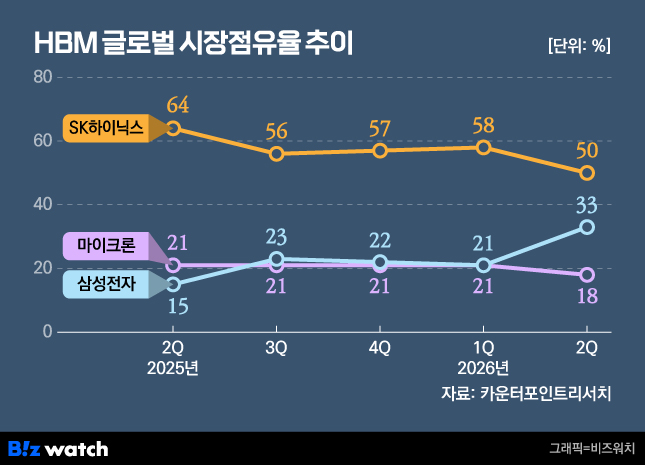
A Narrowing Lead
Samsung Electronics has cut its gap with SK Hynix in the high-bandwidth memory (HBM) market to less than half in a single quarter. According to Counterpoint Research, Samsung’s global HBM revenue share rose to 33% in the second quarter of this year, up from 21% in the first. SK Hynix, still the leader at 50%, surrendered 8 percentage points, shrinking the gap between the two Korean rivals from 37 points to 17.
The numbers alone are striking. But the story they tell matters because it sits at the center of the AI supply chain. Every major Nvidia GPU that ships into data centers depends on HBM stacks. Whoever controls HBM supply doesn’t just capture revenue — they influence who gets chips, when they arrive, and at what margins.
Samsung’s jump is not a fluke. The company has been quietly increasing HBM deliveries to multiple big-tech customers, broadening its base beyond the single-client dependency that has defined SK Hynix’s dominance. The data suggests Samsung is now supplying more buyers, which means less vulnerability and more leverage in a market where Nvidia’s demand far outstrips supply.
The HBM4 Catalyst
The real inflection point may not be behind us — it may be just beginning. The bulk of HBM revenue this year still comes from HBM3E, the fifth generation. But the sixth generation, HBM4, is entering volume shipment now. HBM4 commands higher prices, better margins, and deeper integration with Nvidia’s next-generation Vera Rubin accelerator. Counterpoint expects Samsung to accelerate its share gains specifically through HBM4 shipments.
For SK Hynix, this is the moment a commanding lead becomes a contested market. The company has long enjoyed preferential access to Nvidia’s most advanced GPU designs. If Samsung matches or exceeds SK Hynix on HBM4 quality and delivery timelines, that advantage erodes. And when it does, Nvidia gains something it hasn’t had much of: a credible second source.
That is a structural change. A single-source dependency concentrates risk and weakens the buyer’s position. Two strong suppliers change the negotiation entirely.
Micron Is No longer Watching
Micron sits at 18% in HBM, down 3 points from Q1. But the quarterly decline obscures a much more aggressive move. The company plans to nearly double its HBM production capacity to roughly 100,000 wafers per month by year-end, up from 40,000 to 50,000 last year. It is shipping equipment to Taiwan and Singapore now. By December, HBM4 12-stack products could account for half of Micron’s output.
Industry estimates put Samsung and SK Hynix each at 150,000 to 200,000 wafers per month. Micron’s 100,000 would still trail both, but it represents a dramatic compression. When AI accelerators need more HBM than the market can deliver, the difference between 100,000 and 40,000 wafers is not incremental — it is the difference between having customers and losing them.
Micron’s strategy is unmistakable. It is trading short-term revenue share for long-term positioning. If demand holds and capacity ramps as planned, Micron could claim a far larger slice of the HBM4 cycle than its current numbers suggest.
CXMT Finds the Cracks
While the HBM headline dominates, a quieter shift is happening in commodity DRAM. ChangXin Memory Technologies (CXMT), the Chinese state-backed memory maker, recorded a two-digit revenue share — 10% — in the global DRAM market in Q2. This is the first time the company has reached double digits in a single quarter, and the trajectory is steep: under 1% in 2023, 4% in Q2 2023, 8% in early 2024, and now 10%.
CXMT did not take this share by competing head-on with Samsung, SK Hynix or Micron on advanced nodes. It moved into the space the big three are leaving behind. As those companies prioritized HBM and high-margin products, commodity DRAM supply tightened. CXMT filled the gap with existing capacity and steady expansion.
Its DRAM production is running at around 300,000 wafers per month today. Industry forecasts put that number at 600,000 by 2028 — roughly matching SK Hynix’s current total DRAM capacity. That is a massive build in a sector where capital expenditure typically runs in the tens of billions annually.
CXMT is also looking upward. The company is ramping low-power DRAM variants and has begun HBM3E mass production. It is a generation behind the Korean leaders on HBM, but it has the scale, a guaranteed domestic customer base in China’s booming AI sector, and state support that insulates it from normal market discipline. In a fragmented global trade environment, that combination matters more than technical catch-up curves suggest.
What Changes for Nvidia and the AI Builders
The immediate consequence of a four-way memory competition is supply. For the past two years, Nvidia’s ability to deliver new GPUs has been constrained by HBM availability — and that availability was overwhelmingly in SK Hynix’s hands. Samsung’s growth and Micron’s expansion give Nvidia an outsized strategic gift: supplier choice.
That choice changes pricing dynamics. It reduces single-supplier risk. It shortens lead times, because Samsung and Micron can allocate capacity to Nvidia-specific orders without displacing SK Hynix’s other customers. And it introduces a competitive pressure that SK Hynix cannot ignore.
For the AI companies building on Nvidia silicon — Microsoft, Meta, Google, Amazon — the implication is less abstract. More HBM supply means more GPUs shipped, faster. It also means the cost per unit of memory could stabilize or decline, improving the margins on AI infrastructure purchases that have been straining budgets.
The Four-Way Fight
An industry source described the current shape clearly: the memory market is moving from a three-player structure to a four-way contest. Samsung is closing SK Hynix in HBM. Micron is closing both Koreans in capacity. CXMT is carving out DRAM share the big three are deprioritizing and aiming higher.
This is not a temporary blip. Each quadrant is being reinforced by deliberate investment. Samsung and SK Hynix are already working on HBM4E, the generation after HBM4. Micron is expanding Taiwan and Singapore fabs. CXMT is scaling from 300,000 toward 600,000 wafers per month.
The competitive pressure benefits buyers. It raises the risk of supply disruption falling on any single player. And it gives the United States and China each a growing domestic memory capability, a shift with geopolitical dimensions that go well beyond market share tables.
The question no longer is whether the three-way order is fracturing. It is how fast the new equilibrium forms — and who ends up positioned best when the next AI cycle demands more memory than anyone can currently produce.