Samsung Is the Canary in Koreas Tumbling Market
Korea's export engine is hitting a wall as Middle East shocks send oil above $90 and bond yields higher just before earnings season. Samsung and SK Hynix lead the sell-off.
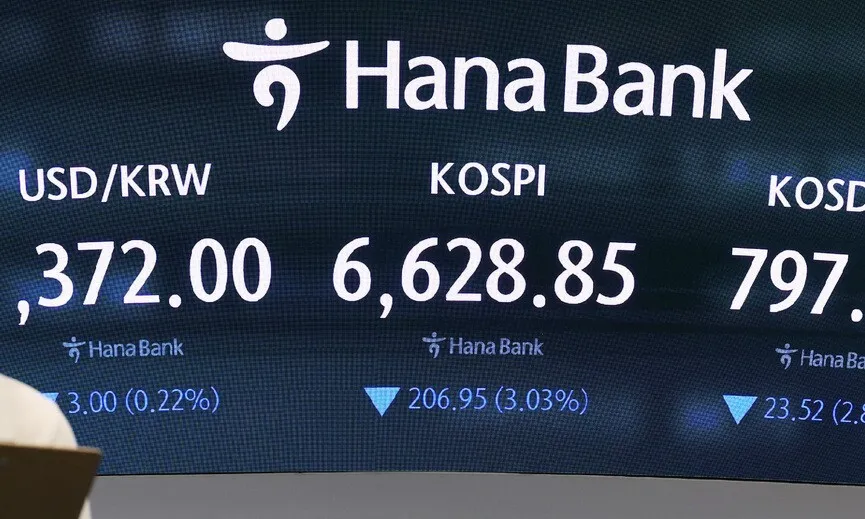
The KOSPI Just Sold Off 2.5%. This Is the Worst Possible Timing.
The KOSPI opened down nearly 3.1% on Monday morning, clawed back to lose 2.5%, and stayed there — all before most American investors had even logged onto their terminals. Samsung Electronics fell 2.87% to 253,500 won. SK Hynix shed 2.89% to 1.644 million won. Of the roughly 879 stocks trading on the market, 709 were in the red. The only bright spots were a handful of financial names like KB Financial and Shinhan Financial, each climbing a modest 1%.
The immediate trigger is familiar: the US struck southern Iran on Sunday, and Iran responded with missiles and drones aimed at American bases across the region. But the market damage is not simply a reaction to headlines. It is a structural hit to an economy that has spent the past two years betting on cheap energy and loose money to carry its exports.
Oil Above $90 Again — and That Changes Everything for Korea
West Texas Intermediate settled at $90.22 a barrel, up 5.2%. Brent crude closed at $94.65, up 4.6%. Both readings matter individually. Together they signal that the Middle East is no longer a distant risk and that supply disruption is priced in for the near term.
For South Korea — the world’s fifth-largest energy importer — every dollar above $90 in crude is roughly $600 million in extra import costs per month. The country’s current account, which has been a lifeline through repeated rate-hike cycles, narrows fast when energy bills jump. A trade surplus that looks manageable at $75 oil starts to underwrite something much tighter at $90. That is not speculation. It is the arithmetic that central banks across Asia already have on their spreadsheets.
Korea’s inflation outlook worsens immediately. The Bank of Korea has been walking a narrow path between supporting growth and holding the won steady. If imported inflation reaccelerates, the BoK loses room to cut, and the won — already volatile — faces renewed selling pressure. Both outcomes squeeze Korean multinationals that borrow in dollars and sell in won.
Bonds Are Rising Alongside Oil — and That Is Worse
The more consequential number on Monday may not be oil at all. Long-term government bond yields in the US, Japan, and the UK moved higher simultaneously, driven by the same inflation scare. When oil spikes and rates spike together, the market is pricing in a stagflation scenario rather than a simple demand shock. That distinction matters enormously for equity valuations.
Growth stocks get hit twice. Their future earnings are discounted at a higher rate, and the revenue growth underpinning those earnings looks less likely in a slower-growth world. Korea’s market concentration in technology and semiconductors makes this exposure acute. The KOSPI is not a diversified portfolio. It is a concentrated bet on global demand for chips, displays, batteries, and autos — all of which slow down when borrowing costs rise and energy expenses eat into corporate margins.
Samsung and SK Hynix: Earnings Season Meets a Shock
Samsung Electronics and SK Hynix together account for roughly a third of the KOSPI’s market capitalization. When they sell off, the index sells off with them. Their 2.9% declines on Monday were not isolated. They are the market’s way of repricing both companies against a worse macro backdrop just as investors are about to read their earnings reports.
Semiconductor demand has been uneven. Memory prices have recovered from the 2023 trough, but the recovery has always depended on global growth staying resilient. Higher oil and higher rates undermine exactly that assumption. AI-driven demand for high-bandwidth memory is real, but it is a narrow tail in an otherwise cyclical story. If corporate capex softens because borrowing costs stay elevated for longer, Samsung’s foundry business and SK Hynix’s DRAM shipments both face headwinds that have nothing to do with geopolitics and everything to do with a tightening global financial cycle.
The earnings season angle is the part English-language coverage tends to miss. Korean analysts and domestic retail investors are entering this quarter with thin margin for error. A single earnings miss or guidance cut, amplified by a rising-yield environment, can accelerate selling far beyond what the macro data alone would justify. That is the dynamics that turns a 2% gap-down into a sustained rout.
What the Banks Got Right — and What They Missed
KB Financial and Shinhan Financial’s 1% gains are the expected move in a rate-rising, oil-spiking environment. Lenders benefit from wider net interest margins when policy rates stay higher for longer. But this is a narrow hedge. Bank profits do not offset the broader economy’s exposure to expensive energy and weaker external demand.
Kiwam Securities researcher Han Ji-young captured the simplest way to read the day: macro variables including oil and bond yields have become unusually sensitive. In plain terms, the market has run out of appetite for bad news. Every new data point — a stronger dollar, a hotter CPI print, a geopolitical flare-up — lands harder than the last because there is no slack left in the system.
What Happens Next
The immediate question is whether Monday’s sell-off is a headline reaction or the start of a repricing cycle. The numbers so far suggest the latter. Oil is above $90. Yields are moving up across three major bond markets. The KOSPI has not just dropped — it has dropped while nearly all sectors participated. That is not a technical bounce waiting to happen. That is a structural shift in risk premia.
For Samsung and SK Hynix, the next few weeks will be decisive. Earnings reports that acknowledge the macro deterioration without offering a clear path to margin defense will invite further selling. Companies that can point to pricing power, cost controls, or demand resilience beyond the cyclical trough will hold ground. The market will reward the latter and punish the former with a ferocity that has nothing to do with fundamentals and everything to do with where the risk premium settles.
Korea’s export engine is firing on fewer cylinders than it was six months ago. The Middle East shock did not break the engine. It just removed the last bit of cushion.