Samsung and SK Hynix Split as DRAM Prices Surge Past $154 Billion
Samsung reclaimed the DRAM market lead in Q2 as generic price spikes outpaced SK Hynix's HBM strength. The divergence between the two Korean giants is rewriting the economics of every AI data center and smartphone on the planet.
The Paradox at the Heart of the Memory Boom
SK Hynix built its memory strategy on HBM — high-bandwidth memory that sits atop AI GPUs and is the single most important component in any data center training cluster today. The company led the market through most of this cycle with that single-minded focus. It has not been enough.
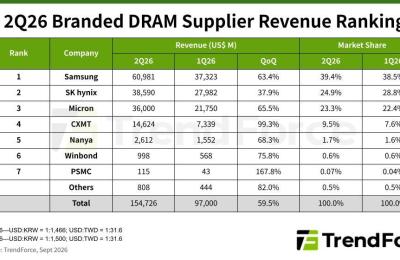
In the second quarter of 2026, DRAM market revenue surged nearly 60 percent quarter over quarter to $154.73 billion, according to TrendForce. Samsung Electronics captured the top position with a 39.4 percent market share and $60.98 billion in DRAM revenue — a 63.4 percent jump from Q1. SK Hynix fell to second place at 24.9 percent share with $38.59 billion in revenue, a growth rate of only 37.9 percent. Its market share dropped 3.9 percentage points from Q1.
The reason is counterintuitive and it will shape the rest of the industry cycle: SK Hynix’s HBM-heavy product mix, once its greatest asset, became a liability when generic DRAM prices exploded upward.
Why Generic DRAM Pricing Beat HBM This Cycle
HBM contracts are typically negotiated on long-term or annual terms. When generic DRAM spot and contract prices spike suddenly — as they did this quarter, driven by AI inference expansion, large-language-model training demand, and server-memory replenishment — HBM pricing cannot adjust quickly enough to capture the full move. The revenue from generic DRAM simply compounds faster over short time horizons.
Samsung, by contrast, operates a far broader mix. It sells high volumes of standard DRAM alongside its own HBM4 shipments, which entered volume production this quarter. The result: Samsung benefited from both the generic DRAM price explosion and the HBM premium simultaneously. Its average selling price increase outpaced both SK Hynix and Micron.
SK Hynix remains the HBM leader by reputation and by volume shipped, but leadership in a single segment does not protect against a market where another segment is moving five times as fast in dollar terms.
Micron Was the Real Winner
While Samsung and SK Hynix fought over first and second place, Micron quietly closed the gap. Server DRAM sales — RDIMM and related products — drove a 65.5 percent revenue increase to $36 billion. Micron’s market share rose to 23.3 percent, narrowing its distance from SK Hynix to just 1.6 percentage points.
This matters because Micron’s strategy has always been different from both Korean rivals. It does not carry the same HBM concentration risk as SK Hynix, and it does not depend on HBM4 volume ramp as a primary growth engine the way Samsung does. Instead, Micron leaned into server memory — the bread-and-butter of AI infrastructure buildout — and captured upside that neither Korean company fully accessed.
For the first time in recent memory, three companies are within striking distance of each other. The old Samsung-SK Hynix duopoly is fracturing.
What This Means for AI and Consumer Electronics
The immediate consequence is a cost squeeze across two very different industries.
AI infrastructure builders — hyperscalers, cloud providers, and the contract manufacturers that serve them — are paying escalating prices for both HBM and generic server memory. Every new data center ramp costs more than the last. The margin compression will hit most acutely for companies that committed to HBM pricing on longer contracts while generic DRAM moved independently.
Consumer electronics faces a different problem. TrendForce projects that generic DRAM contract price growth will slow to 13–18 percent in Q3, down sharply from the explosive Q2 pace. The slowdown is not due to weakening demand. It is because PC and smartphone OEMs are absorbing price shocks and delaying orders. When demand drops out, prices follow — sometimes with a lag of two or three quarters.
The memory cycle has always been brutal in its reversals. The current phase looks like the early stage of one.
The Korea Rivalry, Reconsidered
Samsung and SK Hynix have competed in DRAM since the 1990s. Their rivalry defines Korean industrial policy, export strategy, and the balance of power within the chaebol system. This quarter’s results show what happens when two companies bet differently on the same market and both are right — and wrong.
SK Hynix was right about HBM. It will likely regain ground as HBM4 production scales and HBM pricing renegotiates upward. But it was wrong to underweight the generic DRAM cycle that ran parallel to the AI boom. Samsung was right on both sides, and its diversification paid off in dollars, not just percentages.
The lesson extends beyond Korea. Any company operating in memory — or any sector where sub-markets diverge in pace — needs to recognize that concentration in a single growth story is a strategy, not a guarantee.
What Comes Next
DRAM prices are expected to remain elevated through the rest of 2026, but the rate of increase will decelerate. HBM remains the hotter long-term bet; generic DRAM is the hotter short-term bet. Both are volatile. Micron’s rise suggests that balance-of-portfolio strategies may outperform single-segment dominance in cycles where multiple segments heat up simultaneously.
Samsung’s 39.4 percent share is a return to form. SK Hynix’s 24.9 percent is a wake-up call. Micron’s trajectory is the one watchers are least prepared for — because it proves that the Korean duopoly is no longer the only game in memory.