Saudi Arabia's Two Fronts: How a Pipeline Attack Meets a Blockaded Red Sea
A single Iranian-backed strike on Saudi Arabia's East-West pipeline could cut 4% of global oil supply for weeks. Combined with Houthi control of Red Sea chokepoints, Riyadh faces a stranglehold it cannot easily repair or bomb its way out of.
The Pipeline That Holds 4% of the World
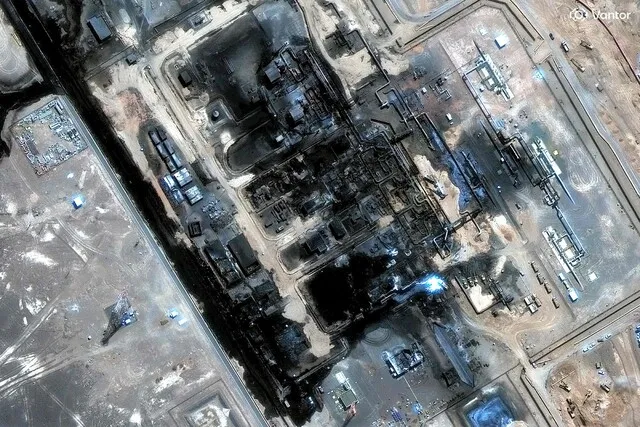
Saudi Arabia’s East-West pipeline is not the kind of infrastructure most people think about until it breaks. For years, it has quietly moved crude from the oil fields along the Persian Gulf coast to the port of Yanbu on the Red Sea — 1,200 kilometers of underground pipe, operating mostly out of sight. After the Strait of Hormuz became too dangerous following the U.S.-Iran escalation, Riyadh shifted roughly 4 million barrels per day through it. That is nearly 4% of global oil supply flowing through a single above-ground pump station.
On November 10, an Iraqi Shia militia hit three of those stations with drones. By the 11th, the entire line was shut down. Reuters reported on the 13th that repairs could take up to six weeks. Some sources said partial flow might resume sooner, but the timeline was far from certain.
That matters because the math is unforgiving. Before the attack, Saudi Arabia was already routing its surplus volume through Yanbu to keep Hormuz-deprived customers fed. With the pipeline down, the kingdom can only export whatever sits in storage tanks at Yanbu — enough for perhaps five to seven days, according to the reports. There are smaller reserves at Egyptian Red Sea and Mediterranean ports, but nowhere near enough to replace four million barrels a day for more than a week.
The world’s largest oil exporter is about to run out of export capacity.
A Strangulation, Not a Squeeze
The more destabilizing detail is not the pipeline itself but what happened around it. The Houthis — Iran-backed rebels who have been blockading the Bab el-Mandeb strait — announced on the 13th that they had captured Qal’at Baher, a town east of the strait. Fighting is raging in Taiz and Marib, with Marib described by Al Jazeera as the last energy-held zone under the Yemeni government. It holds oil and gas fields critical to any future post-war order in Yemen.
Riyadh responded with F-15 strikes — 58 sorties over two days. Air power is impressive in footage but does not rebuild pump stations or unblock a strait. The Houthis do not need to hold territory to make it unusable. They need only enough rockets, drones, and anti-ship missiles to keep commercial shipping away.
So now Saudi crude has two problems. It cannot get out through the pipeline it has come to rely on. And even if it could move the oil to the Red Sea coast by other means, the Bab el-Mandeb remains contested. Ships carrying that oil would face the same insurance premiums and attack risks that have already driven several major carriers out of the route.
This is a pincer movement that no amount of bombing solves.
The Diplomatic Fracture
There was a brief moment when diplomacy looked like it might matter. Iran and Oman scheduled a meeting on the 14th in Muscat to discuss a security arrangement for the Strait of Hormuz. It was cancelled.
Bahrain refused to attend, citing recent Iranian attacks on its territory. Saudi Arabia delayed its own participation, likely because its military was consumed by the Houthi offensive. Oman’s Foreign Minister Badr AlBusaidi offered the most neutral phrasing, saying the meeting was postponed to allow more discussion. That is diplomatic language for: nobody can agree on anything right now.
The cancellation is significant. It means there is no working forum for de-escalation on either of the two chokepoints threatening global oil — Hormuz and Bab el-Mandeb — at the same time. When both are under pressure and neither has a backchannel, markets price in the worst case.
Prices Are Already Pricing It In
Brent crude hit $107 a barrel on the 14th. WTI touched $102. Both were up more than 2% from the previous session. That is not a speculative spike — it is a market that just lost 4% of its most reliable surplus capacity and has no clear path to restoring it.
For reference, the last time global oil faced a disruption of this scale was the 2019 attacks on Saudi Arabia’s Abqaiq facility, which knocked roughly half of the kingdom’s output offline for a short period. The price reaction was sharp but temporary because the recovery was fast. This time is different. The pipeline damage is harder to fix. The Houthi threat is not a one-time event — it is a sustained campaign. And unlike 2019, the disruption is not contained to one facility. It spans both land and sea routes that Saudi Arabia depends on.
Why This Matters Outside the Middle East
South Korea is the clearest example of why a Saudi pipeline disruption lands far beyond the Gulf. Seoul imports the vast majority of its crude from the Middle East and has no alternative supply corridor that can absorb a 4% shock without disruption. Korea’s strategic petroleum reserves cover roughly 100 days of imports under normal conditions — adequate in a crisis lasting days, strained in a crisis lasting weeks. A six-week pipeline outage is exactly the kind of duration that tests those reserves.
Japan faces the same exposure. So does India, which has been quietly increasing its purchases of discounted Russian and Middle Eastern crude in recent months. Any price move above $110 hits demand destruction in import-dependent Asian economies that are already managing fragile current accounts.
Europe is further removed geographically but not insulated. Higher freight insurance, rerouted tankers, and competitive bidding for Atlantic-basin cargoes will push European refining costs higher even if the continent is not directly importing Saudi crude.
Who Wins, Who Loses
The Houthis win by staying cheap and patient. A single drone costs thousands of dollars. A Saudi F-15 sortie costs tens of thousands. A replacement pump station costs far more still. Their strategy has always been asymmetric attrition — make the costs of transit prohibitive without ever needing to defeat the Saudi military outright.
Iran wins because it does not have to fire a shot from its own soil. The Iraqi militia that struck the pipeline is another proxy. Tehran achieves strategic effect — disrupting global energy flows, raising prices, testing alliance coordination — while maintaining plausible deniability. The diplomatic meeting in Oman was supposed to be a containment mechanism. Its cancellation shows the containment is already failing.
Saudi Arabia loses on both fronts. It cannot restore the pipeline quickly. It cannot bomb the Houthis off the Red Sea coast. It is now exposed on two axes that both matter for its export survival.
The United States and its allies lose credibility. Every time a chokepoint closes and no one can reopen it, the guarantee of free navigation becomes a rhetorical exercise. That is a longer-term erosion than any single price spike.
What Comes Next
The immediate risk is simply time. Six weeks is a long time in oil markets. If repairs take the full window — and the early signs suggest they might — we are looking at a sustained supply deficit that will test every spare barrel in the world. The U.S. Strategic Petroleum Reserve is depleted compared to 2019 levels. OPEC spare capacity exists on paper but is concentrated in Saudi fields that themselves face ground threats.
A partial repair within two to three weeks, as some sources suggest, would ease the panic but not resolve the structural vulnerability. The pipeline was never meant to be the sole backup for Hormuz. It was built as redundancy. Now the redundancy is gone, and the primary route — the strait — remains contested.
The next trigger point is likely March or April, when the full winter drawdown of reserves meets whatever spring demand recovery looks like in Asia. If the pipeline is not running by then, the price floor moves decisively higher. If it is running but below capacity, the market lives in a chronic state of anxiety — which is itself a tax on global growth.
There is no clean exit from this. The pipeline can be repaired. The Houthis can be pressured. But neither fixes the underlying reality: an Iranian proxy network that can strike Saudi infrastructure from three directions at once, with no diplomatic off-ramp in sight.