Saudi-Houthi War Pushes Oil Past $100 as Second Chokepoint Falls
Saudi Arabia vows retaliation after Houthi rebels strike energy and civilian targets, killing 73 and igniting fires at oil facilities. With the Strait of Hormuz already blockaded by the US-Israel-Iran conflict, the Red Sea escalation threatens to cut off a second critical oil artery just as markets braced for stability.
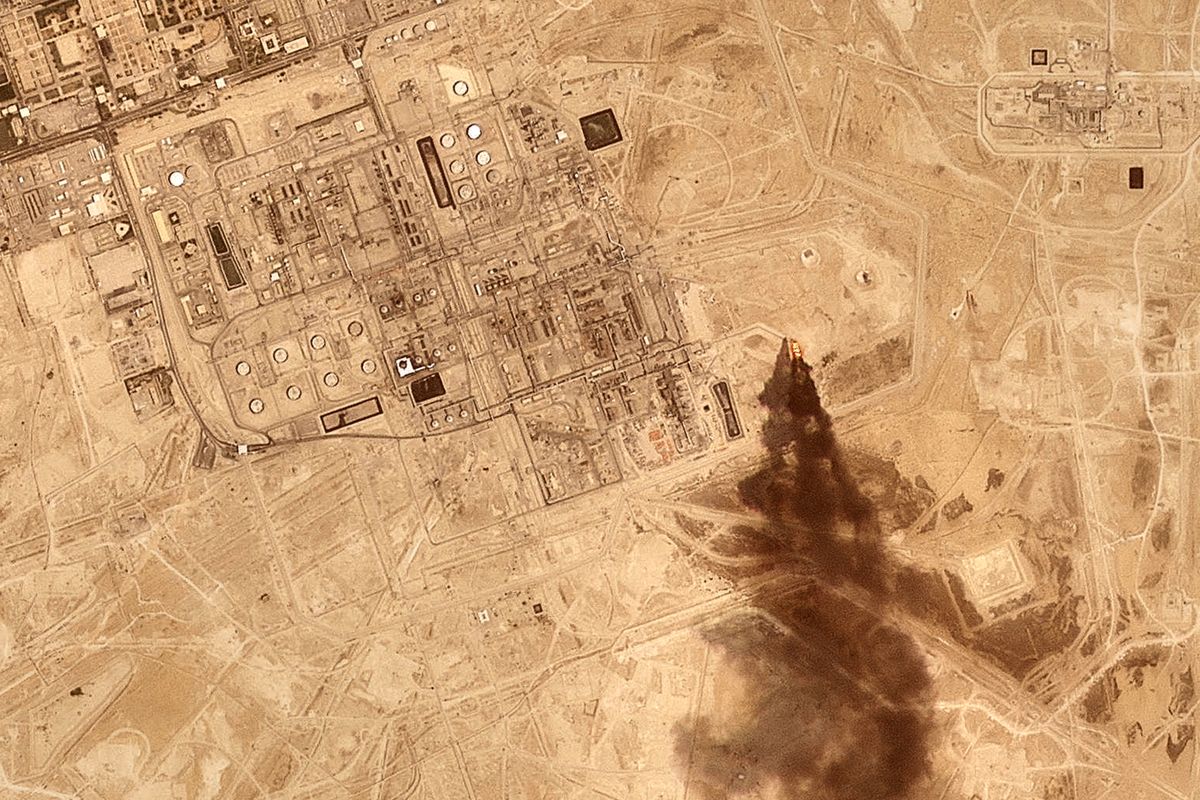
Two Chokepoints, One Crisis
The image from Planet Labs PBC shows smoke rising from Saudi Aramco’s processing facility in Abqaiq on July 27, 2026—a preview of what’s now unfolding in full. On August 8, Houthi rebels struck four southwestern Saudi cities, injuring at least 73 people, igniting fires at energy installations, and forcing temporary halts to oil operations. Saudi officials called it a dangerous provocation. The Houthis called it revenge.
What makes this escalation different from previous cycles of violence is the geometry of global energy trade. The Strait of Hormuz—the route through which roughly 20 million barrels of oil per day flow—is effectively blockaded following the US-Israel-Iran conflict. Now the Red Sea, another critical artery handling millions of barrels monthly, has become a combat zone. Two of the world’s three most strategic oil chokepoints are contested. The third, the Strait of Malacca, sits under Chinese influence and remains stable only by Beijing’s discretion.
The math behind $100+
Brent crude has already broken above $100 per barrel. That number feels abstract until you run the spreads. At current consumption rates, losing even 5 million barrels per day of Red Sea transit capacity—which handles roughly a quarter of global container shipping and significant oil volumes—creates a supply deficit of approximately 2.5 percent of daily global demand. Historical elasticity suggests price responses of 15 to 30 percent for that magnitude of disruption. We are in that response window now.
Saudi Arabia’s energy ministry confirmed attacks on facilities in Abha, Khamis Mushayt, Jazan, and Nazran. Jazan is particularly significant: it hosts one of the kingdom’s largest refineries and an industrial city built around petrochemical exports. Fires there don’t just reduce output—they damage infrastructure that takes months, not days, to repair.
Who wins, who loses
Iran profits from ambiguity. The Houthis operate as a proxy force, allowing Tehran to exert pressure on Saudi energy infrastructure without direct attribution. Every barrel of oil that doesn’t flow through the Red Sea weakens Riyadh’s economic position while testing Washington’s security commitments. If America is stretched across the Persian Gulf and the Red Sea simultaneously, the cost of defense rises exponentially.
China loses twice. Beijing imports roughly 40 percent of its oil from the Middle East, much of it transiting the very corridors now under threat. Shanghai’s strategic petroleum reserves—estimated at 80 to 100 million barrels—provide only 60 to 90 days of coverage. Extended disruption forces Beijing to choose between paying premium prices for alternative supplies or rationing demand. Neither option is politically popular.
European consumers lose most immediately. The continent has spent three years building infrastructure to replace Russian pipeline gas with LNG shipments—many of which traveled through the Red Sea and Suez Canal route. That supply chain now faces the same vulnerability it was designed to avoid. Germany’s industrial sector, already contracting, faces another shock to input costs.
The inflation problem returns
Central banks spent 2024 and 2025 convincing markets that the worst of the post-pandemic inflation surge was behind them. The Federal Reserve began cutting rates. The European Central Bank followed. Markets priced in a soft landing.
Oil at $100 per barrel adds approximately 0.8 to 1.2 percentage points to annual inflation rates across major economies, depending on transmission lags and exchange rate effects. That is not theoretical. The 1979 oil shock pushed US inflation from 11 percent to 13.5 percent within a single year. The 2022 Russia-Ukraine crisis added 2 to 3 percentage points to Eurozone inflation in six months.
We are not comparing magnitudes—the current disruption is smaller than those historical episodes—but the timing is cruel. Inflation had been falling toward target ranges. A fresh supply shock reverses that trajectory precisely when policymakers committed to normalization. The Fed now faces an impossible choice: let inflation reaccelerate, or raise rates and trigger recession in economies still recovering from prior tightening cycles.
Yemen’s collapse as background noise
The Humanitarian Crisis in Yemen deserves attention beyond its energy implications. The UN reports 300 killed and 18,500 displaced since the truce collapsed in July. This is a four-year conflict that absorbed less global attention before July and will absorb less after August 9. The displacement figures likely underestimate true numbers—IDP camps across southwestern Yemen struggle with food security and disease outbreaks that predate the current escalation.
The Houthis’ maritime blockade declaration represents a strategic shift. Previously, attacks targeted specific military or energy installations with calibrated messaging. A full blockade signals willingness to disrupt commercial shipping indiscriminately—a escalation that raises the risk of accidental collision with non-belligerent vessels and invites broader military response.
What happens next
Three scenarios emerge from this moment.
The first is contained escalation: Saudi retaliation strikes Houthi positions in Yemen, killing additional fighters and civilians, but both sides retreat from wider war after demonstrating capability. Oil prices spike to $105 to $110 then stabilize as markets price in the new baseline. This is the most likely outcome but the least comforting—the $100 level becomes the floor, not the ceiling.
The second is regional expansion: Iran intervenes more directly, opening fronts along the Persian Gulf and threatening UAE and Qatari infrastructure. Shipping insurers withdraw from the entire region. Oil breaches $120. Central banks are forced into emergency rate hikes. Recession risks materialize across Europe and potentially the US.
The third is black swan: a major facility like Abqaiq suffers catastrophic damage, reducing Saudi output by 2 to 3 million barrels per day. That represents 20 percent of global supply disruption from a single event. Prices could approach $150. The geopolitical system fractures as allies compete for dwindling reserves.
The strategic lesson
The world assumed energy security had been solved—not through diplomacy, but through diversification. Shale revolution freed America. LNG terminals multiplied across Europe. China built reserves and alternative routes. The assumption was that no single chokepoint could paralyze global trade.
That assumption died in 2026. Two chokepoints now under active threat means the system has far less redundancy than the literature suggested. The $100 oil price is not a anomaly—it is the market’s correction for overconfidence.
Riyadh’s retaliation remains uncertain. Saudi leadership has signaled willingness to respond but has also demonstrated caution about widening conflicts that draw in Iran directly. The calculus depends on whether the Abqaiq strike—a facility vulnerable to exactly this type of attack—sustains damage that threatens long-term production capacity. If it does, the response will be proportionate to the strategic wound, not the immediate casualty count.
Global markets will price this within hours. Inflation expectations will adjust within weeks. Central banks will respond within months. The question is whether policymakers acted during the calmer period between Hormuz’s blockade and Red Sea escalation—or whether they sleepwalked through the warning signs that this moment was inevitable once the first chokepoint fell.