Saudi Arabia's Oil Veins Severed as Houthis Seal the Red Sea
A destroyed East-West pipeline and Houthi capture of strategic islands have left Saudi Arabia's oil exports hanging by a thread — and Washington has told Riyadh it's on its own.
The Pipeline Is Gone. So Is the Escape Route.
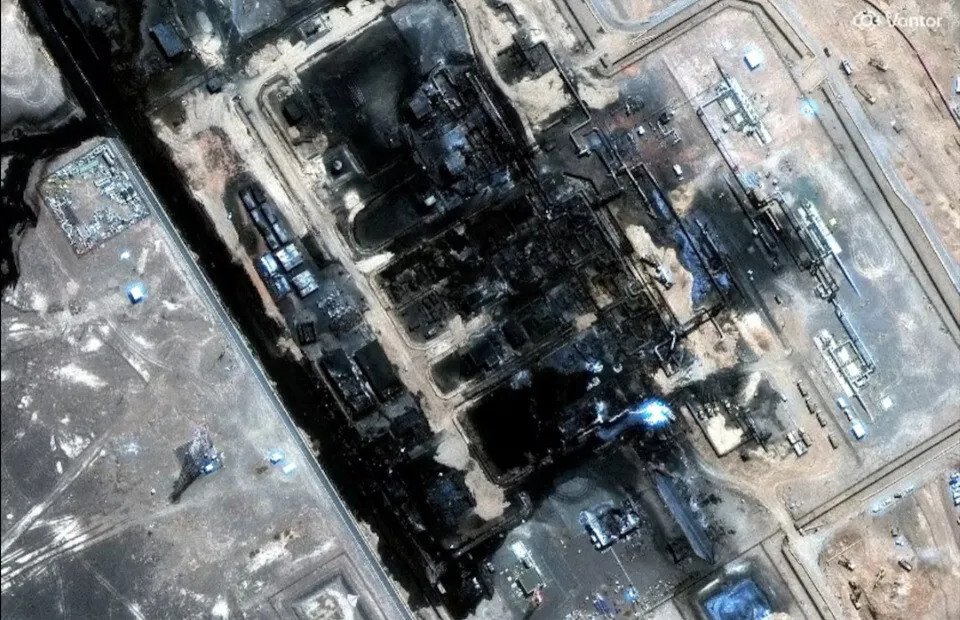
Satellite images released in the wake of April 11 show what should have been impossible to miss: a line of fire across the Saudi desert, where the East-West oil pipeline — the kingdom’s alternative lifeline to the Red Sea — lies ruptured and smoking. The strike came from Iraqi militia drones, a reminder that the battlefield around Saudi Arabia has quietly expanded from Yemen’s mountains into the kingdom’s own territory.
This is not a symbolic wound. The pipeline has moved roughly 5 million barrels per day of crude and refined products from the Eastern Province to the Red Sea terminal at Yanbu since it came online decades ago. It was always the Saudis’ insurance policy against closure of the Strait of Hormuz. Now that insurance is ash.
The Houthis Hold Both Doorways
Worse still, the Houthis have taken control of the Red Sea’s southern chokepoint in a matter of days. On April 10, they seized the port city of Mocha on Yemen’s Red Sea coast. By April 11, they occupied Perim Island — the volcanic rock at the narrowest point of the Bab el-Mandeb strait — effectively turning the waterway into a Houthi-controlled corridor.
Combine that with the ongoing threat to the Strait of Hormuz, through which Saudi Arabia and its Gulf neighbors ship the vast majority of their crude, and you have a monarchy whose two maritime arteries are under enemy fire while its overland pipeline lies destroyed. The geographic squeeze is as literal as it gets.
Diesel prices in the region have surged roughly 40 percent in the past three months, a figure tracked by local energy markets and cited by Korean reporting. That number is not just a headline — it is the price signal of a supply chain already fraying at the edges.
The Diplomacy Has No Date
An April 14 meeting of foreign ministers from Saudi Arabia and other Gulf states with Iran had been scheduled precisely to discuss the Hormuz situation. It has been postponed indefinitely. There is no revised date. The diplomatic track that both sides pretended was still open is now visibly stalled.
What makes this more than a routine pause is that the Houthis are not acting alone — they are the most visible frontline of Iranian proxy power, and their gains in Yemen reflect a strategy that has been honing for years. The capture of Mocha and Perim Island is not spontaneous; it is the culmination of a campaign that Saudi Arabia thought it had contained after its exhausting eight-year intervention in Yemen ended in a fragile ceasefire in 2022.
Washington Said No
Perhaps the most revealing detail emerged quietly: on April 10, Crown Prince Mohammed bin Salman called President Donald Trump requesting that US forces strike Houthi positions. The request was declined.
The reasoning, according to multiple reports, is domestic politics. With November midterm elections approaching, the Trump administration is feeling the gravitational pull of anti-war sentiment. The calculus is straightforward — there is no political gain in escalating a Middle Eastern conflict, and every gain in keeping the oil flowing quietly is outweighed by the risk of a drawn-out entanglement.
Mike Ratney, the former US ambassador to Saudi Arabia, told AP that the situation is “tremendously frustrating” for Riyadh, noting that the worst-case scenario Saudi officials feared has materialized while the White House shows “zero enthusiasm” for involvement in Yemen.
For a kingdom that has long leaned on the US security umbrella as its primary guarantee, the message is unmistakable: you are on your own.
Even the Enemy’s Enemy Is Wavering
The geopolitical realignment is unfolding in real time. The United Arab Emirates — the Gulf state that has been the most combative toward Iran and the one most willing to confront Tehran directly — is now reaching out across the divide. On April 13, at the BRICS summit in India, UAE Crown Prince Sheikh Khaled bin Mohammed Al Nahyan held a meeting with Iranian President Masoud Pezeshkian to discuss improving relations.
This is a striking reversal for Abu Dhabi, which in recent years positioned itself as the regional counterweight to Tehran. The shift is not ideological; it is existential. When the waterways your economy depends on are blockaded, hostility becomes a luxury you can no longer afford.
Barbara Leaf, former US assistant secretary of state for Near Eastern affairs, told the New York Times that Saudi Arabia and its Gulf partners are likely to pivot toward diplomacy, though she warned that any agreement with Iran would require an “unpleasant compromise” — a phrase that understates how painful such concessions would be for regimes that have built years of rhetoric on the idea that Tehran must be contained, not accommodated.
Who Wins. Who Loses.
Iran and its Houthi proxies are winning. They have blocked two critical maritime chokepoints and destroyed a major land-based pipeline without firing a single ballistic missile at Saudi territory directly — the Iraqi militia’s drone strike did that work. The cost to Iran is minimal; the disruption to Saudi Arabia is catastrophic.
Global markets are watching. The Strait of Hormuz handles roughly 20 percent of global oil consumption. If it closes for any sustained period, the price shock will reverberate from Riyadh to Tokyo to Europe. The 40 percent diesel surge in three months is the precursor, not the ceiling.
Saudi Arabia loses credibility. The kingdom spent a decade and tens of billions of dollars on its Yemen campaign and emerged with nothing but a ceasefire and a hostile militia on its southern border. The pipeline destruction confirms what many analysts have suspected: Riyadh’s strategic depth is far thinner than it advertised.
The United States loses leverage. Every time Washington declines to intervene, allied confidence erodes. Gulf states will continue diversifying their security arrangements — hedging with Beijing, deepening ties with Ankara, exploring independent defense postures — because the American security guarantee now comes with visible conditions and visible hesitations.
What Comes Next
Three scenarios are plausible, and none of them are comfortable.
First, a limited diplomatic thaw. Gulf states, pushed to the wall, negotiate a tacit understanding with Iran that curbs Houthi operations in exchange for sanctions relief or indirect security guarantees. It would be ugly, it would anger hardliners on all sides, and it would mark a fundamental rearrangement of Middle Eastern power. Leaf’s “unpleasant compromise” describes exactly this path.
Second, a prolonged stalemate. The Houthis hold the Red Sea chokepoints, Saudi exports reroute through damaged infrastructure at reduced capacity, and the kingdom lives with chronic supply disruptions. Oil prices stay elevated. Regional investors retreat. This is the base case if neither side wants full escalation but both refuse meaningful concession.
Third, escalation. If Saudi Arabia concludes that inaction is worse than war, it could resume offensive operations in Yemen with greater intensity, possibly drawing in Iranian forces directly. That would widen the conflict dramatically and trigger the kind of global energy spike that no major economy is prepared for.
The April 14 ministerial meeting was supposed to be about talking. Its cancellation tells you everything: when the pipelines break and the islands fall, diplomacy becomes a secondary concern. The question now is whether Riyadh chooses to fight, negotiate, or simply endure — and whatever it picks, the global oil market will feel it within weeks.