LG's 5GW Cooling Bet Moves Korea Up the AI Supply Chain
LG Electronics signed a long-term chiller supply deal with US infrastructure firm AIR Control Concept covering 5GW of AI data centers. The move signals Korean firms pivoting from components into mission-critical infrastructure.
The real bottleneck in the AI gold rush isn’t chips. It’s heat.
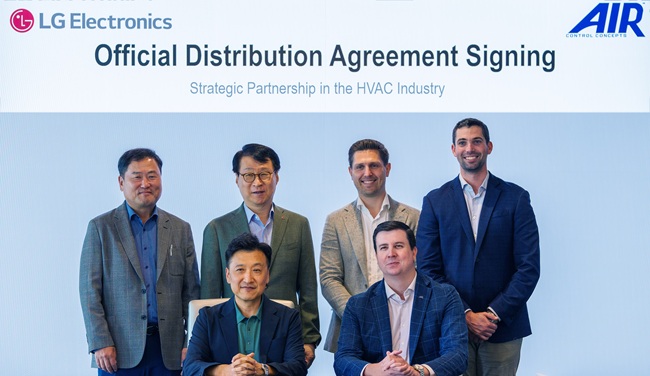
LG Electronics confirmed on October 5 that it signed a long-term chiller supply agreement with AIR Control Concept, a North American infrastructure platform, to cool AI data centers spanning a combined 5 gigawatts of capacity. The deal isn’t about supplying components to be bolted onto someone else’s machine. It is about owning a critical node in the physical layer of artificial intelligence — the plumbing that keeps GPUs from melting down.
Whoever controls the cooling controls the pace of deployment. That is the strategic insight behind this contract, and it is why the details matter more than the headline number.
AIR Control Concept is not a passive buyer
The counterparty deserves close attention. AIR Control Concept is not a reseller or a trading company. It designs, builds, and services AI data centers across the United States and Canada. Its subsidiary, AIR Mission Critical, executes large-scale data center projects end-to-end. That means LG is locked into a relationship with a firm that sits at the intersection of construction, public procurement, and aftermarket service — not a one-off equipment purchase.
AIR Control Concept has already delivered multiple hyperscale facilities in Virginia, Texas, and Ohio. Its project pipeline extends through 2028, which gives LG’s order book a degree of visibility rarely found in the volatile semiconductor supply chain. The company’s CEO, Tom Keefe, has publicly described the partnership as a multi-year structural commitment rather than a tactical procurement move. That framing matters. It signals that LG is being brought into the design phase — before blueprints are frozen and suppliers are locked in.
The 5GW figure in context
The 5GW figure is staggering when you contextualize it. A typical modern AI data center runs between 50 and 100 megawatts. This contract, therefore, covers roughly 50 to 100 individual facilities. That is a portfolio-scale commitment, not a pilot project. For comparison, the entire Korean data center market — including all cloud, enterprise, and edge facilities — totals approximately 3GW of current capacity. LG has just secured a single contract that exceeds its domestic market by nearly two-to-one.
The geographic distribution is equally significant. While the contract is structured around US and Canadian assets, the engineering and manufacturing remain centered in South Korea. LG’s Incheon and Gumi facilities are being retooled for high-volume chiller production specifically for this account. That means the value-add — R&D, precision machining, quality control — stays on Korean soil even as the installed base expands across North America.
Where the money is going
The initial supply focuses on chillers — the machines that produce the chilled water circulating through liquid cooling loops to absorb heat from GPU clusters. LG plans to expand the supply mix to include coolant distribution units, or CDUs, which meter and route that chilled water at the rack level. Together, these two components form the backbone of direct-to-chip liquid cooling, the architecture most hyperscalers are adopting as power density per rack climbs past 100 kilowatts.
The financial signal is already strong. LG reported 600 billion won in order intake for its AI data center cooling solutions in the first half of 2026 alone. Full-year cumulative orders are tracking toward the trillions. The company has publicly set a target of 1 trillion won in chiller business revenue by the end of 2027. These are aggressive numbers for a division that barely existed as a standalone revenue line a few years ago.
Margins on these contracts are materially higher than LG’s legacy HVAC business. Industrial chillers for data centers carry gross margins estimated in the 25 to 30 percent range, compared to the 12 to 15 percent typical of commercial building cooling. The shift is reshaping LG Electronics’ profitability profile even as it repositions the company’s market identity.
The Korean infrastructure pivot
This deal marks a shift that has been building for months but rarely explained clearly. Samsung Electronics is also pursuing data center infrastructure contracts globally. Korean manufacturers are collectively moving from supplying discrete components — memory chips, display panels, battery cells — into integrated facility systems. The logic is straightforward: when you are selling the silicon that powers AI, you should also sell the systems that keep that silicon running.
The advantage Korean firms hold is manufacturing discipline and speed. China dominates cheap hardware and basic mechanical systems. European firms like Liebherr and Stulz have deep HVAC heritage but limited agility in data-center-scale deployments. Korean companies sit in the middle: capable of high-precision manufacturing at scale and fast enough to meet the hyperaccelerated timelines of AI build-outs. That positioning is exactly what hyperscalers need right now.
This pivot also carries second-order implications for the Korean economy. The government’s semiconductor push has focused heavily on TSMC’s Georgia Fab and Samsung’s Texas plant. The cooling contract represents a parallel strand — one that exports not just silicon but the infrastructure that makes silicon viable. If Korean firms capture a dominant share of AI thermal management, they gain leverage that extends far beyond their immediate customer base. Hyperscalers in other regions will feel the pressure to align with Korean supply chains simply because no alternative exists at equivalent scale.
Supply chain resilience and the China factor
A quiet but consequential dimension of this deal involves decoupling risk. For years, Western hyperscalers relied on Chinese HVAC manufacturers for cost-effective cooling solutions. That dependency has eroded sharply as geopolitical tensions have intensified. Chinese firms still offer lower unit prices, but their reliability track record in mission-critical environments remains unproven at the 5GW scale. More critically, their service and spare-parts networks outside of Asia are thin.
LG’s entry fills that gap. The company brings a global service footprint — maintenance teams in Dallas, Atlanta, Chicago, and Toronto — that Chinese competitors cannot match. For a hyperscaler, that footprint is not a nice-to-have. It is a prerequisite. A chiller failure during peak inference workloads can cascade into millions in lost revenue within hours. Procurement teams now prioritize supply-chain certainty over unit cost savings, and LG is positioned to capture that premium.
Who wins, who loses
Hyperscalers win immediately. Nvidia, Google, and Microsoft are all racing to deploy GPU clusters that push the thermal limits of traditional air cooling. Every month of delayed deployment costs millions in unrealized inference revenue. A reliable, large-scale chiller supplier shortens that timeline.
LG wins by establishing a sticky position in the infrastructure stack. Cooling systems have long service lives — 15 to 20 years. Once a data center is designed around a specific chiller and CDU architecture, switching costs are enormous. This is a relationship business, and the 5GW contract locks in that relationship for years.
Traditional European cooling suppliers lose ground. Companies that have dominated the data center thermal market for two decades are being bypassed at the procurement stage. The gap is widening fast. Chinese HVAC manufacturers lack the reliability track record and global service network that hyperscalers demand at this scale.
Labor and capability implications
The deal also carries employment implications that extend well beyond LG’s engineering teams. Building and servicing 5GW of cooling infrastructure requires thousands of technicians, commissioning engineers, and lifecycle managers across North America. LG has signaled intent to localize a portion of its service workforce through partnerships with technical colleges and trade programs in key deployment regions. That approach mirrors the strategy Japanese and German firms used to embed themselves in Western industrial ecosystems during the 1980s and 1990s.
The long-term effect could be a self-reinforcing loop: local expertise reduces service response times, which improves customer satisfaction, which drives further contract wins. Korean firms that invest in this cycle early will accumulate institutional knowledge that is difficult for late entrants to replicate.
What happens next
Watch for three developments over the next twelve months. First, whether LG expands this partnership beyond chillers into full liquid cooling loop design — not just supplying equipment but engineering the entire thermal architecture. Second, whether AIR Control Concept signs additional Korean suppliers as capacity constraints tighten. Third, whether Samsung responds with a competing infrastructure deal of similar scale, which would signal a full-blown Korean bidding war for AI facility contracts.
The cooling market for AI data centers is projected to grow at a compound annual rate exceeding 30 percent through 2030. LG’s 5GW contract is an early foothold in a market that will be worth tens of billions of dollars. The question is no longer whether Korean firms will compete in AI infrastructure. It is how much of it they can capture before the window closes — and whether they can convert a component-supplier identity into something far more durable: infrastructure ownership.