Saxony-Anhalt Election: What AfD's Dominance Means for Europe's Eastern Flank
The AfD's projected surge in Saxony-Anhalt signals more than a German state-level upset. With the far-right on course for its best result ever in eastern Germany, European leaders should worry about what this means for Ukraine support, NATO cohesion, and the EU's political trajectory.
The Vote That Should Worry Brussels
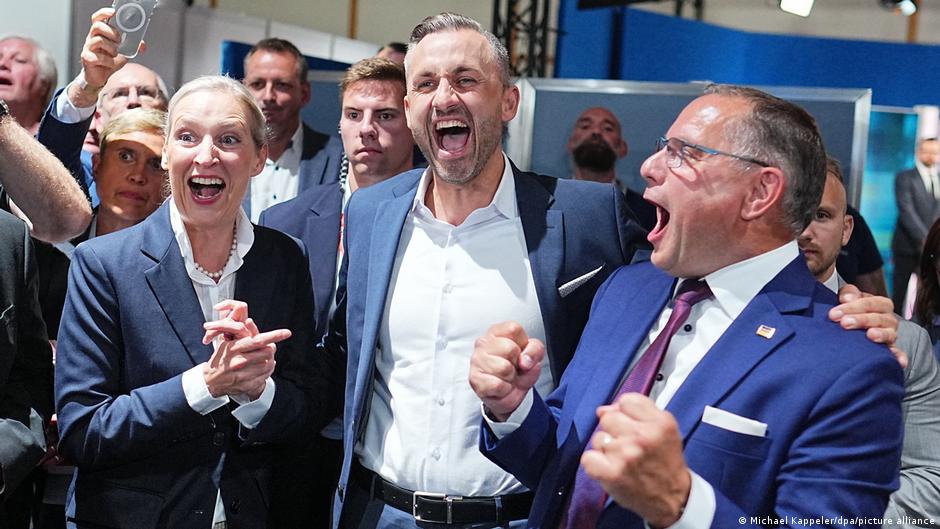
Ulrich Siegmund called it history. In Magdeburg, far-right party members celebrated exit polls putting the Alternative for Germany at 44.5 percent of the vote — more than double the incumbent CDU’s 18.5 percent. Thirty-nine seats in the state parliament, three short of an outright majority. It is the strongest result yet for a party that has spent years at the fringes of German politics.
The jubilation was real. But so was the tension. Around 1,800 police officers from other states were deployed in Magdeburg. Sniffer dogs barked intermittently. Every bag was checked twice. DW reporter Matthew Moore described the scene as resembling a high-security G7 summit rather than a regional election night.
This is not just a German story. What is happening in Saxony-Anhalt is a stress test for the entire European order — and the gauges are flashing red.
The Merz Strategy, Broken Before It Began
Chancellor Friedrich Merz came into office with a clear pledge: cut AfD support in half by taking a hard line on immigration and positioning the CDU as the defender of German values. The Saxony-Anhalt results suggest that strategy has not yet taken root in eastern Germany, where the AfD is consolidating a dominance that looks increasingly structural.
Merz did not even appear at campaign events in the state. His silence was not accidental. A defeat of this magnitude was a risk he was willing to run — but he lost. CDU Secretary-General Franziska Hoppermann insisted there would be no discussion about Merz’s future. She is wrong to bet on stability. This result will haunt the chancellor’s coalition. The CDU’s worst showing in Saxony-Anhalt since reunification is a warning shot that cannot be ignored.
The Coalition Trap
Here is where things get dangerous for European stability. The AfD leads. But no other party wants to govern with it. The Greens, CDU, SPD, and FDP have all ruled out coalitions. That leaves the AfD in a position of maximum leverage: the strongest party in the state, unable to govern alone, and holding all the cards in any negotiation.
The only party where a majority of voters believe the AfD should participate in government is the left-wing populist BSW, which is projected to win five seats. Even then, only 57 percent of BSW supporters hold that view. A grand coalition between the CDU and AfD is politically impossible today. A minority government relying on BSW tolerance is theoretical. Nothing is certain until the final vote count.
But the mere possibility is what matters. In a state where the working-age population is projected to shrink by a quarter by 2045 without immigration, where Siemens Energy’s CEO warned that nostalgic energy policies would damage German industry, and where the AfD’s program calls for mass deportations and the expulsion of skilled migrants — the economic case against AfD governance is overwhelming.
Economist Monika Schnitzer said it plainly: if the AfD takes over, Saxony-Anhalt will become significantly less attractive to skilled workers and companies from abroad. Michael Hüther of the German Economic Institute put it more sharply: any state competing for foreign workers must not strengthen a party that openly calls for their expulsion.
What This Means for Ukraine
This is the part European capitals should be watching most closely. The AfD has been consistently hostile to military aid for Ukraine. Its leadership has framed support for Kyiv as a betrayal of German interests. An AfD-led government in Saxony-Anhalt — or worse, pressure on the federal government to accommodate the party — would create a direct friction point with Berlin’s stated commitment to Ukraine.
Saxony-Anhalt may seem like a distant province to Warsaw or Kyiv. But it is not. The state hosts important infrastructure, including the port of Tangermünde and facilities related to Germany’s energy transition. More importantly, it is a laboratory. If the AfD can govern effectively in Saxony-Anhalt, the model becomes exportable. If it cannot — if economic stagnation follows — the narrative weakens across the continent.
France, the Netherlands, and the Nordic states are all watching. Maria Lehtla, Sweden’s minister for EU affairs, has warned that Russia seeks to weaken Europe from within. The AfD is not Moscow’s creation. But its electoral success aligns precisely with Russian objectives: fracturing European consensus, draining resources from Ukraine, and undermining trust in democratic institutions.
The Eastern German Divide
Saxony-Anhalt is not an anomaly. It is a symptom. Voter turnout was up 50 percent since 2021 — a sign that civic engagement is intensifying, not declining. But the question is in which direction. Pollsters from Infratest dimap noted that the so-called Shy-Voter problem — respondents refusing to admit they support the AfD — has eased. People are voting openly now. That makes the projections more reliable than in past cycles.
The Greens, surprisingly, performed well above pre-election polls, landing at 8.9 percent instead of the expected 5 percent. Their lead candidate Susan Sziborra-Seidlitz vowed to be the antagonist of the right. Felix Banaszak called the conditions dramatic. Both are right. The Greens’ gains show that liberal democracy still has momentum in eastern Germany. But momentum is not the same as victory.
What Happens Next
The final results will not be known until after midnight. But the trajectory is clear. The AfD is on course to become the strongest party in Saxony-Anhalt’s parliament. The CDU is reeling. The coalition math is a nightmare.
For the EU, the message is blunt: the far-right is not a temporary phenomenon in Germany’s east. It is institutionalizing. The party has moved from protest to potential governance. That shift changes everything.
European leaders should not panic. But they should not look away either. Saxony-Anhalt is a data point. The next one could come in Bavaria, or Baden-Württemberg, or Berlin. The question for the EU is whether it treats these elections as domestic quirks or as symptoms of a broader realignment — one that will determine whether Germany remains a reliable partner for Ukraine, a committed NATO member, and a steady hand on the European continent.
The answer to that question starts in Magdeburg.