The SCO Summit Is Performance Multipolarity, Not a Real Alliance
China, Russia, and India gathered in Kyrgyzstan for a SCO summit billed as a counterweight to U.S. influence. But the organization is held together by grievance, not strategy — and India's presence reveals the limits of anti-Western convergence.
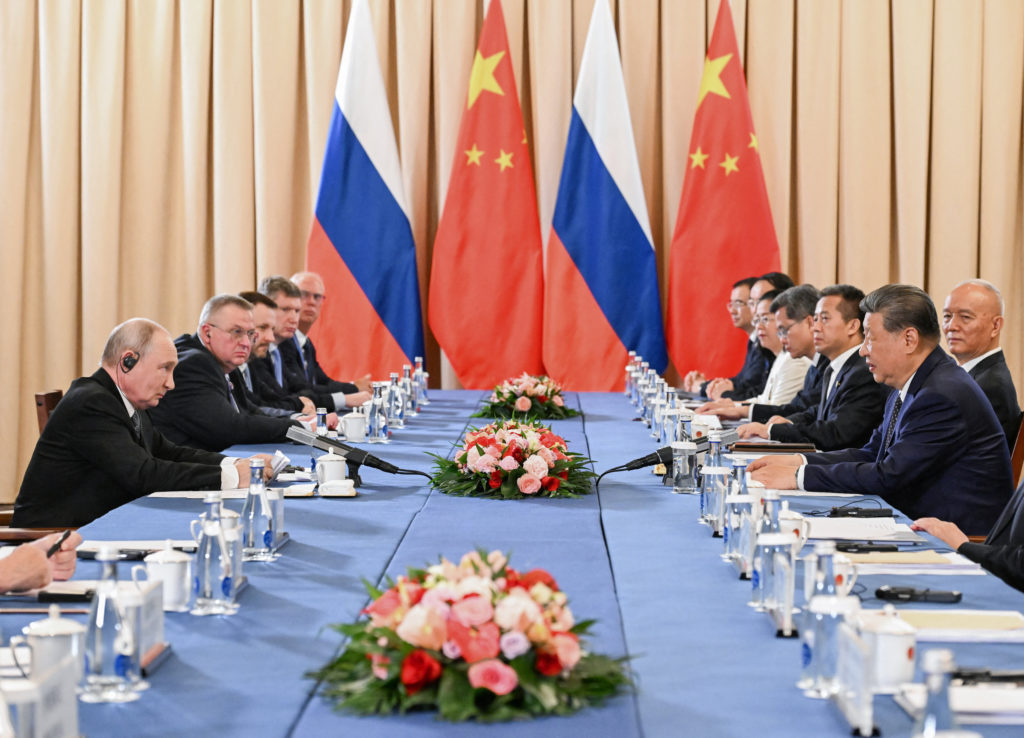
The Photo Op That Masks a Fractured Club
Bishkek went dark for a week. Malls closed. School was delayed. Commercial flights were grounded. The Kyrgyz capital was locked down not for an invasion or a terror threat but for a summit.
The Shanghai Cooperation Organization — the SCO — has become the preferred stage for leaders who want the world to see them outside the Western orbit. This week, that meant Vladimir Putin meeting separately with Xi Jinping and Narendra Modi, affirming a permanent visa-free regime with China and praising strengthening ties with India. It meant Iranian President Masoud Pezeshkian preparing to use the platform four and a half years into Russia’s war in Ukraine and six months into Iran’s war with the United States and Israel.
The visual is striking. The substance is thinner.
India’s Calculus: Presence Without Alignment
Modi’s attendance is the most telling element of this summit, and not because India is about to pivot away from the West. He told Putin through a translator that India supports efforts to end the war in Ukraine and that the world needs to move from endless war to the end of hostilities. The language was careful. The positioning was deliberate.
India is not joining an anti-U.S. bloc. It is ensuring it cannot be excluded from the conversation about how the post-American order might look. That is a different thing entirely.
Dinakar Peri of Carnegie India put it plainly: the SCO gives New Delhi a seat at a table where the rules are still being written, even if India does not control the agenda. It provides first-hand intelligence on regional currents and a venue to project itself as a reliable stakeholder rather than a passive observer.
But that seat comes with strings. The two countries that matter most to India’s strategic calculations — China and Pakistan — are both members. China is India’s primary adversary on the border. Pakistan is its perennial rival. Both sit at the same table where discussions about an alternative world order take place, an order largely shaped and promoted by Beijing with Moscow’s support.
For India, the SCO is insurance, not destiny.
Putin’s Balancing Act — and Its Limits
Putin’s bilateral meetings reveal the architecture of Russia’s current strategy. With Xi, he locked in a visa-free regime that will now be permanent — a symbolic deepening of a partnership that has grown increasingly asymmetrical. Russia needs China far more than China needs Russia, and the numbers bear that out across trade, energy, and diplomatic cover at the UN.
With Modi, the message was warmer but vaguer. Russia’s relationship with India is strengthening, Putin said. It has been strengthening for decades, through every fluctuation in Moscow-New Delhi relations, and it will continue to do so regardless of where India chooses to stand on Ukraine or in any broader coalition.
Russia benefits from India’s presence at forums like the SCO because it lent the appearance of multipolarity — a club that is not just Moscow and Beijing conspiring against the West. But India’s participation also exposes the club’s fragility. New Delhi maintains its defense ties with France, the United States, and Israel. It buys oil from Russia but also sells ammunition to countries at war with Russia’s partner. It speaks the language of strategic autonomy while signing agreements that keep it anchored in multiple camps simultaneously.
The Gap Between Rhetoric and Institution
The SCO was founded in 2001 by China, Russia, and four Central Asian states as a security forum. Twenty-five years later, it has ten members and a growing list of dialogue partners, but its goals and programs remain vague. Its brand recognition outside policy circles is low. It has not produced a unified military posture, a shared economic framework, or a coherent political vision.
China has tried to fill the void with promises of development and financial assistance, positioning the SCO as an alternative to the G7 and other Western-aligned structures. Beijing’s foreign ministry last week declared that the organization has successfully explored a new path for regional cooperation. The declaration itself is revealing — China is the one doing the declaring.
The member states do not share a path. Iran and Pakistan are members, complicating any simple reading of the SCO as an anti-India or anti-Western alliance. Iran’s presence reflects its isolation after its war with the United States and Israel. Pakistan’s presence reflects its deepening ties with China and Russia and its distance from Washington. Neither country’s interests align neatly with the others.
Turkey, a dialogue partner since 2012, wants permanent membership. President Recep Tayyip Erdogan sees the SCO as part of a balanced foreign policy that maintains NATO ties while expanding Eurasian influence. Turkey’s EU membership bid has been stalled for more than twenty-five years. The SCO offers an alternative venue, not an alternative allegiance.
What This Actually Signals
The real story of this summit is not that China, Russia, and India are converging into a cohesive counterweight to American influence. It is that the world’s non-Western powers have found a forum where they can perform that convergence without committing to it.
India gains visibility and intelligence. Russia gains legitimacy and the illusion of a broad coalition. China gains a platform to promote its preferred narrative of an alternative world order. Iran and Pakistan gain diplomatic oxygen. Turkey gains a ladder toward membership. The Central Asian hosts gain economic activity and global attention.
Everyone leaves having gained something. No one leaves committed to anything specific.
That is not a failure of the SCO. It is the SCO’s function. The organization holds together because its members agree on what they oppose more than what they support. Anti-Western sentiment is a common language, but it is not a governance model. Grievance is a foundation, but it is not a structure.
Who Wins, Who Loses, What Comes Next
The winners are the leaders who showed up. The photographs circulate. The statements are issued. The messaging departments log another success. The lock-down of Bishkek ensured no protest mars the image.
The losers are anyone expecting the SCO to deliver concrete outcomes — a unified sanctions-busting mechanism, a coordinated military posture, a alternative reserve currency mechanism that actually works. Those things require trust, shared strategy, and institutional depth. The SCO has none of those in meaningful measure.
What comes next is more of the same: summits in rotating capitals, bilateral side deals between major powers, vague joint statements, and continued hedging by members like India and Turkey who refuse to pick a camp. The multipolar order being discussed is real in its broad direction — American primacy is declining — but the institutions being built to replace it are hollow.
The summit in Bishkek was a preview of that emptiness, dressed up in security restrictions and diplomatic ceremony.