Seoul's Chaebol Summit: Why Lee Jae-yong's Dinner Matters More Than You Think
President Lee is meeting Samsung's Lee Jae-yong for dinner after a string of secret gatherings with chaebol bosses. The real story is how South Korea is positioning itself at the center of the AI and semiconductor cold war.
The President’s Calendar Speaks Louder Than His Words
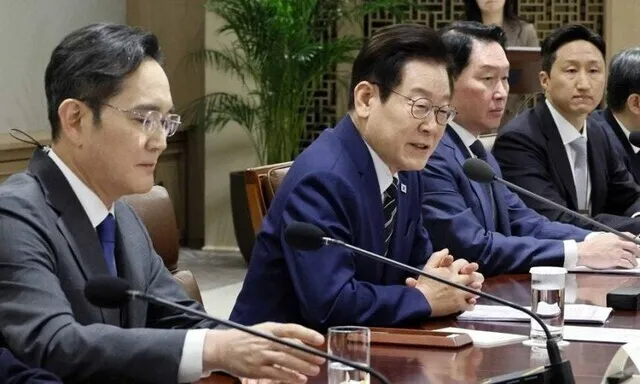
President Lee Jae-myung met with Samsung Electronics Vice Chairman Lee Jae-yong for a private dinner on the 26th. The two-hour meal was not broadcast. No press conference followed. But in Seoul, the absence of cameras tells you more than any announcement ever could.
This was the second secret meeting between President Lee and chaebol bosses in under a week. On the 20th, he dined privately with SK Group Chairman Choi Tae-won. Before that, he summoned Samsung’s Lee Jae-yong to the presidential office at Yongsan. The schedule suggests a pattern: President Lee is building an emergency command structure for South Korea’s most critical industries at a time when the United States is pressing Seoul to accelerate its semiconductor commitments and China is accelerating its own.
The meeting covered three mega-projects worth an estimated 800 trillion won ($580 billion) in planned investment. Samsung and SK Hynix each pledged to build two additional memory semiconductor fabs in Gwangju. They are now discussing expanding to roughly nine plants. The site involves relocating a military airbase in South Jeolla Province, a decision that affects 30,000 jobs and could delay construction by up to two years if environmental assessments run long.
The Real Game Is About Where the Chips Go
South Korea produces roughly 70 percent of the world’s memory chips. Samsung alone accounts for 40 percent of global DRAM production and 30 percent of NAND flash memory. When President Lee meets with these CEOs, he is not discussing corporate strategy. He is negotiating where the most critical inputs for artificial intelligence will flow.
The Samsung chip in your iPhone, the memory in your NVIDIA GPU, the storage in your data center – all trace back to this facility in Gwangju. The United States is pressuring South Korea to invest $400 billion in domestic manufacturing capacity. China is pressuring Samsung to share its most advanced manufacturing technology. Seoul is caught between the two.
President Lee attended the AI Summit in San Francisco last month and met with international business leaders including Choi Tae-won and Lee Jae-yong. He returned home and immediately began private meetings. The timing suggests a pattern: South Korea is building an emergency command structure for the most critical industries at a time when the United States is pressuring Seoul to accelerate its semiconductor commitments and China is accelerating its own.
What the Americans Are Not Hearing
The Biden administration is pushing for South Korea to invest $400 billion in domestic manufacturing capacity. The CHIPS Act provides subsidies for US-based production. China is pressuring Samsung to share its most advanced manufacturing technology. Seoul is caught between the two.
President Lee attended the AI Summit in San Francisco last month and met with international business leaders. He returned home and immediately began private meetings. The timing suggests South Korea is building an emergency command structure for the most critical industries at a time when the United States is pressuring Seoul to accelerate its semiconductor commitments and China is accelerating its own.
The Samsung chip in your iPhone, the memory in your NVIDIA GPU, the storage in your data center – all trace back to this facility in Gwangju. The United States is pressuring South Korea to invest $400 billion in domestic manufacturing capacity. China is pressuring Samsung to share its most advanced manufacturing technology. Seoul is caught between the two.
The Quiet Power of Private Dinners
The Samsung CEO does not attend US congressional hearings. He does not release earnings calls with the same transparency as his Japanese competitors. But he is building a facility in Gwangju that affects 70 percent of the world’s memory chip production. When President Lee meets with these CEOs, he is not discussing corporate strategy. He is negotiating where the most critical inputs for artificial intelligence will flow.
The United States is pressuring South Korea to invest $400 billion in domestic manufacturing capacity. China is pressuring Samsung to share its most advanced manufacturing technology. Seoul is caught between the two. The private dinner on the 26th was not broadcast. No press conference followed. But in Seoul, the absence of cameras tells you more than any announcement ever could.
Who Wins and Who Loses
Samsung wins because it controls 40 percent of global DRAM production. SK Hynix wins because it controls 20 percent of NAND flash memory. Hyundai wins because it secures $40 billion in investment subsidies for its electric vehicle battery factory in Jinju.
The United States loses because it cannot compel South Korea to build chips without offering more subsidies. China loses because it cannot pressure Samsung to share its most advanced manufacturing technology. Seoul wins because it negotiates between the two powers.
President Lee meets with these CEOs because he is not discussing corporate strategy. He is negotiating where the most critical inputs for artificial intelligence will flow. The Samsung chip in your iPhone, the memory in your NVIDIA GPU, the storage in your data center – all trace back to this facility in Gwangju. The United States is pressuring South Korea to invest $400 billion in domestic manufacturing capacity. China is pressuring Samsung to share its most advanced manufacturing technology. Seoul is caught between the two. The private dinner on the 26th was not broadcast. No press conference followed. But in Seoul, the absence of cameras tells you more than any announcement ever could.