Seoul's Frozen Apartment Market Is Shattering Retirement Plans
Seoul apartment transactions plummeted 60% month-on-month in August as tax changes, loan restrictions, and rate hikes lock sellers and buyers into paralysis. For a generation that treats housing as its primary retirement fund, the standstill is becoming a quiet crisis.
The Market That Stopped Moving
In May, 8,962 apartments changed hands in Seoul. In August, just 2,322 did. That is not a gentle cooling — it is a near-freeze.
The drop has a simple explanation and a complicated consequence. The explanation is policy fatigue. The consequence is that millions of Koreans who counted on their homes as retirement savings are now stuck: unable to sell at acceptable prices, unable to buy their way down into smaller units, and watching the one asset they trusted most lose its liquidity at exactly the wrong moment in their lives.
The numbers come from Ham Young-jin, head of research at Woori Bank’s Real Estate Research Lab, whose monthly tracking of Seoul transactions remains one of the clearest signals in the Korean housing market. What he is seeing is a market caught between three forces — loan restrictions, tax reform uncertainty, and rising interest rates — none of which are likely to shift before year end.
Why May Was the Exception
To understand why August felt like a cliff, you have to look back at April and May. Transaction volumes spiked to 8,962 in May, up roughly 50 percent from April. That surge was not organic demand. It was a panic sale driven by a single deadline: May 9, when a multi-homeowner capital gains tax surcharge — a punitive rate applied to people who owned more than one property — was scheduled to expire.
Owners who had been sitting on extra apartments sold them in a rush before the tax bite landed. It created a bubble in the data that made May look like a boom month. It was not. It was a deadline-driven exit.
Once that wave passed, the market simply stopped moving. Buyers stayed away because borrowing costs rose and loan limits tightened. Sellers stayed away because the prices buyers were willing to pay were too low. The result was a bilateral standoff that has defined every month since.
Who Is Trapped
The most consequential group is not developers or investors. It is elderly homeowners.
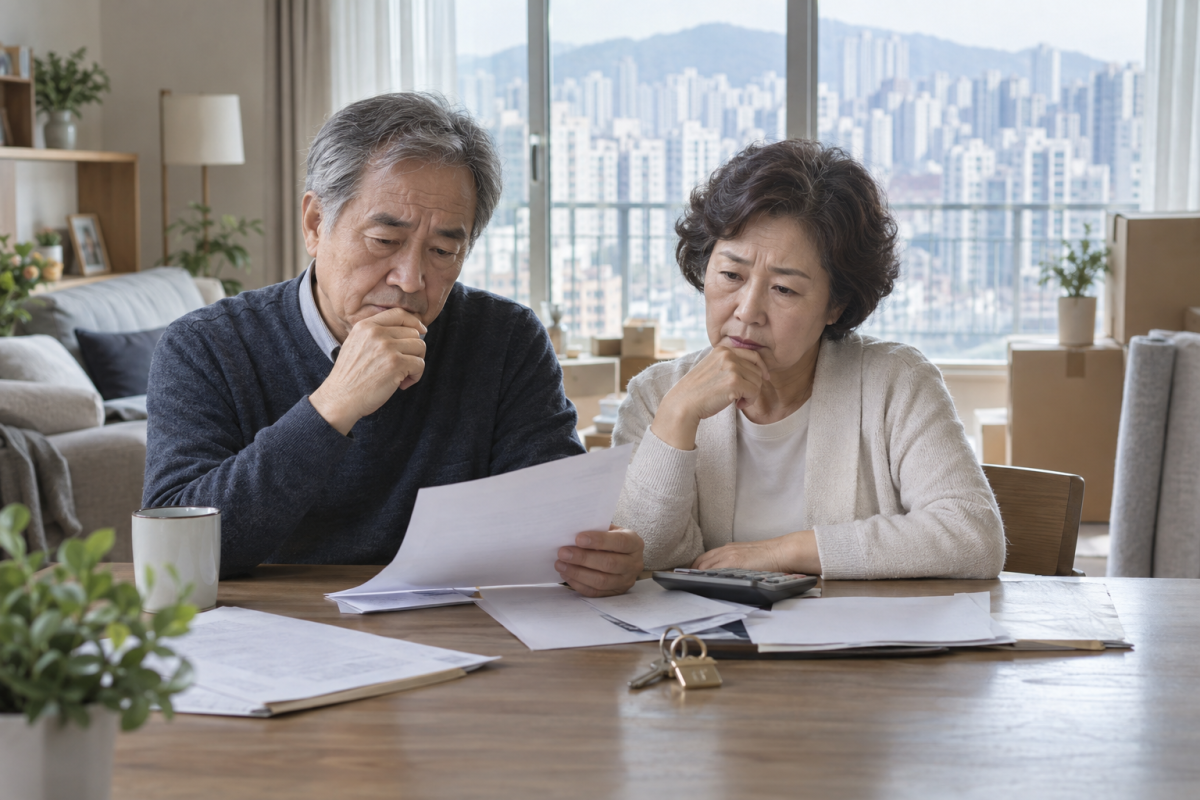
In South Korea, housing is not just shelter — it is the dominant pillar of household wealth and, for many seniors, the primary vehicle for retirement funding. The cultural script is clear: live in your home through your working years, sell it when you retire, downsize, and fund the rest of your life from the proceeds. For a generation that grew up with limited pension coverage and underdeveloped financial markets, this script provided a reliable roadmap.
That roadmap is now broken.
Elderly homeowners looking to sell face a thin pool of buyers, tighter mortgage rules, and higher borrowing costs — all of which push transaction prices downward. Meanwhile, those hoping to move into smaller, easier-to-maintain homes find that the cost of borrowing to finance even a down payment has risen sharply. The result is paralysis. Many seniors are simply waiting, hoping conditions improve, while their need for liquid retirement funds grows.
The Price Tier Shift
What trades are happening are concentrated at the bottom. Apartments priced at 900 million won or below accounted for 54.3 percent of August transactions, up from 47.1 percent in January. That is a meaningful shift in market composition — it signals that buyers, constrained by tighter loan rules, are funneling into the only segment where financing remains feasible.
Meanwhile, transactions in the 900 million to 1.5 billion won range collapsed from 31.79 percent to 6.67 percent year to date. Sales above 1.5 billion won fell from 21.07 percent to 13.33 percent.
The high-end market is not just quiet — it has effectively vanished. And the high-end is precisely where many elderly homeowners would hope to sell, since that is where the liquidity and the price premiums live.
Gangnam’s three flagship districts tell the same story in sharper relief. Their share of total Seoul transactions fell from 16.1 percent in May to just 9.1 percent in August — the lowest level of the year. Even in Gangnam, where loan dependence is lower and wealth is more concentrated, owners are holding back. The tax reform plan that the government unveiled in early August has not been finalized, and that uncertainty alone is enough to keep the most cautious sellers on the sidelines.
Where the Pressure Is Building
The regional flip is telling. While Gangnam stagnated, mid-tier and lower-tier districts like Seongbuk and Jungnang showed more resilience. Their share of total transactions rose to 90.9 percent in August. These are not luxury areas. They are working-class neighborhoods where prices are already modest and where buyers face less financing friction.
This geographic redistribution matters because it signals that the market is not dead — it is being compressed into a narrow band of affordability. The middle of the market has gone missing, and that is where the retirees were hoping to transact.
What Comes Next
Ham’s assessment is unambiguous: the direction of the Seoul market over the next few months will be determined by three variables, none of which are under the control of individual buyers or sellers.
First, the final form of the tax reform plan. The August announcement was a draft. The specifics — particularly how it treats multi-homeownership and capital gains — will shape seller behavior far more than any interest rate move. A harsher-than-expected outcome could trigger another deadline-driven wave of sales, this time in autumn. A softer one might stabilize expectations.
Second, whether the central bank raises rates again. Two increases have already landed this year. Another hike would further tighten mortgage availability and deepen the freeze.
Third, the stability of the rental market. Fall and winter are traditionally volatile months for Korean rental contracts, and any disruption there would push displaced tenants into the purchase market — or, more likely, deepen the polarization between renters and homeowners that is already fracturing public sentiment.
The Bigger Picture
The frozen apartment market is not just a real estate story. It is a generational wealth story. South Korea’s elderly population is growing faster than any major economy in the world, and housing has been the default retirement strategy for decades. When housing stops flowing, retirement plans stop working too.
The current standstill means that for the first time in years, a large cohort of Korean seniors is facing a fundamental question: what do you do when the asset you counted on can no longer be sold?
The answer is still writing itself. But the data from August suggests the next few months will not bring an easy resolution.