Seoul's Quiet Constitutional Crisis No One Is Watching
South Korea's Supreme Court chief justice has defied President Lee Jae-myung's demand to re-nominate a justice candidate — a first in the nation's constitutional history. The standoff reveals a deeper struggle over judicial independence that could reshape the balance of power.
A First in Constitutional History
Chief Justice Cho Hee-dae did something South Korea has never seen before. When President Lee Jae-myung rejected a Supreme Court justice nominee and demanded a replacement, Cho refused — citing a complete absence of constitutional authority for such a re-nomination request.
The sequence is precise. On August 18, Cho submitted two candidates in writing to the president: Son Bong-gi, a senior judge at the Daegu District Court, and Kim Sung-soo, a judge at the Seoul High Court. On August 28, the presidential office rejected only Son, calling the nomination unilateral and without prior consultation, and demanded a re-nomination. Cho waited 25 days before responding in writing: there is no legal basis for a re-nomination request, and the court will not comply.
President Lee had already moved forward with appointing Kim Sung-soo the day before Cho’s response. The appointment ceremony took place with Cho present. By then, Lee was en route to the United Nations General Assembly, beginning a trip through the U.S. and Mexico. Cho’s statement, issued on September 22, came as a direct rebuke to a sitting president while he was abroad.
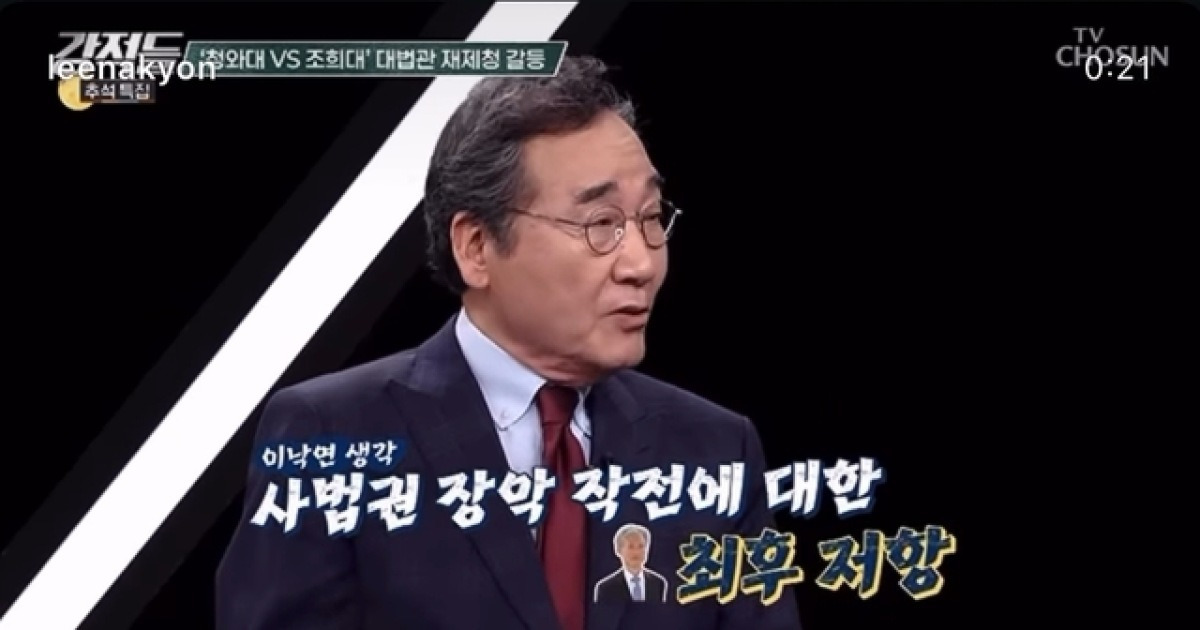
Former Prime Minister Lee Nak-yun, now a senior figure in the New Future Democratic Party, publicly backed Cho on September 22. “This decision, reached after careful deliberation, should be highly evaluated,” he wrote on social media. “This episode will go down as a page in the history of judicial independence in the Republic of Korea.”
That last sentence carries weight. Lee Nak-yun has been among the most vocal critics of the current administration’s approach to the judiciary. For months, he described a systematic effort to neutralize judicial checks on executive power — through legislation to abolish the prosecution service, proposals to expand the Supreme Court, new criminal provisions for judges and prosecutors who deviate from official interpretations, and the introduction of what critics call a de facto fourth appellate tier. He once predicted Cho would accept the president’s rejection quietly, reasoning that the chief justice’s office would prefer silence over confrontation. He was wrong.
The Anatomy of a Breakdown
To understand how a presidential rejection of a single nominee became a constitutional clash, you need to follow the timeline back to January 21, 2026.
The Supreme Court Justice Nomination Recommendation Committee — a body meant to screen candidates before they reach the president — had identified four judges as potential successors to former Justice Noh Tae-ak, whose seat had been vacant for an extended period. The four were: Kim Min-ki and Park Sun-young, both senior judges at the Seoul High Court; Yoon Sung-sik, a department head at the same court; and Son Bong-gi from Daegu.
Under normal practice, the Blue House and the Supreme Court reach a consensus on candidates behind closed doors before the chief justice formally nominates them. That consensus broke down. The two institutions could not agree on which of the four should fill the vacancy. Cho, facing pressure to fill the seat, unilaterally nominated Son and Kim Sung-soo — the latter apparently replacing Park or Yoon after further consultations that remain unclear.
The presidential office called this a breach of convention. It rejected Son and demanded a re-nomination from a different pool. Cho called it a constitutional impossibility. The constitution, Article 104, Section 2, states that Supreme Court justices are appointed by the president with the consent of the National Assembly, upon nomination by the chief justice. There is no provision for the president to reject a nomination and require a new one. There is no provision for a re-nomination procedure at all.
Cho’s reasoning rested on a narrower point as well. Article 82 requires that all presidential acts of state be issued in writing and countersigned by the prime minister and relevant state ministers. The August 28 letter from the Blue House requesting re-nomination contained no specific grounds, no cited constitutional provision, and no countersignature. Cho treated this omission as fatal.
The Conflict-of-Interest Shadow
What makes this dispute more than a procedural squabble is the political context surrounding one of the rejected candidates. Opposition lawmakers have raised questions about whether the presidential office’s rejection of Son Bong-gi was actually a cover for wanting a different judge appointed — Kim Min-ki.
Kim Min-ki’s record includes a role in the second trial of the Daejang-dong land development corruption case during Lee Jae-myung’s tenure as mayor of Seongnam. In that case, the court overturned a first-instance conviction of Kim Man-bae, a major shareholder in Hwacheon Dayu, a company at the center of the corruption allegations. The conviction at first instance had been significant; the acquittal on appeal drew immediate scrutiny.
Compounding the perception problem: Kim Min-ki’s husband is Oh Young-joon, a justice on the Constitutional Court. The couple’s overlapping judicial influence — one at the high court level, the other at the constitutional bench — has drawn accusations of a conflict of interest that opposition figures say explains the Blue House’s selective rejection of the August nominations.
These allegations remain unproven. But they fuel the broader narrative that the executive branch is attempting to shape the composition of the courts through behind-the-scenes pressure rather than open constitutional process.
Why This Matters Beyond Seoul
Constitutional disputes over judicial appointments are not unusual in democracies. What makes South Korea’s current crisis notable is the speed and intensity with which it has unfolded — and the institutional asymmetry at its core.
President Lee Jae-myung entered office with a legislative majority and a reform agenda that targets several pillars of the current legal framework. The prosecution service, long a check on executive power in South Korea, faces abolition. Proposed legislation would create new criminal offenses for judges and prosecutors whose rulings deviate from government-approved interpretations of the law. The Supreme Court itself would be expanded, altering its internal balance.
The judiciary’s response has been restrained — until now. Cho Hee-dae’s refusal to comply with a re-nomination demand, and his public justification for it, represents the most overt institutional pushback yet. It is also carefully limited. He did not challenge the president’s authority to reject a nominee. He did not question the legitimacy of the nomination committee. He addressed only the specific request for re-nomination, grounding his refusal in the text of the constitution and the formal requirements of presidential acts.
That restraint is strategic. Overreach would invite a political counter-move. Precision leaves room for dialogue.
What Happens Next
Several scenarios are plausible. The most immediate is that the presidential office accepts Cho’s position and moves forward with Kim Sung-soo alone, leaving one seat on the Supreme Court vacant. A second is that the Blue House escalates — perhaps by filing a lawsuit challenging Cho’s authority, or by pressuring the National Assembly to intervene. A third is that both sides retreat into further silence, with the vacancy persisting and the underlying tension unresolved.
The constitutional question at stake is narrow but consequential: does the president have any mechanism to reject a chief justice’s nomination and force a new one? The constitution is silent. Cho has answered that silence by saying no. The president has not yet responded to that answer directly.
International observers of South Korea’s democracy tend to focus on elections, trade policy, and North Korea. They rarely track institutional friction between the executive and the judiciary unless it erupts into open confrontation. This episode has not yet erupted. But the fact that Cho felt compelled to issue a public statement — while the president was overseas — suggests the standoff is deepening rather than fading. The next move belongs to the Blue House. Whatever it chooses, the precedent it sets will outlast this particular vacancy.