SK Hynix's 2030 Memory Gamble and Its America Bet
SK Hynix's CEO says a memory shortage will persist through 2030 and keeps US investment on the table — a dual bet that reshapes how global chip politics plays out.
The Shortage Was the Product
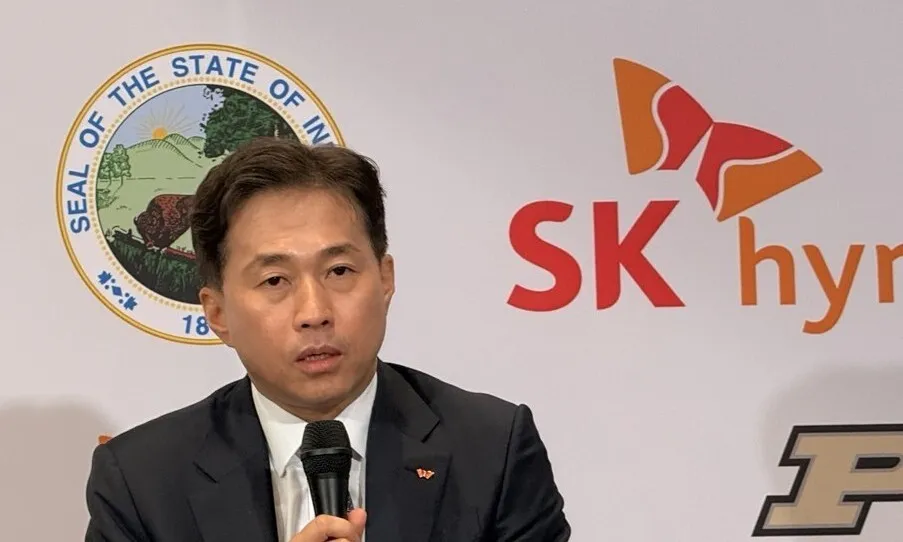
SK Hynix just handed Washington exactly the kind of leverage it has been trying to extract. In an October press conference at its West Lafayette, Indiana fab, CEO Kwak Noh-jung told reporters that a memory semiconductor shortage would persist through 2030 and that the company remained open to further US investment.
The calculus behind the statement was unmistakable. SK Hynix needs America as a customer, a manufacturing partner, and a tariff shield. The White House has been pressing Korean chipmakers to produce more wafers on US soil — a demand tied directly to the broader tariff and export-control regime that could otherwise strangle Korean exports to China. By saying the door was open, Kwak was speaking the language of Washington even while offering no new commitment.
There is no shortlist. There is no plan. What there is, though, is a market structure that makes SK Hynix’s position stronger than it has been in decades — and a timeline that gives it leverage over American policy makers who need HBM now.
HBM Changed Everything
The most consequential claim Kwak made was not about geography but about the nature of the market itself. He argued that the next downturn — whenever it arrives — will not look like the last ones. Old memory cycles ended in brutal slumps: manufacturers flooded the market with generic DRAM, prices collapsed, and companies bled cash.
HBM (high-bandwidth memory) breaks that pattern. It is not a commodity. It is a custom product designed in lockstep with the AI customer whose chip it will serve. The margin protection comes from the collaboration, not the factory. SK Hynix told me implicitly that demand will not collapse — it will merely slow down or plateau.
The math matters. HBM is already the single most valuable memory product on the market, and SK Hynix is competing with Samsung Electronics and Micron for Nvidia’s orders. Every generation — HBM3e, HBM4 — embeds more logic into the package. HBM4 itself, which SK Hynix called “the first signal of memory and logic convergence,” fuses the base die with logic circuits inside the same stack. That is not incremental. It is a redefinition of what a memory company does.
The implication is blunt: the companies that survive the next cycle will not be the ones with the cheapest fabs. They will be the ones closest to the system architect. SK Hynix is betting it already is.
The America Hedge
Kwak’s comments on US investment came against a backdrop of sustained pressure from Washington. The Trump administration has floated tariffs on Korean semiconductors and repeatedly urged Korean firms to expand their American footprint — especially in front-end wafer production. The logic in Washington is simple: keep critical fabrication on allied soil, reduce reliance on Taiwan and South Korea, and gain a lever over China.
SK Hynix’s answer was diplomatic but strategically precise. It did not say no. It said no today. Kwak invoked chairman Choi Tae-won’s publicly stated investment principle — that overseas expansion requires adequate water, power, talent, and subsidies — which is the Korean corporate version of “not yet.” The phrasing leaves every door cracked without committing to walk through any of them.
Why this matters beyond the PR win:
- America needs SK Hynix’s HBM for its own AI ambitions. If SK Hynix delays US expansion, it gains negotiating power on tariffs and export rules. If it accelerates too quickly, it surrenders leverage.
- Chinese customers remain a risk. Samsung and SK Hynix both sell memory chips into China — a market worth tens of billions. US restrictions already limit what they can ship there. An expanded US presence could ease Washington’s scrutiny but would invite Beijing’s retaliation.
- Taiwan is the real flashpoint. SK Hynix has not announced a US fabs for HBM specifically. The company’s major US investment is its West Lafayette facility, which focuses on logic-related semiconductor production. Any move to bring HBM packaging or front-end processing to America would be a fundamentally different — and far more expensive — commitment.
The 2030 Timeline Is the Real Story
The 2030 shortage projection is SK Hynix’s strongest card. If the company believes demand for HBM will outstrip supply through the end of the decade, it controls two audiences: American politicians who want domestic supply, and AI vendors who need parts. Both are desperate. That gives SK Hynix options it simply did not have during the DRAM gluts of the 2010s.
The company is already using those options. SK Hynix announced an AI-focused investment fund operating through a US subsidiary, targeting startups in digital signal processing, networking, and interconnect technology — areas that sit squarely at the memory-logic boundary. This is not philanthropy. It is a quiet bet that the next generation of AI infrastructure will require SK Hynix’s expertise in both memory and the systems that move data.
It also signals that the company sees itself evolving beyond a component supplier. Memory was always about electrons. The future is about moving those electrons fast enough to keep an AI data center fed. The companies that master the interface — the package, the board, the protocol — capture more of the value chain.
Who Wins, Who Loses
Nvidia and other AI chip designers win the most in the near term. A prolonged shortage keeps their supply chains dependent on a small number of qualified vendors — including SK Hynix. That dependency is exactly what SK Hynix wants.
Samsung faces a strategic squeeze. It lost the HBM race to SK Hynix for several generations. If SK Hynix’s customized-model strategy proves resilient through the next downturn, Samsung’s commodity advantage shrinks further. The Korean government’s own industrial policy may force Samsung to invest in America alongside SK Hynix, compounding the cost.
Chinese AI firms lose. Export controls and the concentration of advanced HBM production in a handful of Korean and American facilities create a bottleneck Beijing cannot easily bypass. SMIC and other Chinese foundries lack the processes to compete with HBM4-level integration.
Washington gains tactical leverage but creates its own dependency. Pulling Korean fabrication into America reduces one risk — over-reliance on Taiwan — while creating another: a handful of fabs owned by foreign corporations, subject to foreign labor markets and home-country political shifts.
What Comes Next
The most likely path is a slow, calibrated deepening of SK Hynix’s American presence rather than a sudden transformation. Expect announcements about packaging, testing, or R&D centers in the US within the next 18 months — the kind of investment that satisfies Washington without locking the company into front-end wafer fabrication, which is capital-intensive and politically fragile.
Expect the 2030 shortage narrative to harden into concrete capacity plans by late 2026 or early 2027, when the next round of AI chip roadmaps will force SK Hynix to reveal whether it can actually fill the gap.
And expect tariff policy to remain the shadow over every conversation between Seoul and Washington. SK Hynix’s openness to US investment is a hedge, not a strategy. The real strategy is the one Kwak hinted at when he described HBM as a partnership product: become so embedded in the American AI stack that decoupling becomes impossible — and the price of that embedding is paid in dollars, not yen or yuan.
That is the bet. The question is whether the bet pays off before the next cycle turns.