South Korea's $40,000 Moment May Be as Fragile as It Is Symbolic
A plunging won and a semiconductor boom have lifted South Korea within touching distance of $40,000 per capita GNI for the first time in 12 years. But the milestone is far more fragile than the headline suggests — and could vanish just as quickly.
The $40,000 door is cracking open. But the hinge is thin.
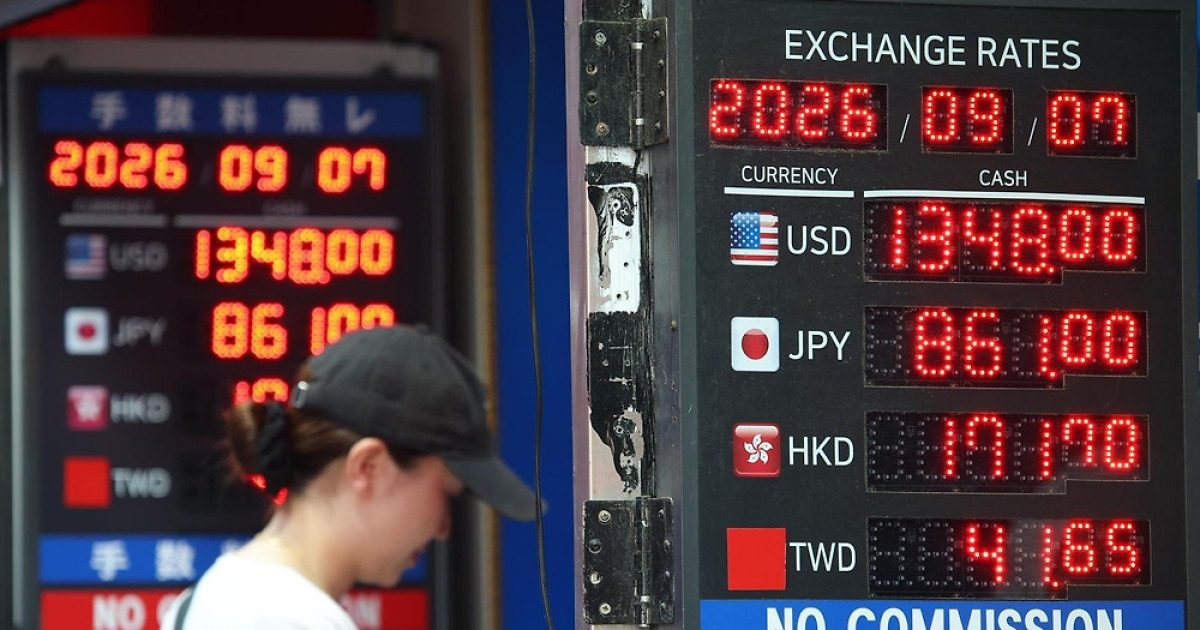
On Sept. 7, the won-dollar rate settled at 1,340.5 won, the lowest weekly closing level since October 2024. Trade-driven dollars poured into the Korean treasury from an unlikely source — semiconductors. And all at once, a number that had pinned South Korea to the $30,000 per-capita income band for twelve straight years looked as though it might finally break.
Based on the year-to-date average exchange rate of 1,471.4 won and the government’s July GDP growth forecast of 12.3 percent, Korea’s per-capita gross national income is on track for roughly $40,179. Keep the annual average below 1,478 won through December, and the country joins the United States, Germany, the United Kingdom, France, and Italy as the sixth nation with a population over 50 million to breach the $40,000 GNI threshold.
That headline alone makes the milestone worth celebrating. What is less clear — and what deserves scrutiny — is whether South Korea can stay there, or whether this breakthrough will follow the same arc as Japan’s: a brief flash into the $40,000 tier, then a retreat back to the $30,000s as currency and growth realities reassert themselves.
Japan’s shadow
Japan crossed $40,000 per-capita GNI in the late 2010s before sliding back into the $30,000 range by 2024. The twin drivers were stagnant growth and a yen that repeatedly weakened against the dollar. Korea risks mirroring that pattern if its own growth proves narrowly tethered to a single sector and its currency reverses course just as quickly as it has fallen.
The numbers do not yet show structural diversification. Between January and August, South Korea’s total exports surged 52.8 percent to $693.3 billion. But semiconductors alone accounted for $281.2 billion of that total — a 169.6 percent jump — and a 40 percent share of all shipments. When the chip cycle cools, the whole export figure cools with it.
That is the difference between an economy that earns its way into a new income bracket through broad-based productivity gains, and one that gets there because the dollar temporarily weakened while a single industry ran hot.
The pension fund variable
There is another reason the won’s recent slide may not be sustainable. Korea’s National Pension Service, widely described in local media as a dominant force in FX markets, recently paused its currency-hedging operations and began buying dollars outright. That action — triggered, apparently, by the sharp appreciation of the won — removed some downward pressure on the exchange rate during intraday trading on Sept. 7, when the pair briefly touched 1,334.7 won before retreating.
The implication is straightforward: the pension fund’s shift from hedging to dollar accumulation is an admission that the won was appreciating too fast, and an active effort to buy time against further strength. If Korean institutional investors expand their overseas allocations through the fourth quarter and into next year — as government policy and domestic “ant army” retail flows encourage — dollar demand will climb. Every additional dollar purchased pushes the won back down and pulls per-capita GNI with it.
Researchers at the Capital Market Research Institute have flagged this exact dynamic. The message is not subtle — the won can reverse when investors move from defensive hedging to opportunistic dollar buying, and the timing of that shift may be closer than most assume.
What actually determines the floor
The Bank of Korea and the World Bank have noted that Taiwan surpassed $40,000 per-capita GNI last year, but its population sits at just 23 million — far below Korea’s 51.6 million. The comparison underscores the scale of what Korea would be achieving: a mass economy reaching an income level that many small, wealthy states have long held.
But crossing the line is not the same as entrenching it. Macroeconomic historian would point to three conditions that separate durable transitions from temporary ones: diversified export bases, sustained productivity growth outside cyclical industries, and structural reforms that raise the floor rather than just inflating the ceiling.
Korea’s service sector and non-semiconductor manufacturing, which absorbed much of the country’s employment growth over the past decade, show far slower momentum. Real wage growth for rank-and-file workers remains uneven. Household debt sits at roughly 103 percent of GDP. None of these problems are solved by a favorable exchange rate.
Why this matters beyond Korea
A $40,000 GNI milestone shifts Korea’s positioning in two useful but underappreciated ways. First, it re-anchors the country firmly in the advanced-economy club — not a middle-income country pretending at prosperity, but an economy whose average citizen commands a level of national income comparable to Western Europe. That matters for trade negotiations, for alliance politics, and for how international investors classify Korean assets.
Second, it undercuts the narrative that China’s economic momentum has irreversibly overtaken East Asia’s older industrial powers. South Korea’s path — even if narrow and chip-dependent — shows that a single-country story can still be told against the broader Chinese slowdown. The nuance is easy to miss in English-language coverage that tends to frame the region in terms of China versus no one else.
The harder question: can Korea hold the line?
Most analysts who spoke to Dong-a Ilbo about this topic — including professors at Ewha Womans University and senior researchers at the Capital Market Research Institute — did not dispute the arithmetic. They disputed the durability. The argument runs like this: Korea can reach $40,000 this year because a strong semiconductor cycle and a weak dollar cooperate; it may lose that ground next year if either reverses.
That is not a trivial distinction. A one-year milestone measured in nominal dollars — not purchasing-power parity, not per-hour productivity, not median household income — is a headline achievement, not an economic transformation. Japan learned that lesson painfully. Korea should pay attention.
The coming quarters will be decisive. If the won drifts back toward 1,450–1,500 from current levels and semiconductor revenues normalize, the per-capita GNI figure will compress. If the chip boom extends and the dollar stays weak, Korea may simply ride the wave further.
Either way, the real measure of success should not be whether $40,000 is reached. It should be whether South Korea builds an economy that does not need the dollar to fall to get there.