South Korea Erases LGBTQ+ from Anti-Hate Guidelines — Then Claims It Fights Hate
South Korea's Ministry of Education released an anti-hate speech handbook that omits sexual minorities entirely — removing protections that existed in a 2020 national guide and prompting six of seven expert reviewers to resign. A policy contradiction with regional implications.
Who Loses When Hate Speech Guidelines Delete the People Being Hated
South Korea’s Ministry of Education released an anti-hate speech handbook this week that deliberately omits sexual minorities. Six of seven expert reviewers quit rather than endorse it. The contradiction is the story — a government claiming to combat hate while erasing the very people hate targets.
The guide was created after the Baesae High School baseball team mocked the 1980 Gwangju Democratic Uprising — a genuine abuse scandal that exposed a casual cruelty culture in Korean classrooms. The Ministry said it would use the incident to build a response manual for teachers. What it built instead is a document that defines hate speech broadly but points at everyone except LGBTQ+ students. The irony is structural: a manual born from one act of historical mockery now enabling a different kind of mockery against sexual minorities.
The Seoul Metropolitan Office of Education had already drafted a version that included sexual orientation and gender identity as categories of protected harm. The Ministry stripped them all out, replacing explicit language with vague references to “various forms of discrimination” that teachers were expected to interpret themselves — an instruction that functioned as a prohibition.
The Numbers That Define the Regression
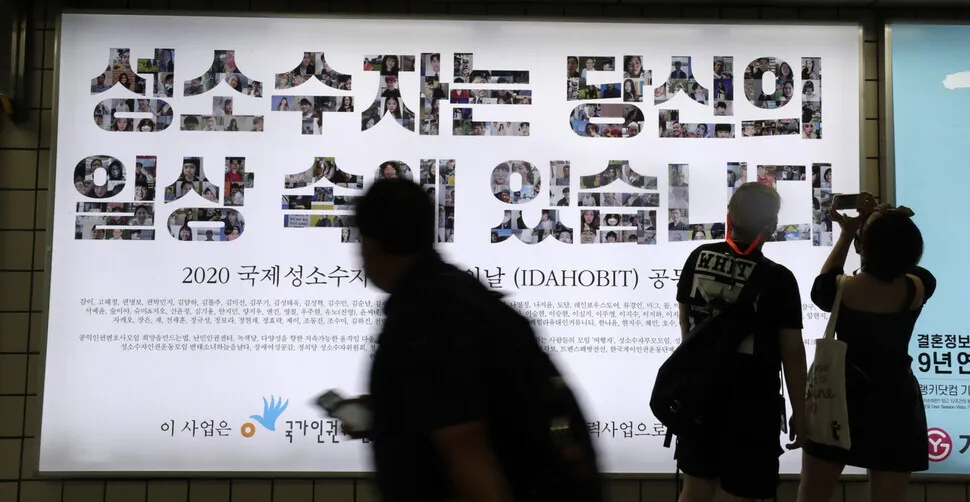
The timeline is stark. In 2020, the National Human Rights Commission and the Association of Provincial and Metropolitan Superintendents of Education co-produced a school guide called “Is Our School Safe From Hate Speech?” — and it explicitly named sexual orientation and gender identity as criteria for judging discriminatory expression. Teachers received it. Schools discussed it. The language was on the page, distributed to over 10,000 educational institutions nationwide.
The current Ministry version removes every such reference. Six of seven reviewers who examined the draft resigned, refusing to attach their names to a document that erased the populations most targeted by the hate it claims to combat. Their resignations were not performative — they followed months of internal debate, documented objections, and repeated attempts to restore the removed language, all of which were rejected by Ministry officials.
Hong Sung-soo, a law professor at Sogang Women’s University, was among them. She said the guide’s authors acknowledged that foreigners, migrants, disabled people, women, and sexual minorities have long been the primary targets of hate speech — and that removing the last group wasn’t a neutral editorial choice but an intentional act of exclusion. Her objection was recorded in meeting minutes and ignored in the final publication.
Park Jeong-yeon, a public interest human rights lawyer, said the guide itself performs the discrimination it claims to address. “Suggesting that controversies or opposing complaints about sexual orientation and gender identity should be avoided is itself a discriminatory act,” she said. “The government and local authorities are signaling that they will tolerate and enable anti-LGBTQ+ harassment in schools.”
The Ministry’s Own Explanation
An education official confirmed the real reason the Ministry gave for removing sexual minority content: it worried that distributing materials referencing sexual orientation and gender identity would generate opposing complaints from conservative religious groups and make school distribution politically difficult.
That is institutional cowardice dressed up as pragmatism — and it matters far beyond South Korea. The official’s statement, made on condition of anonymity, revealed a calculus that prioritizes administrative convenience over student safety. “We want to reach every school,” the official explained. “But if we include language about sexual minorities, certain religious organizations will file formal complaints, and we cannot guarantee the guide will be adopted in those districts.”
Educators at Korean high schools report that the bullying is ongoing and lethal. One anonymous teacher told Hankeyore: “LGBTQ+ students are being mocked, excluded from activities, and some have attempted suicide — and the current school reality is that there is no institutional guidance to address these patterns. When a teacher sees a student being harassed because they are gay, what are they supposed to do? The handbook gives them no language, no framework, no protection.”
Lee Hye-jung, education professor at Kyonggi University, said anti-gay slurs like “you sound gay” or “are you gay?” play out daily in Korean classrooms. “Without explicit guidelines, teachers have no institutional backing to challenge this culture,” she said. “Students are facing bullying, exclusion, and even suicide attempts — and the government’s response is to remove the very language that would protect them.”
The Ripple Effects
The immediate consequence is clear: Korean teachers now have no official manual that tells them how to respond when a student is outed on an anonymous messaging app, excluded from club activities, or harassed with anti-gay slurs in the hallway. The Ministry’s own explanation — that referencing sexual minorities would generate complaints — signals that the government views LGBTQ+ students as an administrative inconvenience rather than as people requiring protection.
But the damage extends beyond classroom manuals. The policy shift sends a message to every queer teenager in South Korea: your existence is too controversial to mention in official documents designed to keep you safe. The contradiction is structural — a government that tells LGBTQ+ students their harassment is someone else’s problem while simultaneously claiming to fight all forms of hate.
For students navigating daily anti-gay bullying and the constant fear of being outed on social media, the message is unambiguous: the state sees them as a problem to be managed rather than as people to be protected. The Ministry’s explanation — that referencing sexual minorities would generate complaints — tells them exactly where they stand. They are the complaint.
Regional and Global Implications
The longer-term signal is what this means for South Korea’s international standing. The country has worked hard to project a progressive image globally — hosting international human rights conferences, producing influential cultural exports, and positioning itself as a champion of democratic values in a region where authoritarianism remains common. By quietly removing sexual minorities from its own anti-discrimination framework, South Korea is eroding the credibility it has tried so hard to build.
The regional contrast is instructive. Singapore still criminalizes homosexuality under Section 377A of its Penal Code, with penalties of up to two years imprisonment. China’s state media continues to frame LGBTQ+ topics as socially problematic, with broadcasts prohibited and websites blocked. Japan’s protections remain fragmented across municipalities, with only a handful of prefectures offering same-sex partnership certificates and no national anti-discrimination legislation. South Korea occupied the middle ground — the first East Asian country to produce a national anti-hate speech guide that explicitly named sexual minorities. That middle ground has now vanished.
International human rights organizations have noted the regression. The International Lesbian, Gay, Bisexual, Trans and Intersex Association (ILGA) cited South Korea’s policy shift as evidence of