Korea's Quantum Breakthrough Is Flying Under the Radar
South Korea has quietly achieved key milestones in superconducting quantum computing, doubling its near-term coherence-time target and hitting 99 percent fidelity on two-qubit gates. The question is no longer whether Seoul can participate in the quantum race—it is who gets to share the infrastructure.
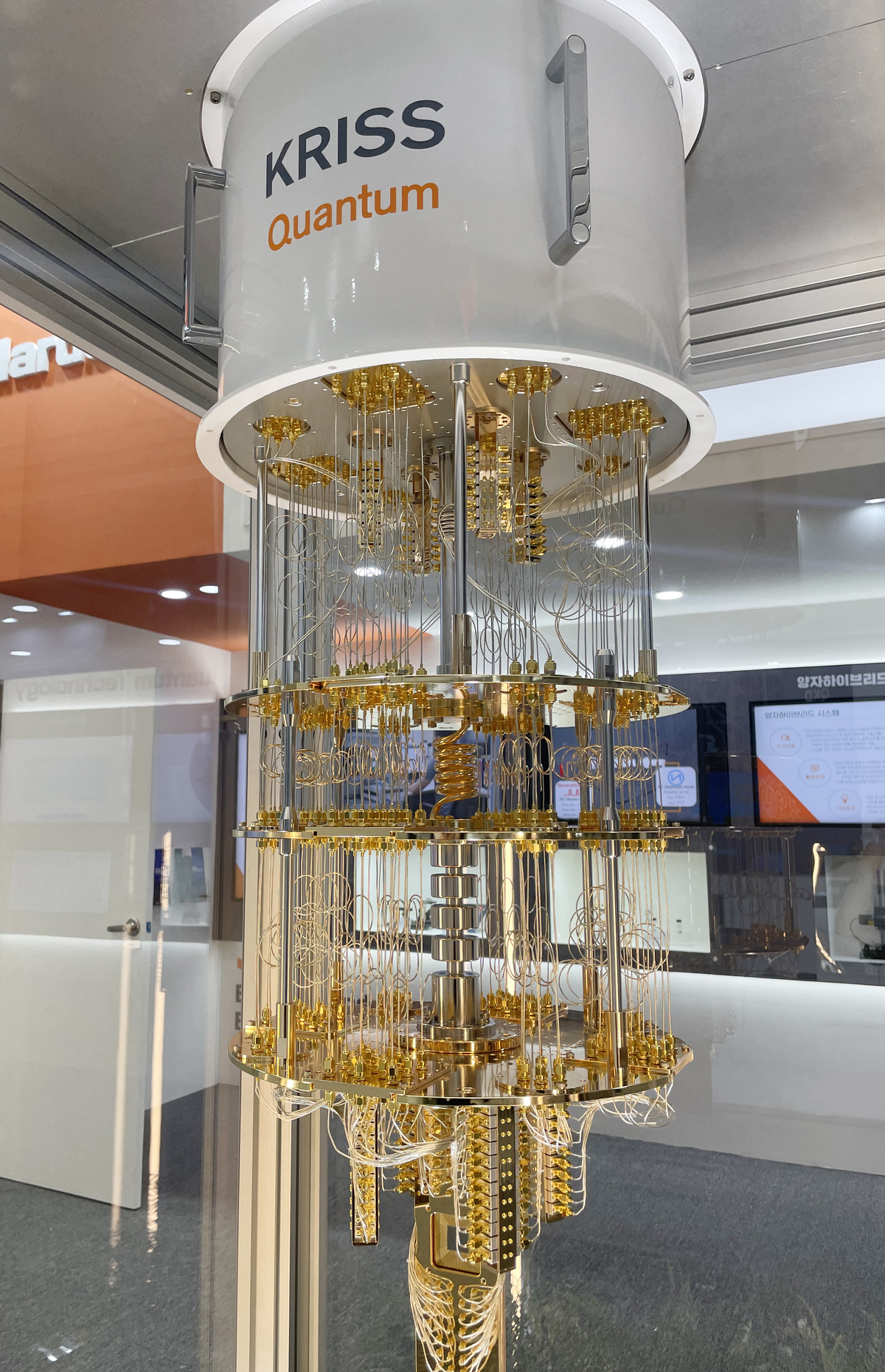
South Korea Just Cleared Its First Real Quantum Hurdle
Not loudly, not with a press conference in Silicon Valley, but South Korea has quietly cleared one of the most important benchmarks in quantum hardware development—and English-language outlets are barely noting it.
At an annual review of the Ministry of Science and ICT’s Quantum S&T Flagship Program in Daejeon last week, officials revealed that the country had already smashed its own 2026 target for superconducting qubit performance. Researchers sustained quantum information for more than 100 microseconds—twice the 50-microsecond goal set for next year—and achieved 99 percent accuracy in two-qubit entanglement operations. Both results came during the first year of a five-year initiative that was only supposed to be ramping up.
That timing is the story here. Most national quantum programs announce ambitions and grant allocations for years before delivering performance data. Korea delivered.
What Those Numbers Actually Mean
Coherence time and gate fidelity are the two metrics that separate laboratory curiosities from useful machines. Qubits lose their quantum state through environmental interference. The longer a qubit holds information, the more complex computations become possible before decoherence ruins everything.
One hundred microseconds sounds small next to classical compute cycles, but for a superconducting quantum processor it moves the system meaningfully closer to the thresholds needed for error correction—a prerequisite for anything beyond toy problems. The 99 percent fidelity figure matters just as much. Two-qubit gate errors compound exponentially across a multi-qubit circuit, so squeezing error rates below roughly one percent is the narrow gateway to any kind of reliable large-scale computation.
Neither number proves a working 100-qubit quantum computer exists today. They prove that the foundational materials and control techniques are converging fast enough to make the 2029 target plausible. The Flagship Program explicitly aims for an error-corrected 100-qubit superconducting processor by then. If the trajectory holds, that becomes credible rather than aspirational.
The Architecture That Places Korea in the Room
Korea chose superconducting qubits. So did IBM. So did Google. That is not a trivial alignment. Superconducting processors are the only architecture to date that has produced machines with commercial relevance, and the ecosystem—from dilution refrigerators to microwave control electronics to fabrication know-how—is heavily concentrated among a handful of players in the United States, Europe, and increasingly Japan.
By betting on the same architecture and hitting those targets a year early, Korea positioned itself inside the mainstream competition rather than on a side track. A photonic or trapped-ion approach might have won different headlines. Superconducting wins partnership talks.
The follow-on work being showcased outside the computing section reinforces that reading. Researchers reported progress on solid-state quantum repeaters capable of generating entanglement on demand, along with all-photonic repeater designs that connect entangled states using light alone. Both routes feed directly into long-distance quantum networks, and the team has filed patents on related components including quantum frequency converters. Repeaters are the missing link between isolated quantum lab experiments and a functioning quantum internet—and anyone who controls that infrastructure gains leverage regardless of whose processor runs fastest.
In the sensing category, a compact diamond NV-center magnetometer capable of measuring cardiac magnetic fields without skin contact was presented. Unlike traditional SQUID-based systems, it operates at room temperature and does not require electrode placement. Commercial deployment timelines were not disclosed, but the application space—non-invasive cardiac diagnostics—is large enough to attract private investment if performance proves reproducible across patient populations.
Why This Should Matter Outside Korea
The immediate implication is regional. Japan launched its own quantum push with substantial public funding and close ties to Japanese fab equipment makers. Taiwan dominates the advanced semiconductor manufacturing base that any superconducting qubit production line would eventually rely on. The Philippines, Vietnam, and Indonesia have all discussed quantum readiness frameworks. A credible Korean processor capability does not emerge in isolation—it pulls the supply chain, the talent pool, and the standards bodies along.
On the policy side, the alignment is already visible. Korea has been coordinating quantum export controls with the United States under the broader bilateral technology security dialogue. If Korea produces error-corrected quantum hardware before the U.S.-China decoupling period hardens completely, Seoul faces a choice that Beijing watches closely: how much of that capability enters joint ventures with Chinese institutions, and how tightly Washington’s restrictions apply to a partner that is no longer a marginal player.
This is not hypothetical. Semiconductor export rules already force Korea to navigate similar tensions daily. Quantum hardware shares many of the same choke points—ultra-low-noise wiring, specialized lithography, cryogenic components—and the same geopolitical scrutiny. The question now is whether Korea’s head start forces an earlier conversation about dual-use boundaries than either Washington or Seoul anticipated.
Who Wins, Who Loses, What Comes Next
Korea wins credibility. The government-backed Flagship model, often criticized for favoring coordination over speed, just demonstrated it can deliver ahead of schedule on core hardware metrics. That changes how American and European labs view partnership possibilities and how Chinese institutions assess whether to invest domestically or seek alternatives abroad.
The United States wins a reinforced ally in a technology domain it has fought hard to keep ahead. It also inherits a new dependency: Korea’s progress increases the likelihood that quantum hardware will flow through Seoul rather than exclusively through Boston or Santa Barbara, which reshapes licensing negotiations.
China loses relatively—but the loss is incremental, not decisive. Korea’s achievement does not close the overall gap with the world’s top performers. It does narrow the space in which Beijing can assume the rest of East Asia will remain dependent on imported quantum capability.
The next checkpoint arrives in 2029, when the Flagship Program expects its first error-corrected 100-qubit processor. Everything between now and then—patent filings, repeater demonstrations, private-sector involvement—will determine whether this year’s surprise translates into sustained participation in the quantum economy or another case of promising results fading before commercial relevance. Early indicators lean toward the former. The pace thus far suggests otherwise.