Starship Finally Hit Orbit — Here's Why It Rewrites Space
SpaceX's Starship reached Earth orbit on its 14th test, ending years of near-misses. The milestone reshapes the Artemis timeline, reignites the Moon race against Blue Origin, and signals that full-reuse heavy-lift may be closer than anyone expected.
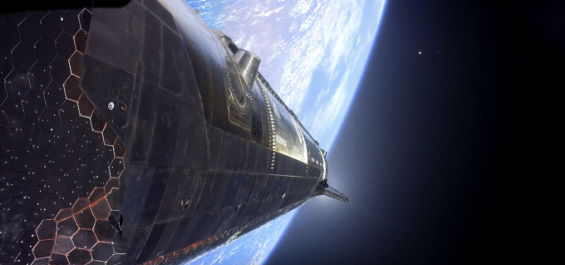
Starship crossed a threshold no one thought would come this fast
SpaceX’s Starship reached Earth orbit on its 14th test flight, ending a string of flights that got close — altitude records, controlled descents, engine cuts — but never broke through into sustained orbital flight. The vehicle launched from Starbase in Texas carrying 26 Starlink satellites, completed part of its planned six-orbit, ten-hour mission, and then came home early after one engine shut down ahead of schedule. The flight was cut to three hours for safety reasons.
That it happened at all on test 14 is what makes this noteworthy. Previous attempts had climbed above the Kármán line and returned, but orbit requires a specific combination of velocity, staging precision, and engine reliability that the system had never demonstrated in flight. Hitting orbit means the basic architecture — the super-heavy booster, the ship itself, the raptor engine cluster — is fundamentally viable. The engineering problems now shift from “can it get there?” to “can it return intact, refuel in orbit, and do this repeatedly?”
The Artemis countdown just got sharper
NASA selected Starship as the Human Landing System for its Artemis program precisely because of that raw lifting capacity — 124 meters tall, described as the largest spacecraft in human history — and the ambition to make it fully reusable. Artemis 3, targeting a summer 2026 crewed lunar landing, is now approaching with a vehicle that has at least proven it can reach orbit. That is a prerequisite the agency needed before green-lighting further lunar-phase operations.
The immediate concern is timing. An engine anomaly that forced an early termination is not a disaster, but it raises questions about redundancy and fault-tolerance design. If Starship is going to ferry astronauts to the lunar surface, every propulsion failure mode needs to be catalogued. The good news: the shutdown was handled by existing safety protocols, and the team was already flying test profile data. The less comforting part: Artemis 3 is supposed to launch in roughly a year, and the window for crewed lunar landing hardware integration is narrowing.
Artemis 4, scheduled for sometime after 2028, will be the first mission where astronauts actually use Starship as a lunar lander. Between now and then, SpaceX has at least one more test flight planned — this one aimed at landing the vehicle back on the launchpad. Elon Musk has publicly estimated a 50 percent success rate for that maneuver. Whether that assessment holds depends entirely on how quickly the team can iterate between test 14 and the next attempt.
Blue Origin is still in the room
NASA’s dual-source strategy was always going to create competition, and Blue Origin’s Blue Moon lander is still a factor. Both vehicles were selected for parallel development under separate Artemis contracts. Artemis 3’s Orion capsule is scheduled to dock with whichever lander is flight-ready first, and Artemis 4 will use the same vehicle. That “first ready” clause matters because the program has already absorbed delays once; a second failure or extended wait could force another pushback.
Blue Origin has not publicly confirmed orbital-class test results comparable to what SpaceX achieved Tuesday. Its development path has been slower and more incremental. But Blue Moon is designed for a different operational profile — it does not need to return to Earth, which changes the engineering calculus. The side-by-side selection means NASA holds leverage. If one vehicle stumbles, the other can still carry the crew. That is the intent. Whether the schedule allows for either buffer remains the open question.
The economics of reusability change everything
The deeper significance of this flight extends far beyond Artemis. Starship is being built as a fully reusable system — the booster lands, the ship lands, both fly again. No other operational launcher comes close to that model. Falcon 9 reuses the first stage and lands it; Starship aims to reuse everything, including the upper stage, which is far harder because it must survive re-entry heating and land precisely.
If SpaceX achieves that, the marginal cost of launching mass to orbit drops dramatically. Starlink deployments, satellite constellations, deep-space payloads, and even point-to-point Earth transport concepts all become economically plausible at scales that were previously fantasy. The 26 Starlink satellites on board this flight were payload, not the mission — but the pattern matters. Each subsequent flight is expected to carry more, and the cadence is supposed to accelerate.
The 10-hour, six-orbit profile tested today was partly a proxy for lunar transit operations. A mission to the Moon requires similar duration, thermal management, and systems checkout in microgravity. Getting comfortable with multi-orbit habitation is a step toward the kind of refueling and rendezvous operations that a lunar mission demands. The early engine cutoff complicates the data set, but it does not erase the achievement.
What happens next
SpaceX’s next target is the landing test — the vehicle returns and touches down on the pad or a barge. Musk’s 50 percent readiness estimate is a blunt number, but it reflects a company culture that treats each flight as a rapid learning cycle rather than a make-or-break event. That philosophy has gotten them this far, and it is likely to keep pushing the schedule forward even as individual tests produce mixed results.
NASA will watch closely. Artemis 3 cannot proceed confidently until Starship demonstrates the reliability a crewed lunar landing demands. The agency has already pushed the first landing date once and will not do it again without stronger evidence. Blue Origin will continue its own development track, knowing that the dual-source design gives it an advantage even if SpaceX advances faster.
For the global space industry, the message is clear: the era of heavy-lift launchers being one-flight marvels may be over. Starship’s orbit achieved on test 14 compresses timelines that competitors assumed would stretch across the decade. Whether it can land itself on a pad next time is the question that will determine if this milestone translates into sustained operational momentum — or becomes another beautiful test flight that the archives preserve while the schedule slips.