How 'Super Males' Eradicated an Invasive Species in Six Years
Idaho researchers have achieved what poison and electric nets never could: wiping out an invasive trout by flooding rivers with YY males that produce only sons. The breakthrough raises big questions about where genetic control ends and ecological restoration begins.
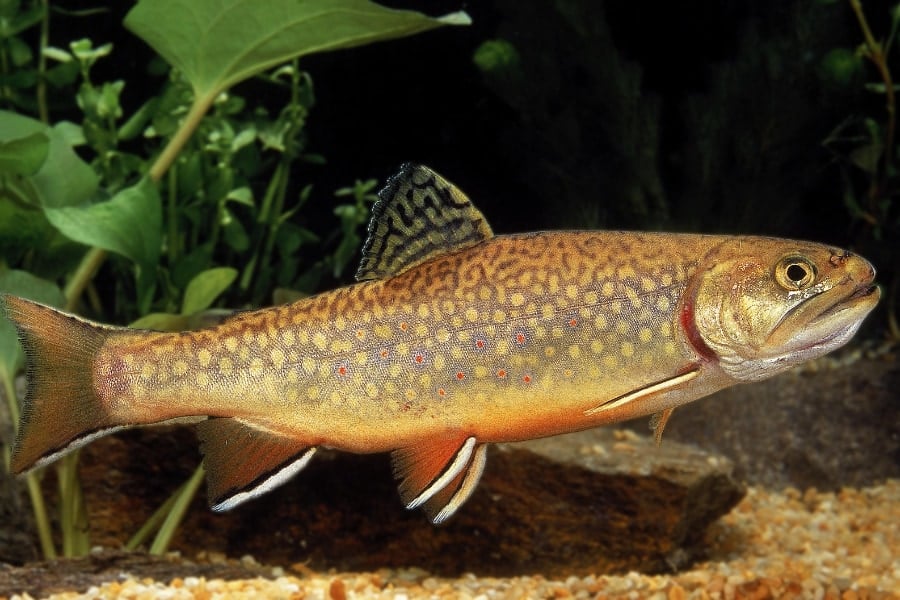
The fish that fights back
Brook trout were not supposed to be in western North America. They belong to the Appalachian corridor, and in the late 1800s someone thought it would be fun to drop them into Idaho streams for sport fishing. It was. For a while. Then the real trouble began.
Brook trout outcompete native cutthroat and westslope grayling for food and spawning grounds. They hybridize with those species, swamping their genetics. And they reproduce faster than you can sweep them out of a river. By the early 2000s, the Idaho Department of Fish and Game had spent decades trying to push brook trout out of designated native trout waters using two tools: electrofishing and rotenone, a broad-spectrum fish poison. Both worked locally. Both failed strategically.
Electrofishing reaches perhaps a kilometer per day and misses the deep pools where brook hold over winter. Rotenone kills everything in the treatment zone — native fish included — and the compound degrades before it clears the watershed. Meanwhile brook trout get faster at reproducing as their numbers drop, a classic compensatory growth response that turns every cull into a recruiting event.
The math was brutal. You could remove 90 percent of the fish in a reach and within three years the survivors would rebuild the population. It was like trying to clean a house by sweeping dust under the rug.
The YY solution
In 2008, researchers at the department’s hatchery system tried a different equation. Instead of killing the fish already in the water, what if they changed the next generation?
Brook trout, like most fish with genetic sex determination, use an XX female, XY male system. A normal male carries one X and one Y and passes either to his offspring. Cross a normal male with a wild female and you get roughly equal numbers of sons and daughters — the population replaces itself.
But what if the male carried two Y chromosomes — a YY supermale? He would pass Y to every single offspring. Mated to a normal XX female, the result is 100 percent XY sons. No daughters. No future brood stock. The population stops replacing itself the moment those YY fathers enter the gene pool.
The concept is elegant. The execution required turning a hatchery operation inside out. Producing YY males meant selecting from a population where the trait is vanishingly rare — something like one in several thousand fry — then fixing it through controlled crosses and marker-assisted selection. The hatchery team used a hormone-induced feminization trick to create pseudo-females from XY genetics, then crossed those with normal males to concentrate the Y chromosome. By 2011, they had a stable line of YY supermales.
Releasing them was the harder question. The Idaho Fish and Game program chose a small headwater tributary in the Salmon River basin, a place where brook trout had pushed cutthroat to the edge. They stocked it with YY males at a density calculated to ensure every wild female would encounter at least one supermale during spawning season.
Then they waited.
The six-year test
The computer models predicted that after an initial period of rapid decline, the population would hit a wall. With no females being born, the last wild females would age out. Once they died — typically around five to seven years for brook trout in Idaho waters — the population would collapse because there would be no one left to lay eggs.
That prediction held. At the six-year mark, the department reported zero female brook trout in the treatment reach. The remaining population consisted entirely of males — normal XY males sired by YY fathers crossing with the last generation of wild females. Those males would never produce daughters. Without intervention, the lineage would continue indefinitely as all-male fish. But the department chose not to let that happen. They ran a final rotenone treatment to clear the residual males and restock the reach with native cutthroat from their own hatchery program.
The result was a river that, six years after the first YY release, contained no brook trout at all. The native population was recovering. It was, by every available metric, a total elimination.
Why this matters beyond Idaho
The brook trout story is important because it demonstrates something that population biology has wrestled with for decades: you can drive an invasive species to local extinction without wiping out the ecosystem in the process. Rotenone is a sledgehammer. YY supermales are a scalpel. Both remove the target. Only one leaves the rest of the river intact.
That distinction matters in places where native fish hang by a thread. The same logic applies to killer algae in Australian reefs, to lionfish in the Caribbean, to cane toads in Australia — any case where the invasive organism reproduces fast enough that conventional control can never keep pace. Sex-ratio distortion is, in principle, a self-sustaining strategy once established. You do not need to keep treating the river forever; you need one well-timed pulse of supermales and the mathematics do the rest.
The Idaho program does not claim self-sustainability in the wild. Each year they release new YY males because the trait does not persist — a YY male crossed with a wild female produces XY sons, not YY grandsons. The program requires annual stocking, at least until the brook population is close enough to zero that a single release eliminates the remainder. That is a feature, not a bug: it means the genetic modification does not escape into the broader gene pool. There is no risk of YY fish establishing themselves in a non-target river. The modification is strictly contained by the release protocol.
The ethical geometry
A technique this effective will draw criticism. Some conservationists argue that releasing genetically modified organisms — even ones modified by selective breeding rather than transgenic engineering — crosses a line. Others worry about precedent: if you can engineer a sex distortion trait into brook trout, why not into something more dangerous, like an invasive mosquito or a pathogen vector? The ethical question is not whether the technology exists. It is whether we have the judgment to use it.
The counter-argument, offered by the researchers who spent fifteen years on this project, is simpler. The alternative is letting invasive species win. Brook trout in western Idaho are not a natural part of the ecosystem. They are an introduced competitor that has driven cutthroat trout to extinction in entire watersheds. The choice is not between a modified fish and a pristine river. The choice is between a modified fish and an empty one.
What comes next
The Idaho results have attracted attention from fisheries agencies in New Zealand, Australia, and Europe, where brook trout and related salmonids have been introduced and caused similar damage. The technique is not limited to trout. Most salmoniform fishes share the same XX/XY system. Sex-ratio distortion could, in principle, be adapted to brown trout in European rivers, rainbow trout in Great Lakes tributaries, or char species across the Northern Hemisphere.
The technical barriers are modest. The biological barriers are larger: YY males may have reduced fitness compared to XY males, which would slow the spread of the trait. The Idaho team addressed this by selecting for robust YY lines in the hatchery, and field data suggests their fish perform competitively. Whether that holds in different environments remains an open question.
What is clear is that the Idaho project solved a problem that conventional methods could not. Six years after the first release, there were no female brook trout left in a river where they had been impossible to eradicate by any other means. That is not a small result. It is a new tool in the conservation toolbox, and it changes the calculus for every agency that has ever watched an invasive species rebuild itself the moment they turned off the electrofishing boat.