Tesla Just Proved Robotaxis Can Run Without LiDAR — and That Changes Everything
Tesla's first commercially deployed Cybercab fleet in Austin clears a critical market threshold — and its camera-only sensor strategy either exposes a cost advantage over competitors or a dangerous gamble. The stock reaction tells you which way Wall Street is leaning.
The Number That Matters Was 45
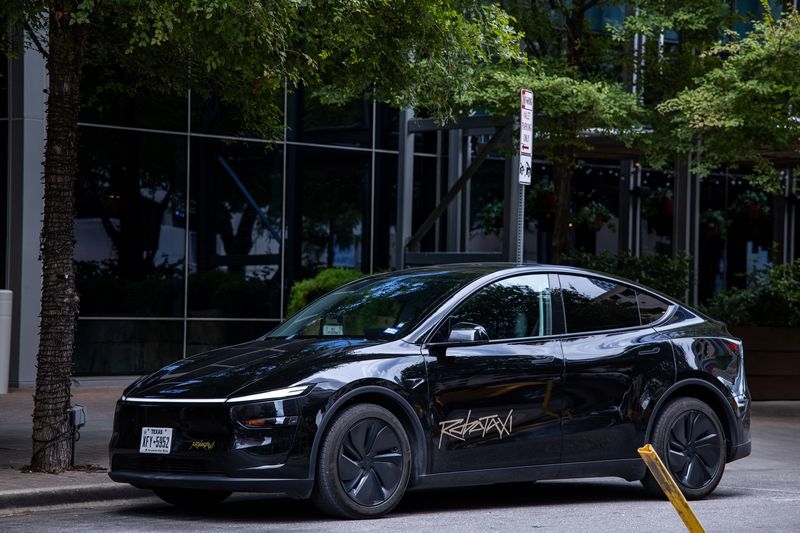
Tesla registered 45 Cybercabs for commercial operation in Austin. The market was waiting for exactly this threshold. Analysts at Piper Sandler said 25 to 50 units would be the line between meaningful deployment and theatrical demo — anything less and investors would start pricing in a longer wait for scale, anything more and the robotaxi thesis gets real backing. The stock closed 5 percent higher the day after the announcement, after already gaining 18.2 percent in August on anticipation.
The total Tesla fleet operating in Texas now stands at 420 vehicles, but only 45 of those are purpose-built Cybercabs with no steering wheel and no pedals. The rest are modified Model Y units running with safety operators still onboard. That distinction matters. The Cybercab deployment marks Tesla’s transition from prototyping autonomy to operating a dedicated robotaxi service — and it makes Tesla the second company in the US to run commercially deployed driverless vehicles, joining Waymo ahead and Zoox behind.
What makes this moment distinct from prior announcements is the absence of fanfare. Musk has repeatedly projected timelines that slipped — the Optimus humanoid robot debut shifted from 2024 into 2025, the Cybercab was initially unveiled in 2024 but stalled before hitting streets. The Austin rollout arrived without a keynote spectacle, suggesting Tesla’s autonomy team moved from a marketing-driven cadence to an engineering-driven one. That shift itself is a signal: the company is prioritizing operational data over narrative momentum.
The 45-unit fleet represents roughly $1.8 million to $2.7 million in hardware value at Cybercab’s stated sub-$30,000 target price point. It is modest capital deployed against a market that Waymo alone values at up to $250 billion by 2030 according to Goldman Sachs projections. The asymmetry — minimal spend, enormous potential upside — is precisely what attracted the stock’s gain.
No LiDAR Is the Bet, Not the Bug
The Cybercab carries no LiDAR. No radar. No visible sensor array beyond cameras. Tesla is going all-in on a vision-only approach powered by its neural-network inference stack, the same architecture that has powered Full Self-Driving since 2023. The engineering rationale is straightforward: LiDAR units from established suppliers run between $5,000 and $15,000 per vehicle at current volumes. Removing them collapses a significant slice of per-unit cost.
But the implications run deeper than unit economics. The vision-only strategy forces Tesla to solve the full stack — perception, prediction, planning — with fewer safety nets. A LiDAR-equipped vehicle can fall back on geometric precision when camera interpretation falters: a pedestrian silhouetted against a bright sky, debris scattered across a lane, an intersection where traffic signals conflict with actual right-of-way conventions. Without that backup, every edge case must be handled purely through learned patterns from visual data. The system either masters those patterns or it doesn’t.
Waymo’s fleet runs on a multi-sensor stack precisely because it accepts the cost premium in exchange for reliability across edge cases. Tesla is betting that scale and software maturity will close that gap faster than the hardware can justify the expense. The company has accumulated over 3 billion miles of real-world driving data from its consumer FSD fleet — data that no competitor can match in volume, even if Waymo may lead in quality-controlled miles. Whether volume compensates for the lack of sensor redundancy remains the central unanswered question.
If the bet pays off, Tesla’s robotaxi economics become impossible for competitors to match without their own LiDAR elimination. If it fails, every failure mode that a LiDAR-equipped vehicle would have caught becomes a public incident. The first high-profile collision involving a Cybercab would not simply damage Tesla’s stock — it could trigger regulatory backlash that stalls the entire autonomy push for years.
The second-order effect extends to the broader sensor industry. Velodyne, Luminar, and Mobileye have built trillion-dollar market expectations on the premise that autonomous vehicles require multi-sensor stacks. A successful vision-only robotaxi deployment at scale would devalue that thesis and redirect capital toward camera manufacturers and neural-network inference providers. Tesla’s approach, if validated, effectively reshapes the supply chain for the entire autonomous vehicle sector.
The Regulatory Window Is Opening
The National Highway Traffic Safety Administration is simultaneously proposing to eliminate the requirement for manual steering controls on autonomous vehicles sold in the US. Under current regulation, vehicles without pedals or a steering wheel can apply for an annual exemption limited to 2,500 units. NHTSA’s proposed rule change would remove that constraint entirely, clearing the path for mass-market production of driverless vehicles.
Tesla has not yet filed a separate exemption application for the Cybercab, according to an NHTSA spokesperson. The agency says it is monitoring the situation closely. That gap between policy intent and formal approval is where the near-term uncertainty lives. If NHTSA finalizes its proposal before Tesla’s Cybercab fleet faces its first serious safety incident, the regulatory tailwind becomes a structural advantage. If an accident occurs before the rule change is codified, the agency could reverse course and throttle the program.
There is a second regulatory dimension worth noting. California, where Waymo operates its largest fleet, requires autonomous vehicle operators to disclose crashes and publish safety reports. Texas does not impose the same transparency requirements on companies operating within its borders. Austin’s deployment therefore benefits from a regulatory environment that is both permissive and opaque — favorable for rapid iteration, less favorable for public confidence.
The federal government’s posture is equally consequential. The Trump administration has signaled support for accelerating autonomous vehicle approvals, framing them as a competitive necessity against Chinese EV makers. Congressional pressure on NHTSA to move quickly is likely. If the manual-control exemption is finalized before 2026, Tesla stands to capture the largest regulatory window any automaker has ever faced.
Who Wins, Who Loses, What Comes Next
Tesla wins if the 45-unit Austin fleet runs cleanly for three to six months. Clean operation builds the dataset, validates the cost structure, and pressures regulators to accelerate the manual-control exemption. The stock already priced in some of this optimism — the 18 percent August gain suggests the market was not surprised by the deployment. What remains to be proven is whether the company can scale from 45 Cybercabs to hundreds in a single market, and whether it can sustain operations without a safety driver for extended periods.
Waymo loses if the camera-only approach proves viable at scale. Waymo’s entire competitive moat rests on sensor redundancy and reliability data accumulated over millions of miles. If Tesla demonstrates that a vision-only fleet can achieve comparable safety at a fraction of the hardware cost, Waymo’s premium positioning becomes a liability, not an advantage. Zoox faces the same pressure — its Amazon-backed fleet is also LiDAR-heavy and currently operating at far smaller scale than both Waymo and the emerging Tesla network.
Uber and Lyft lose the most. Both companies have invested billions in autonomous vehicle partnerships and software development, yet neither has a proprietary vehicle platform. Uber’s partnership with Waymo operates in a handful of cities. Tesla’s Cybercab is an owned fleet with owned software and owned hardware — a vertically integrated model that undercuts the platform-dependent approach entirely. If Tesla achieves national robotaxi coverage at sub-$30,000 per unit, ride-hailing platforms become distributors, not operators. The entire business model that Uber built on the back of independent contractors faces an existential threat from a company that owns both the labor substitute and the vehicle.
The competitive pressure will extend beyond transportation. A functional robotaxi network generates data advantages that compound across adjacent markets — logistics, delivery, mobile retail. Tesla has already indicated that the Cybercab platform could be adapted for autonomous delivery. The same camera-only stack that moves passengers could move packages, groceries, and parcel deliveries at costs that legacy logistics companies cannot match.
Elon Musk’s original timeline — half the US covered by end of 2025, Cybercab priced below $30,000 — remains unmet. Tesla has production capacity for more than 125,000 Cybercabs annually. Meeting that output target while maintaining safety standards and regulatory compliance is the gap between promise and delivery.
The Austin deployment is not the finish line. It is the first time Tesla has moved from test vehicles with safety operators to a dedicated, publicly callable fleet. The next six months of incident reports, rider experience data, and regulatory filings will determine whether this was a turning point or a prelude. If the Cybercab fleet accumulates a million revenue-generating miles without a reportable incident, the autonomy race shifts decisively toward Tesla’s approach. If the first month produces a string of near-misses or public collisions, the story changes tone dramatically — and the market will begin repricing the robotaxi thesis from opportunity to risk.