Tesla's Robot Factory Is Now Real — What It Means for Automation
Tesla has begun early production of Optimus humanoid robots in its former EV assembly lines in Fremont, California. The milestone matters far beyond Silicon Valley: it signals the start of a genuine commercialization race in humanoid robotics, with second-order implications for manufacturing, labor economics, and the future of physical work worldwide.
A Factory Line Remade
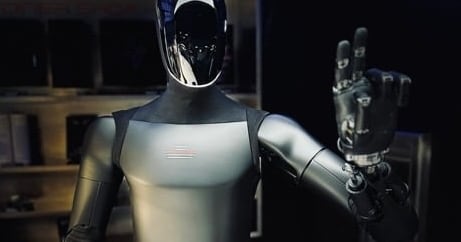
Tesla has started building its Optimus humanoid robots on the factory floor in Fremont, California — the same site where it once assembled Model S and Model X sedans and SUVs. The company confirmed the milestone in its Q3 earnings release on October 21, framing it as the beginning of a new era in its manufacturing portfolio. Robot production does not yet mean commercial delivery, but the fact that hardware is moving off a line at all marks a decisive step from prototype to product.
Elon Musk described the robots coming out of this line as the first that meet mass production quality standards, and said the manufacturing process has been validated for commercial product output. He also acknowledged that the company still has work to do: hardware will keep improving, the production process will be refined, and current output sits in what Tesla called an early ramp-up phase before full-scale volume production begins.
The path from here to a commercial product is not short. Musk said Tesla aims to start delivering Optimus to external companies around the end of 2027. Reaching a production rate of roughly 20,000 units per week is expected to take about a year from the current baseline, with supply chain build-out and design changes identified as remaining bottlenecks.
The physical space itself tells part of the story. The Fremont facility, sprawling across roughly 5.3 million square feet, has undergone quiet but significant reconfiguration over the past two years. Sections once occupied by legacy vehicle tooling have been repurposed to accommodate robotic assembly workstations, sensor calibration rigs, and what Tesla internally refers to as “deployment readiness labs” — areas where early-unit Optimus bots are put through repeated stress tests that simulate months of factory floor wear in compressed timeframes.
The Real Challenge Isn’t Making the Robot
Building the hardware is only part of the problem. The harder question, and the one Musk flagged most pointedly, is durability. A robot that falls apart after a month on the job is not a product — it is an expensive prototype. Musk said the design must be refined until Optimus can work reliably and safely in real industrial environments, emphasizing that reliability and longevity are non-negotiable for commercial adoption.
One specific pain point he highlighted was the robot’s hands. Manufacturing durable, precise manipulator hands at scale remains a major engineering hurdle, and early production ramp-up is unlikely to be smooth. This is not abstract: hand design is the intersection of dexterity, cost, and wear resistance, and getting it wrong means robots that cannot perform the tasks they were built for. Early iterations of the Optimus hand used a tendon-driven mechanism that showed promise in lab settings but struggled with force modulation — the robot could grip too hard or slip unpredictably, both failure modes that would be unacceptable on a live factory floor where human coworkers operate nearby.
Then there is the question of how robots learn to do actual work. Unlike vehicles, which accumulate vast datasets through billions of miles driven on public roads, humanoid robots do not yet have a comparable natural data pipeline. To address this, Tesla is building what it calls the Optimus Academy — a system for training robots across a range of tasks through structured practice and data collection. Musk noted that the absence of a large-scale, real-world operation like a vehicle fleet is a structural difference that makes training data harder to gather and validates why the commercialization timeline is longer than a simple hardware build would suggest.
What the Academy represents is a deliberate attempt to solve a problem that has plagued the broader robotics industry: the gap between controlled demonstration and unstructured real-world operation. A robot that can fold laundry in a staged video does not automatically know how to handle a crumpled t-shirt on a cluttered bin. The data problem extends beyond dexterous manipulation — it covers locomotion over uneven terrain, fall recovery, interaction with unpredictable human environments, and what engineers call “edge case resilience”: the ability to handle situations the robot was never explicitly trained for.
What This Signals for the Robotics Race
The announcement carries weight beyond Tesla itself. Humanoid robotics has been talked about for years across the industry — Boston Dynamics, Figure, AgiBot, Unitree, and others have all shown prototypes and made promises. Tesla’s decision to retool an existing car line rather than build a dedicated robotics facility signals that it now views Optimus as a core business, not a side project. That commitment changes the calculus for everyone else in the space.
There is a financial implication as well. Tesla’s market valuation has long been tied to its automotive business, and the pivot toward robotics introduces a potential second major revenue pillar. Even modest Optimus sales could meaningfully shift investor expectations. Analysts who have tracked the announcement note that the mere fact of a converted assembly line — one that already has unionized workers, quality assurance protocols, and a parts supply chain — gives Tesla a structural advantage over startups that must build manufacturing capability from scratch. The capital expenditure required is lower because the infrastructure already exists; the remaining investment goes toward retooling rather than ground-up construction.
The broader implication is a shift in how manufacturing and automation economics may evolve. If Tesla can produce a general-purpose humanoid robot at a price and durability level that works in factories, warehouses, and eventually homes, the unit economics of physical labor change fundamentally. That is not hyperbole: humanoid form factors are attractive precisely because they fit into spaces designed for human workers without requiring wholesale infrastructure redesign. Stairs, doorways, tool mounts, control panels — all designed to human scale — become immediately usable. This is why the robotics industry has circled back to the humanoid form despite its complexity. The alternative, specialized robots, require custom engineering for each environment and cannot migrate between tasks.
For the automotive industry, the irony is stark. Tesla used its own factories as proving ground for mass-producing EVs at low cost, and that same discipline is now being applied to robots. The Fremont line, once dedicated to premium sedans and SUVs, now produces machines that may one day work inside those very factories. Some of the early testing has already fed back into vehicle production: Optimus units have been used for internal material handling and quality inspection tasks, creating a closed loop where the robots improve the factory that builds them.
Second-Order Effects Nobody Is Talking About Yet
The most interesting implications of this milestone extend well beyond the robotics industry itself. One area receiving surprisingly little attention is the supply chain ripple effect. Tesla’s move into humanoid robot production at scale will create demand for components that have historically been niche: harmonic drives, force-torque sensors, high-reduction gearboxes, and custom actuators. These are the same components used in industrial robotic arms, but the volume required for tens of thousands of humanoids per year — as opposed to hundreds of specialized arms — will push them toward commodity pricing. That price compression benefits not just Tesla but every company building robots of any kind, potentially lowering barriers to entry across the entire sector.
A second underappreciated effect involves workforce dynamics. Tesla’s hiring pattern at Fremont has already begun to shift. The company is recruiting more software engineers, machine learning specialists, and robotics technicians alongside traditional manufacturing roles. This mirrors a broader trend seen in industries that have undergone automation transitions: the net job count does not necessarily collapse, but the skill composition changes dramatically. Workers who can adapt to programming, maintaining, and collaborating with robotic systems tend to retain employment; those whose roles are fully displaced face a steeper transition. The policy implications are significant, particularly in regions where automotive manufacturing has been a primary employer.
There is also a geopolitical dimension. China-based robotics companies like AgiBot and Unitree have moved quickly on hardware, and China’s state industrial policy treats humanoid robotics as a strategic priority comparable to semiconductors. Tesla’s factory milestone reasserts American competition in a domain where the balance of influence could shift depending on who achieves commercial-scale production first. The 2027 delivery target is not just a corporate deadline — it is effectively a race against a timeline that other governments and companies are treating with equal urgency.
The Timing and the Stakes
Late 2027 is Musk’s target for first external deliveries. That gives Tesla roughly 18 months to solve the remaining engineering problems: hand durability, training data scale, supply chain depth, and production rate ramp. If Tesla hits those targets, it will have validated the commercial viability of humanoid robots in a way no other company has. If it misses, the window for first-mover advantage narrows considerably.
The stakes extend beyond one company’s balance sheet. A successful Optimus deployment would accelerate automation investment across manufacturing, logistics, and services globally. It would also intensify debates about labor displacement and the economics of physical work — debates that are already underway in countries like South Korea and Japan, where aging populations and tight labor markets make automation a strategic priority. South Korea, for instance, already has the highest robot density in the world, yet its birth rate continues to fall, making humanoid robots a logical next step in the country’s automation trajectory. Japan faces a similar demographic arc with even steeper projections.
Perhaps most importantly, Tesla’s announcement changes the narrative around humanoid robotics from speculation to execution. For years, the category has been defined by demonstration videos and ambitious timelines that routinely slipped. The conversion of an actual factory line into a robot production facility — with earnings-call disclosure, public acknowledgment of remaining challenges, and a concrete delivery target — represents a qualitative shift in credibility. It does not guarantee success. But it does mean the question is no longer whether humanoid robots can be manufactured at scale, but whether they can be made reliable enough, affordable enough, and smart enough to earn their place in real workplaces.
What Tesla has done so far is prove that a factory line can be converted from car assembly to robot assembly and start producing machines at quality levels intended for commercial use. That is the milestone. What comes next — durability, training, supply chains, and real-world deployment — is the work. The race is no longer hypothetical. It is now moving, and the finish line is closer than most people realized.