This Star Could Prove Einstein Right or Wrong
A star hurtling around the Milky Way's black hole at 8.5% the speed of light is giving astronomers their best shot yet at measuring the hole's spin and testing one of general relativity's toughest predictions.
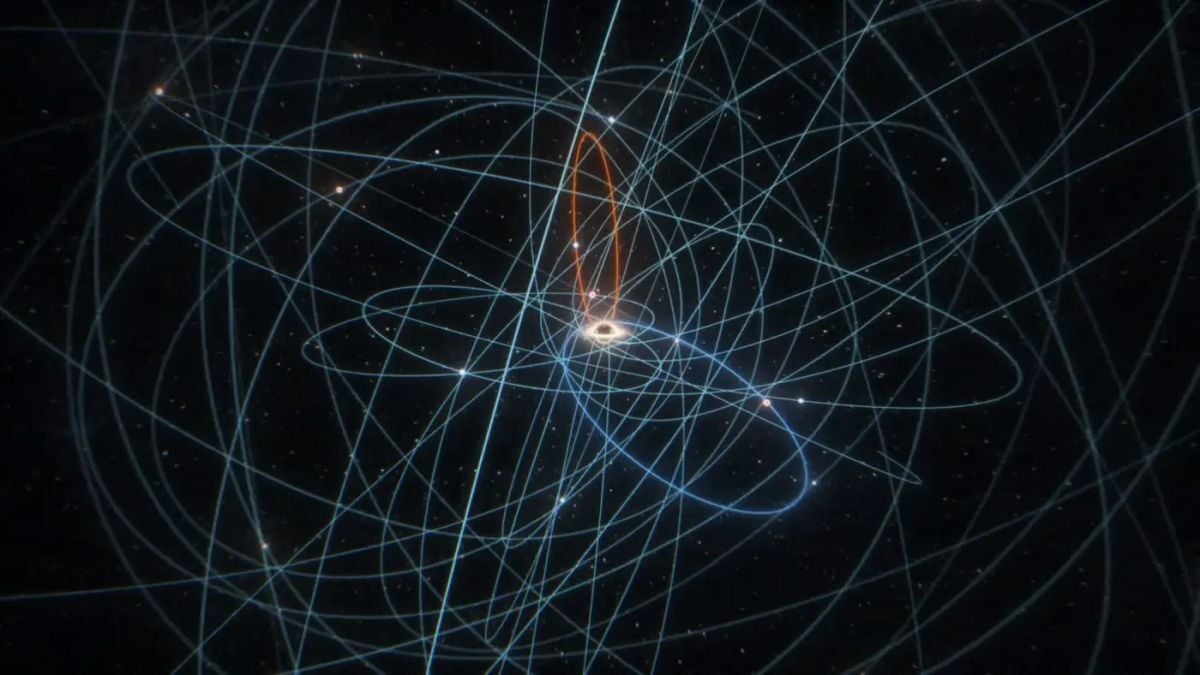
The closest anyone has come to a black hole
S301 is not a new telescope, algorithm, or particle collider. It is a single star, roughly the mass of our Sun, careening through the gravitational maelstrom at the heart of the Milky Way at 25,000 kilometers per second — 8.5 percent of light speed.
That may sound like an abstract achievement until you consider where it happens. S301 swings within roughly 10 times the distance that S2, the previous record-holder, comes to Sagittarius A*, the 4.3-million-solar-mass black hole at our galaxy’s center. Pericenter puts S301 deep inside the regime where Einstein’s general relativity makes its strangest predictions: spacetime itself is stretched, twisted, and dragged around the spinning black hole like taffy on a rod.
A paper in Nature this week from the GRAVITY+ collaboration describes the star’s orbit. What makes it matter is not just the speed. It is the proximity, the short orbital period of 8.7 years, and the fact that the next pericenter pass arrives toward the end of 2031 — close enough in human time that we may have real answers by decade’s end.
Why speed is not the story
Headlines will fixate on 8.5 percent of light speed. That number is dramatic, yes. But the physics that matters here is not velocity for its own sake. It is how deep S301 probes the curvature of spacetime around Sgr A*.
For decades, astronomers have used stars orbiting the galactic center as natural probes. S2, discovered in the late 1990s, delivered the first clean measurements of gravitational redshift and Schwarzschild precession around a supermassive black hole — two effects predicted by general relativity. Those were real confirmations, but they tested only the weakest part of the theory’s prediction for an object this massive. They did not touch the spin.
Spin changes everything. A rotating black hole drags the fabric of spacetime around with it, an effect called frame-dragging or the Lense-Thirring effect. That dragging should leave a subtle imprint on S301’s orbit — a shift in the orientation of the orbit’s ellipse over time, an asymmetry you cannot explain by mass alone. Measuring that shift is the only realistic path to determining Sgr A*’s spin, and spin is the second knob you must turn to test one of general relativity’s boldest claims.
The no-hair bet
Black holes, in Einstein’s theory, are terrifyingly simple. The no-hair theorem says that once you know a black hole’s mass and spin, its entire gravitational field follows. There is no room for extra structure, no hiding place for complications. Everything else — what fell in, how it fell in, the shape of the accretion disk — is radiated away or swallowed, leaving only mass and spin.
That sounds elegant. It is also extraordinarily hard to verify. We have never measured the spin of a supermassive black hole directly. X-ray observations of accretion disks give indirect estimates for some active galactic nuclei, but Sgr A* is too quiescent for those techniques to work well. Dynamical measurements from stellar orbits are the only game in town, and S301 is the first star sharp enough to make it.
If S301’s orbit matches the precession general relativity predicts for a black hole with the measured mass and inferred spin, the no-hair theorem gains a formidable new test at the supermassive end of the mass scale. If the orbit deviates — if the quadrupole moment, the measurable departure from a perfect monopole-plus-dipole field, does not line up — then either our understanding of gravity is incomplete or Sgr A* carries hair we did not expect.
Felix Mang of the Max Planck Institute for Extraterrestrial Physics put it plainly to ScienceAlert: mass is known to sub-percent precision. Spin is the next step. Then the quadrupole. Then the theorem is tested.
How we get there
The clock is ticking, but not urgently. S301 reaches pericenter again late in 2031. That is when frame-dragging effects peak, and when the data will be most discriminating. The GRAVITY+ interferometer at the Very Large Telescope in Chile is already tracking the star. The upcoming MICADO instrument on the Extremely Large Telescope should add three-dimensional motion reconstruction, turning positional measurements into a full orbital solution.
One detail matters more than it appears. The observable size of the frame-dragging signal depends on the relative orientation of Sgr A*’s spin axis and S301’s orbital plane. If the alignment is unfavorable, the effect is smaller and harder to isolate. That is why Mang’s remark about finding another star like S301 is not just optimism. A second probe with a different orbital geometry would break the degeneracy and tighten the spin measurement substantially.
There is also the possibility that S301 arrived here violently. Its extremely elongated orbit is consistent with the Hills mechanism, in which a binary star system wanders too close to the black hole, gets torn apart, and one member is captured while the other is ejected at high speed. Finding S301’s former companion hurtling away from the galactic center would strengthen that case. The orbit alone cannot confirm it.
Who wins, who loses
Astronomers win. This is the kind of discovery that redefines what is measurable. For the first time, we have a probe dipping deep enough to turn a long-standing upper limit on black hole spin into a real measurement. The no-hair theorem, usually discussed in theory papers, becomes an empirical question with an answer coming in the next decade.
General relativity does not lose here unless the data disagree with its predictions. And even then, a deviation at this scale would be more valuable than a confirmation, because it would point the way toward quantum gravity or a modification of gravity in strong fields. Either outcome advances the field.
The broader public loses nothing and gains something rare: a concrete reason to care about the center of the Milky Way. Sgr A* is 26,000 light-years away, obscured by dust, and effectively invisible to optical telescopes. It sounds distant and irrelevant. But S301 proves that the galactic center is not just a dark point in the sky. It is a laboratory where spacetime behaves in ways we can watch, measure, and test — using stars as probes the way particle physicists use colliders.
What happens next
Watch 2028 to 2032. That is when the GRAVITY+ and MICADO teams will accumulate the observations needed to separate the frame-dragging signal from other orbital effects. If the data support general relativity, the no-hair theorem survives another round. If they do not, the implication is enormous.
Either way, the discovery of S301 changes the question. We are no longer asking whether we can measure the spin of a supermassive black hole dynamically. We are asking when.
The answer should arrive before the decade is out.