Toyota Bought Chinese Parts While Its Own Suppliers Watch From the Sidelines
Toyota is ordering its next-generation EV components from Chinese suppliers, leaving Japanese partners behind. The cost gap is structural, not temporary — and it reveals what Western analysts keep missing about China's automotive supply chain.
The Contract That Tells the Whole Story
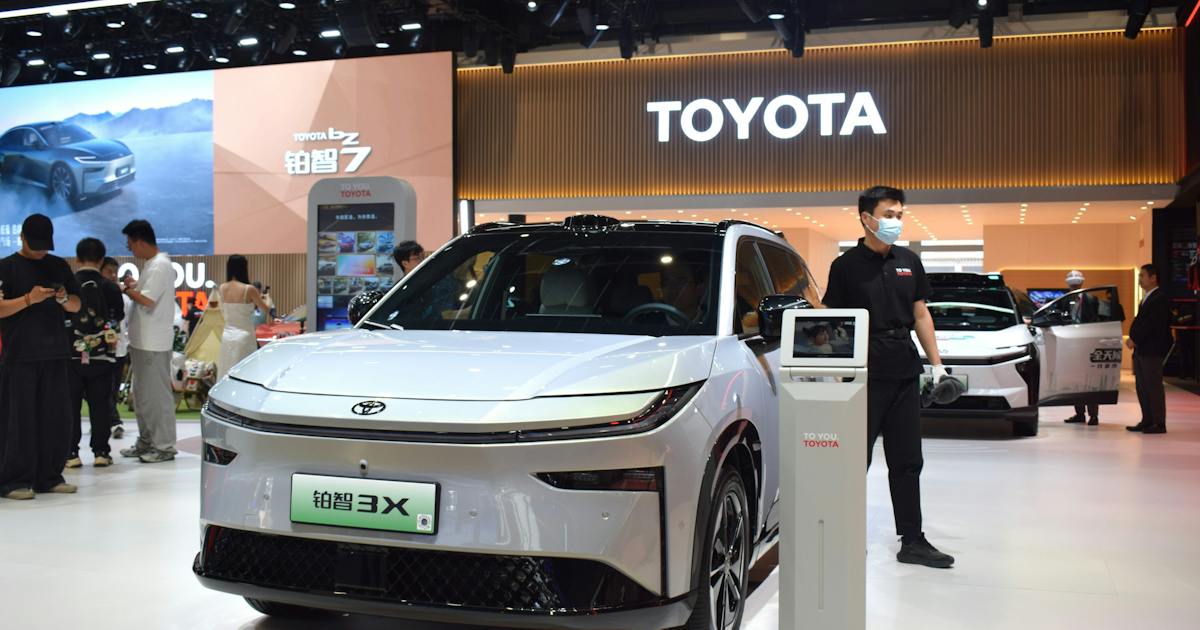
A Chinese auto-parts manufacturer sent a New Year greeting in early 2026 that read like a victory lap. It noted, matter-of-factly, that the company had won a major project tied to Toyota’s Lexus “761D” next-generation electric vehicle program. The same company manufactures control cables — the kind of unglamorous, high-volume component that sits in every modern car and rarely draws attention. But this particular win exposed something far larger than a single contract: Toyota’s Chinese-made EVs, launching in late 2027, are being built with core components sourced from Chinese suppliers. The Japanese firms that spent decades building those parts alongside Toyota are watching from the outside.
This is not an anomaly. It is a structural shift that Western coverage of the auto industry has yet to fully acknowledge.
Why Chinese Suppliers Beat Japanese Ones on Price
Shingo Yu, a senior researcher at MUFG and visiting professor at Shanghai University of Engineering Science, traced the root cause to a fundamental difference in cost structure. Japanese suppliers operate on a fixed-cost model built around the keiretsu system. Quality-assurance teams, dedicated testing equipment, internal certification processes — all of these sit on the balance sheet whether production volumes justify them or not. Each bid carries that overhead, making price reductions nearly impossible on a project-by-project basis.
Chinese suppliers rebuilt their cost model around variable expenses. Rapid prototyping, shared production lines, and outsourced engineering let them restructure costs for each new project. The difference shows up in tender documents as a single-digit percentage gap — sometimes 20 to 30 percent — between the Japanese and Chinese quotes for the same part. In a market where margins on EV components are already razor-thin, that gap is decisive.
The implications extend beyond any single component. When a Chinese supplier can undercut a Japanese rival by that margin on control cables, the same dynamic applies to battery management systems, power electronics, thermal management modules, and increasingly sophisticated interior wiring harnesses. Each category that moves to Chinese sourcing erodes the revenue base that Japanese tier-one firms depend on to sustain their fixed-cost operations — creating a feedback loop where the gap widens with every lost bid.
The Software-Defined Vehicle Problem
There is a second, deeper force at work. The industry is moving toward software-defined vehicles, and that shift changes where value lives in the supply chain. The traditional Japanese strength — precision machining, invisible quality, decades-long component refinement — no longer maps onto the new evaluation criteria. Value is concentrating in integrated systems, not individual parts. A supplier that once competed on micrometer tolerances now competes on how well its component talks to the rest of the car’s architecture.
Japanese firms are not absent from this transition. But their institutional DNA is built for the old world. Toyota itself seems to recognize this tension: the company’s next-generation EV sedan program was abruptly cancelled in May 2026, with related losses estimated in the hundreds of billions of yen, even though Toyota’s then-deputy president confirmed the underlying technology was complete. Resources are being redirected toward SUV variants. The pivot signals that Toyota is recalibrating — but recalibration is not the same as reversal.
The software-defined vehicle also changes the nature of supplier relationships. In a traditional assembly-line model, the buyer-supplier relationship is transactional and layered — Tier 1 supplies Tier 2, which supplies Tier 3. In a software-defined architecture, the boundaries blur. Chinese suppliers, many of whom were built around agile, flat organizational structures, are better positioned to engage directly with OEM engineering teams on integration questions. Japanese keiretsu suppliers, accustomed to multi-generational relationships mediated through long procurement cycles, find themselves answering to customers who expect rapid iteration and co-development timelines measured in weeks, not quarters.
The One Exception That Proves the Rule
Yu pointed out one area where Japanese and Chinese cost structures converged: joint-venture cable projects. In cases where standardization and mass-production economies had already been achieved through Sino-Japanese partnerships, the fixed-versus-variable cost gap had narrowed. Those collaborations worked because the cost problem had already been solved before the bidding process began. Everywhere else, the asymmetry remained.
This suggests the phenomenon is not about Chinese suppliers suddenly becoming cheap. It is about a cost model that was designed for a different era simply no longer competing on equal terms. Japanese suppliers are not being out-innovated so much as out-priced by a system that does not carry the same institutional baggage.
The JV exception is instructive for another reason: it demonstrates that the convergence is possible, but only after significant upfront investment and a willingness to restructure operations fundamentally. For the many Japanese suppliers without an existing JV framework in China, the path to competitiveness requires starting from scratch — which means absorbing losses on current orders while funding the transformation that would make future bids viable. It is a catch-22 that few firms have the balance sheet to endure.
The Ripple Effects Through Japanese Industry
The consequences of Toyota’s sourcing shift will not remain contained within the automotive sector. Japanese supplier firms that lose Toyota contracts will scale back operations, cut employment, and reduce capital expenditure — decisions that reverberate through regional economies in Aichi, Shizuoka, and Gifu prefectures, where supplier clusters form the backbone of local employment. These communities have depended on the steady flow of orders from Toyota and its keiretsu network for generations. When that flow reverses, the social and political costs become immediate.
Meanwhile, Chinese suppliers winning these contracts gain not just revenue but learning. Each component delivered to Toyota’s Chinese operation becomes a reference project — proof that a Chinese firm can meet the quality standards expected of a Japanese OEM. That provenance opens doors to additional contracts, both within Toyota’s own Chinese lineup and with other manufacturers seeking similar supply-chain diversification. The competitive advantage compounds.
There is also a geopolitical dimension that Western analysts frequently underweight. As Chinese suppliers deepen their technical relationship with Toyota in China, knowledge transfer flows in both directions. Toyota gains access to Chinese cost-structuring methods and agile development practices. Chinese suppliers absorb Toyota’s quality-management discipline and systems-integration experience. Over time, this exchange makes Chinese suppliers more competitive not just in cost but in capability — further narrowing any remaining gap in areas where Japanese firms previously held a qualitative edge.
What This Means Beyond China
Toyota’s move will reverberate well beyond its Chinese production lines. Every major automaker with a presence in China — Volkswagen, BMW, Mercedes-Benz, Honda, Nissan — faces the same calculus: source locally from suppliers who can bid flexibly, or import from Japanese partners who carry decades of embedded overhead. The trend is accelerating because the economics are clear, and the timeline is tight. China’s next-generation EV infrastructure is scaling fast, and the window for Japanese suppliers to compete on cost is narrowing.
The broader implication is uncomfortable for Japanese industrial policy. For years, Tokyo has treated China’s automotive rise as a competition between finished-car brands — BYD versus Toyota, NIO versus Lexus. The real shift is happening upstream, in the supply chain, where Chinese parts makers are absorbing roles that Japanese firms once held exclusively. The keiretsu system, long considered Japan’s competitive moat, is becoming a liability in markets where speed and cost flexibility outweigh lineage and long-term partnership commitments.
Japanese suppliers have a narrow path forward. Some are already exploring diversification into non-automotive sectors or new business models. Others will have to accept that their role in China’s EV ecosystem has changed from primary supplier to secondary partner. The firms that adapt quickly will survive. The firms that wait for the old order to return will not.
Toyota’s Chinese EV, when it arrives in late 2027, will not be a Japanese product built in China. It will be a globally designed vehicle using a supply chain that has already moved on.