Trump's B-2 Welcome for Xi Shows Washington Is Redefining Its China Play
Trump is staging the most elaborate military welcome for a Chinese leader in decades — B-2 bombers, F-22s, tech CEOs — revealing a transactional diplomacy that leaves Seoul scanning for signals about where Korea fits in a reordered Asia.
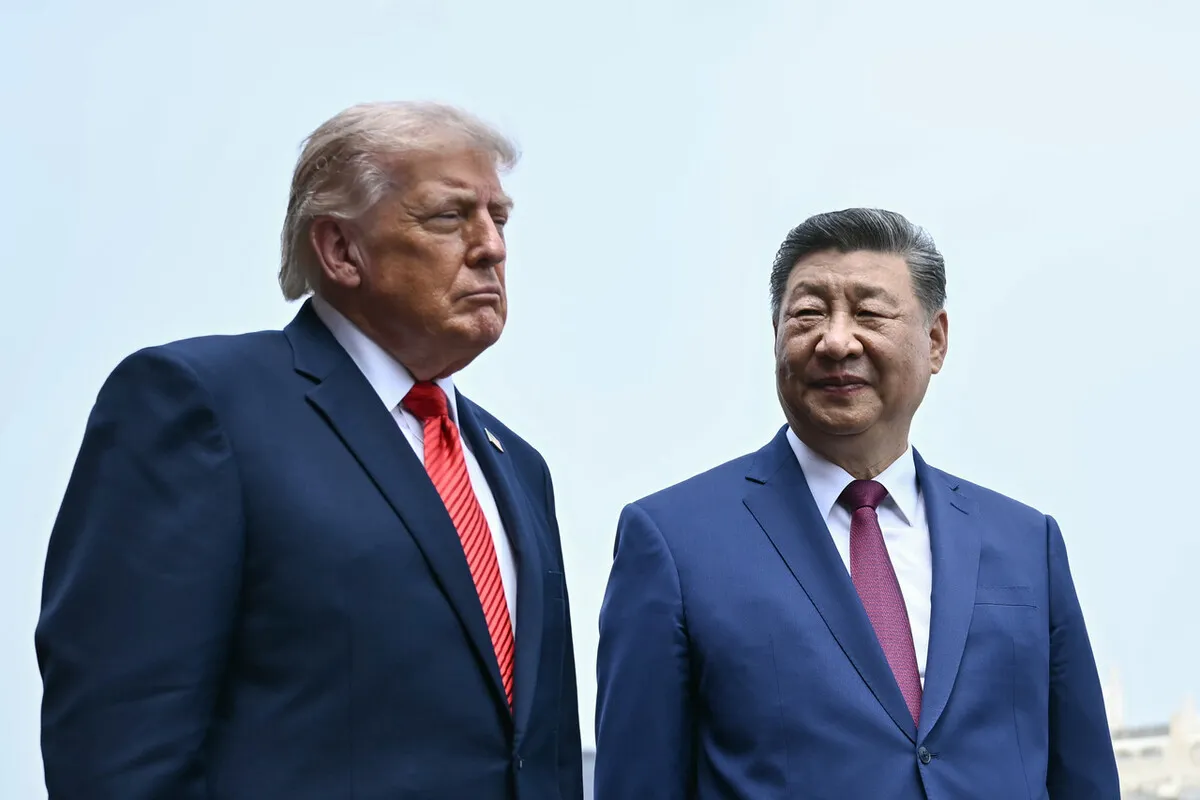
The B-2 Is the Real Message
When Donald Trump decided to greet Xi Jinping with a flyover of B-2 Spirit stealth bombers and F-22 Raptors over the White House, he wasn’t just arranging pageantry. He was deploying one of America’s most sensitive military assets as a diplomatic signal — and the optics traveled fast.
This was the same B-2 Xi got in Alaska last August, when Trump hosted Vladimir Putin. But the context matters: the Alaska meeting was a bilateral encounter in neutral territory, deliberately staged away from Washington. The White House welcome places the bomber squadron over the seat of American power itself, in full view of the press, the public, and every capital watching closely.
The military posture has not changed. The message has.
What the Schedule Actually Says
The itinerary, released by the White House on the 21st, reveals how deliberately this visit was constructed. Xi arrives at Andrews Air Force Base on the 23rd — where US presidents personally greeting foreign leaders is genuinely uncommon. The next morning brings a full state visit ceremony at the White House: 479 service members representing all branches, a Marine Corps band playing both national anthems, and the B-2 and four F-22s cutting across the sky above the South Lawn.
Then the meetings begin. Trade truce extension. Rare earth supply chains. Artificial intelligence governance. These are not decorative topics — they are the fault lines of the current US-China relationship, and they are the very issues where Washington and Beijing are most likely to reach temporary arrangements that shift regional alignments.
Melania Trump will join Peng Liyuan at the Smithsonian’s National Museum of Asian Art — the first formal encounter between the two couples since 2017. That detail matters because cultural diplomacy, however stylized, is part of the same architecture. So is the evening state dinner in the East Room, where the guest list reads like a roll call of American tech power: Jeff Bezos, Elon Musk, Sundar Pichai, Jensen Huang, Sam Altman, Tim Cook, Michael Dell.
The final day brings the Charters of Freedom at the National Archives — the Declaration of Independence, the Constitution, the Bill of Rights — with a special 1787 draft of the Constitution on display for the American founding semiquincentennial. Two leaders, two spouses, three days of carefully choreographed symbolism.
The Transactional Display
What makes this moment distinctive is not the scale of the welcome — state visits have always included military elements — but the specificity of what is being shown. The B-2 is a platform America guards closely. It flies rarely over US soil, and its deployment carries technological significance beyond its ceremonial role. Trump has now used it twice in as many months: once for Putin, once for Xi.
The pattern is clear. This is not deterrence through proximity. It is status through access. The bomber flyover functions as a visual shorthand for a relationship that Washington has chosen, in this moment, to frame as cooperative rather than adversarial — at least publicly.
For Seoul, the signal is worth parsing carefully. A B-2 over the White House is not a B-2 over Seoul. The implication is not threat; it is displacement. Washington is demonstrating that its most consequential diplomatic gestures toward Beijing now include military assets that Korea has never seen deployed in a comparable context.
What Washington Is Calculating
The agenda items tell the story. Trade truce extension signals that the tariff escalations of recent years are being wound back, at least temporarily. Rare earth supply is the concrete leverage point — China controls roughly 60% of global mining and 90% of processing, and any arrangement that stabilizes that flow has direct consequences for electronics manufacturing across Asia. AI governance is the newest frontier, and the presence of Altman, Huang, Pichai, and Cook at the state dinner is not incidental. It signals that Washington views technology competition with Beijing as something that can be managed through engagement rather than containment alone.
The timeline reinforces the reading. Xi’s last state visit to Washington was 2015, during the Obama administration. His last trip to the US was the 2023 APEC meeting in San Francisco. Six months separate the Beijing and Washington encounters. China’s foreign ministry called the exchange a “milestone of historical significance.” That language is not routine.
What Seoul Should Watch
The immediate question for Korea is not whether Trump is friendly toward China — he has been friendly toward Putin and Xi in equal measure — but what the terms of that friendliness require from allies who sit geographically closer to Beijing than Washington does.
Rare earths are the first test. Korea’s semiconductor and display industries depend on Chinese supply chains that run through the same minerals at the center of this discussion. Any US-China arrangement that stabilizes rare earth flows benefits Seoul directly. Any arrangement that ties Chinese supply to political concessions creates exposure Korea did not sign up for.
The second test is AI governance. The tech CEOs at the state dinner represent companies that operate in all three capitals. Their presence signals that Washington intends to shape rules through cooperation with Beijing, not exclusion. Korea’s tech sector, already integrated with both US and Chinese markets, will feel the downstream effects immediately.
The third test is the military calibration. The B-2 flyover is about optics, not operations. But optics matter in a region where every gesture is read as a shift in posture. Korea watches closely when Washington deploys strategic assets for diplomatic purposes — not because it fears the bombers, but because it wants to understand what they mean for the broader architecture of alliance management in the Pacific.
The Point Behind the Pageantry
Trump’s welcome for Xi is not a reversal of US-China competition. It is a redefinition of its surface. The B-2 flies, the tech CEOs gather, the Charters of Freedom are displayed — and behind all of it sits a simple calculation: cooperation on selected issues, competition on the rest, and no apologies for treating the relationship as transactional rather than ideological.
For Korea, the lesson is not that Washington has abandoned the alliance. It is that Washington has moved the alliance into a category where transactional logic applies to everyone equally — partners included. The B-2 over the White House is a gift to Xi. The question Seoul must answer is whether it is willing to accept the same treatment on the same terms, or whether it demands something different from a partnership that has, until now, rested on a foundation Trump has not yet declared outdated.