Trump's Deciding Mode and the Middle-Power Trap
As Trump oscillates between striking Iran and talking to Iran's president at the UN, South Korea and other middle powers face an impossible choice: back Washington and risk regional war, or hedge and risk American abandonment.
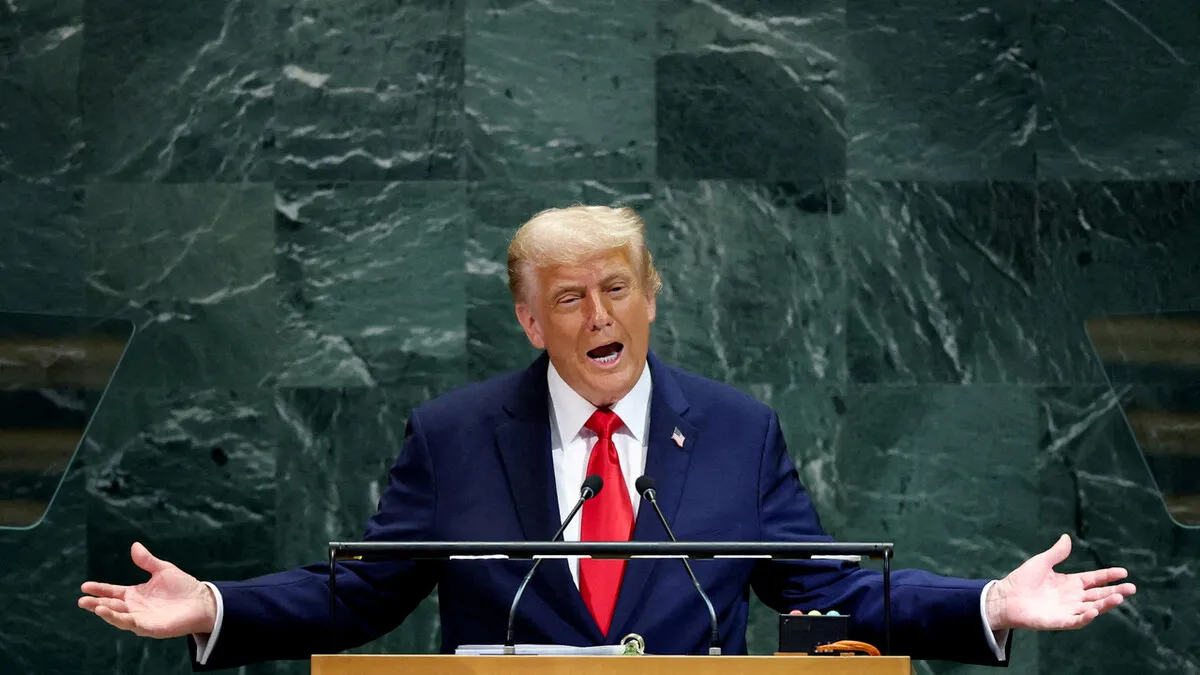
The deciding mode problem
Donald Trump told a Fox News correspondent he is in “deciding mode” on Iran. The three options on the table, according to that account: flatten the country militarily, suffocate it economically, or cut a deal. Trump’s own phrasing was less statesmanlike than most summaries allow — he reportedly asked himself whether he would “actually blow up the whole country” and warned the Iranians to “behave themselves.”
What matters less than the rhetoric, though, is the architecture around it. The United States has permitted Iran’s president, Masoud Pezeshkian, and his foreign minister, Hossein Amir-Abdollahian — wait, the source says Araghchi, so let me correct:Foreign Minister Hussein Amir-Abdollahian or rather Abas Araghchi depending on current lineup — to attend the UN General Assembly. Trump is scheduled to speak on September 22. Pezeshkian takes the podium the next day. That is not accidental scheduling. It is a signal that Washington is keeping one door open while pointing a gun at the other.
Iran responded to this posture with its own signal. The Khatam al-Anbiya Central Military Command — the Islamic Revolutionary Guard Corps’s unified operations branch — issued a statement claiming it had received intelligence that the United States had already decided to resume military strikes against Iran, allegedly in coordination with an unnamed European country. Iran warned that any attack would trigger sustained retaliation against US bases and assets across the Middle East, and that regional states cooperating with Washington would be treated as co-belligerents.
The claim about a European power’s involvement was never substantiated. The substantive threat, however, was precise: Iran is laying out a chain of escalation that makes every American ally in the region a potential target. That is not just deterrence. It is hostage-taking dressed as doctrine.
The economic strangulation play
While the military option looms, the economic one is already active. Mike Waltz, the US ambassador to the United Nations, told CNN that the United States would not set a timetable for any conflict with Iran and that “time is on the president’s side.” He framed a maritime blockade and sustained sanctions as the preferred instruments — a strategy that avoids the political cost of another ground war while keeping the pressure irreversible.
Waltz also made clear that the United States would press allies and partners to enforce those sanctions rigorously at the UNGA. That is the second layer of the strategy: force every middle power to pick a lane. You either enforce the blockade and sanctions fully, or you are complicit in enabling Iran’s war economy.
This is where the triangle tightens.
The Korean predicament
The source material from Hankyoreh — a left-leaning South Korean daily that tends toward pragmatic independence on security questions — does not explicitly analyze Seoul’s positioning. But the framing is telling. The headline leads with Trump’s uncertainty and Iran’s retaliatory vow. The dateline emphasizes the Washington-Seoul-New York axis. The byline sends a correspondent to cover it, not a bureau chief filing a routine dispatch. That signals editorial recognition that this is a defining moment for a country caught between a shrinking American umbrella and an Iran that can disrupt the energy flows South Korea depends on.
South Korea imports roughly 70 percent of its oil from the Middle East. A closure of the Strait of Hormuz — which is exactly what Iranian retaliation threats imply — would send global oil prices above $150 a barrel within weeks. Seoul’s current account would hemorrhage. Inflation would spike. The political consequences for whatever administration is in power would be severe.
Yet South Korea cannot afford to ignore Washington’s demands either. The US troop presence on the peninsula, the intelligence-sharing apparatus, the semiconductor alliance — these are not abstract benefits. They are the foundation of Seoul’s security architecture. Defying the United States on Iran sanctions would unravel that foundation.
This is the middle-power trap in its purest form. Every rational choice carries an existential cost.
Who wins, who loses
Let us be concrete about the players.
Iran wins if it can make the cost of American action prohibitive without actually fighting a war it cannot win conventionally. The strategy is clear: threaten the bases, threaten the allies, threaten the oil. Each escalation raises the price Washington pays for inaction, but also raises the price Washington pays for action. The goal is to create a zone of uncertainty where neither side moves and everyone else suffers.
The United States wins if it can sustain economic pressure long enough to degrade Iran’s military capacity without triggering a regional war. That requires patience, discipline among allies, and a willingness to absorb short-term pain. Waltz’s comment about time being on America’s side reflects that calculus. The question is whether Trump — who has signaled impatience with anything that does not produce immediate visual victories — can maintain that discipline.
South Korea and other middle powers lose either way, but they lose more slowly if they hedge. The strategy is to enforce sanctions nominally while finding gaps in implementation, to maintain diplomatic channels with Tehran even as Washington watches, and to prepare for energy disruption without openly alarming markets. That is the art of middle-power survival in a polarized system.
The Houthi side channel
There is a secondary thread that often gets overlooked. Trump told reporters that contacts with the Houthis are ongoing and that the group has agreed not to fight the United States. Houthi officials confirmed to AP that they communicated this position to Washington.
This matters because it reveals the hierarchy of American priorities. The administration is willing to carve out a truce with the Houthis — a non-state actor operating from Yemen — while keeping the Iran option live. That suggests Washington is trying to isolate Tehran by neutralizing its proxies rather than confronting the regime directly. It is a classic divide-and-conquer approach, and it works only if Iran does not view proxy negotiations as American weakness.
If Iran reads the Houthi deal as evidence that the United States is trying to surround it rather than engage it, the retaliation threats become more likely, not less. The calculus depends entirely on whether Tehran sees a path to de-escalation or only a tightening noose.
What happens next
Several scenarios are plausible over the next few weeks.
The first is the managed tension scenario: Trump delivers a hard line at the UNGA, Pezeshkian delivers a harder one back, and then both sides retreat behind diplomatic cover. Sanctions enforcement intensifies. No shots are fired. The market reacts with volatility but no crisis. This is the outcome most consistent with current trajectories.
The second is the accidental escalation scenario: a naval incident, a bombed facility, a misinterpreted mobilization. Either side blames the other. Retaliation follows. The regional chain reaction begins. This is the outcome that middle powers fear most, precisely because it is hard to model and impossible to prevent through traditional diplomacy.
The third is the deal scenario: behind-the-scenes negotiations produce a framework agreement that allows Trump to claim a diplomatic victory and Pezeshkian to claim he prevented regime change. Both leaders can sell it domestically. Oil markets stabilize. This outcome is possible but requires trust that neither side currently possesses.
The Korean media lens
The Hankyoreh framing — leading with Trump’s indecision rather than Iranian aggression or American resolve — reflects a specific journalistic sensibility. It treats the crisis as a symptom of American strategic uncertainty rather than a confrontation between defined adversaries. That is a notably different reading from, say, a US outlet that would frame the story around Iranian threat escalation or a Saudi outlet that would frame it around energy security.
Korean media tends to see middle powers as the real actors in international crises, even when the headlines feature great power posturing. The assumption is that Seoul, Tokyo, New Delhi, and Ankara will bear the costs of great power failure while having little influence over the outcome. That assumption is not entirely wrong, but it can also produce a fatalistic journalism that underestimates the agency of smaller states in shaping events.
South Korea’s actual maneuvering — quiet lobbying in Washington, maintaining backchannels in Tehran, coordinating with Tokyo on energy储备 strategies — deserves more analytical attention than it typically receives. The hedging is real. It is just rarely dramatic enough for headlines.
The bottom line
Trump is in deciding mode, but the decision is being made around him by forces he did not create and may not control. Iran has chosen escalation through ambiguity. The United States is choosing pressure through patience. South Korea and its peers are choosing survival through calculation.
The next few weeks at the UN will be watched closely not because diplomacy will suddenly succeed, but because they will reveal which direction the great powers are actually heading. And the middle powers will be watching their own reflections in whatever answer emerges.
Oil markets are already pricing in contingency. If prices breach $120 a barrel before Pezeshkian speaks, the market is telling us something: it thinks managed tension is shifting toward the accidental escalation scenario. That is the signal worth watching more than any statement from any capital.