Trump's Greenland Pivot: From Annexation Threat to Base Expansion Deal
Trump abandoned his annexation rhetoric to secure expanded US military bases across Greenland—a deal that rewrites the 1951 defense agreement while leaving Copenhagen's sovereignty intact. The question is what this tells us about Arctic strategy going forward.
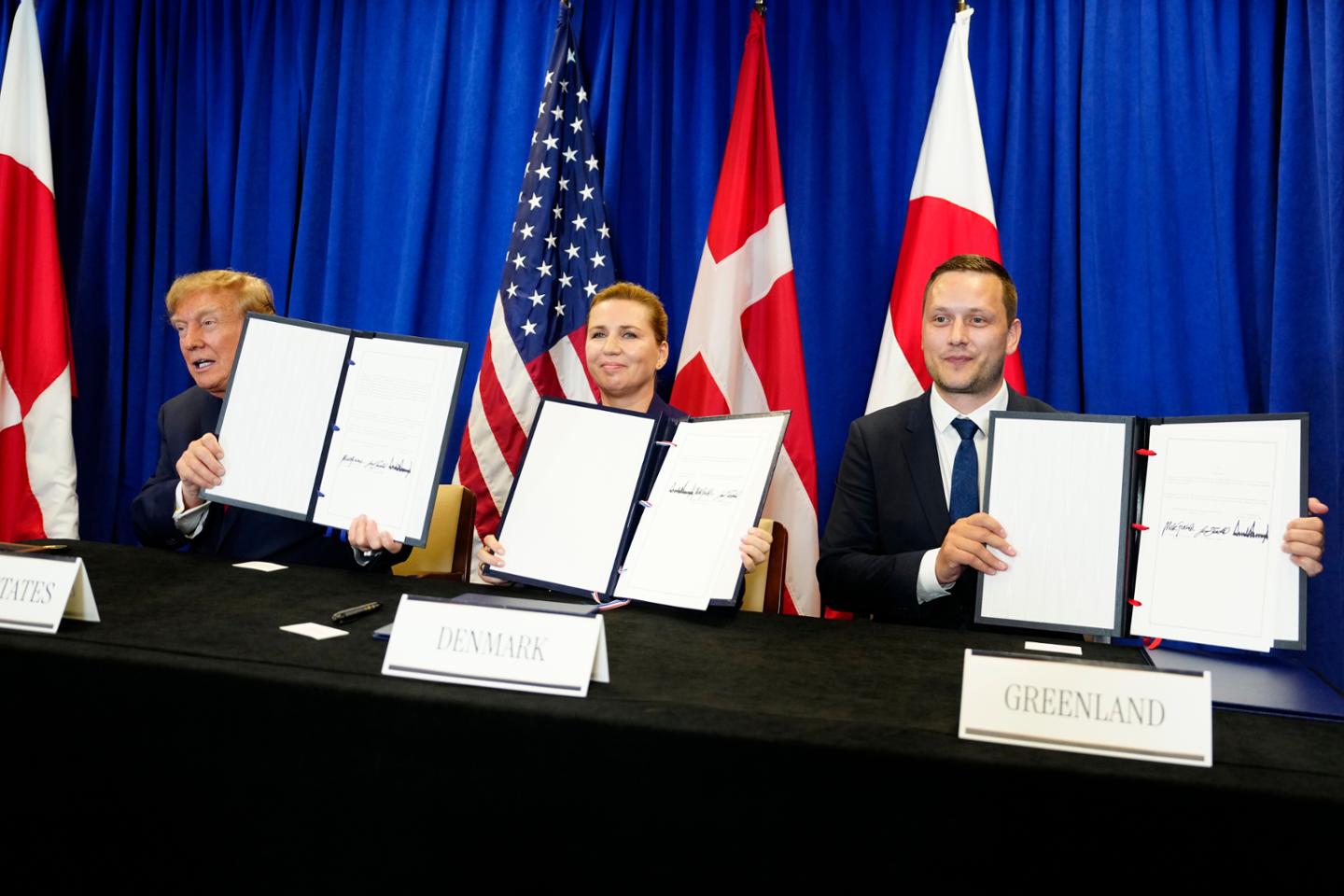
The annexation scare is over. The bases are not.
Donald Trump spent much of his second term treating Greenland like a distressed commercial property—repeatedly suggesting the United States should buy it, alarming European allies who watched a NATO partner’s territory get discussed as if it were a timeshare in Florida. On September 22, at the UN General Assembly in New York, he signed a trilateral security agreement with Denmark and Greenland that pulled the country back from the edge of that humiliation. The tension over annexation has paused. But the military reality on the ground is far more substantial than anyone was offering two years ago.
The United States will operate three military facilities on the island. Two are expansions of existing infrastructure. The third is new. And it sits in the east—a region that has never hosted an American military presence.
What the deal actually does
Here is the geometry of it. In the northwest, Thule Air Base—the high-arctic facility already in operation and already infamous for the 1968 B-52 crash that scattered radioactive debris across the landscape—remains active as a space and missile warning station. That was always there.
In the south, the United States will reactivate the former naval air station at Narsarsuaq, which the Air Force abandoned in 1958. Seven decades of disuse end now. And in the east, a previously unused site at Mestersvig becomes a new military hub.
That last point matters more than it appears. Eastern Greenland has no permanent US military footprint. It is remote, sparsely populated, and positioned along the Denmark Strait between Greenland and Iceland—the same corridor where Soviet submarines once slipped into the Atlantic during the Cold War and where Russian naval activity has resumed in the 2020s. Placing a base there is not a symbolic gesture. It is a surveillance and denial capability aimed directly at the maritime approaches that matter most in any Northern flank calculation.
The agreement also explicitly permits US access to Greenland for deployment of the “Golden Dome” missile defense system—a layered continental defense architecture that the Trump administration has promoted as a replacement or supplement to the Ground-Based Midcourse Defense system. That language is in the deal text. It is not a side letter.
The 1951 skeleton, updated
Ole Weber, a professor at the University of Copenhagen, told TIME magazine that aside from the permanence clause and the foreign-investment restriction, the agreement is structurally similar to the 1951 defense pact it amends. That observation is accurate but slightly misleading. The 1951 agreement gave the United States the right to operate Thule and Narsarsuaq with minimal oversight. This one gives it Thule, Narsarsuaq, and Mestersvig—three nodes instead of two, including a brand-new one in a strategically vacant sector.
The modifications are real even if the architecture is familiar. The deal reaffirms Danish sovereignty and territorial integrity, which is the minimum Copenhagen needed. It recognizes Greenlanders as a people with the right to self-determination under international law, which is something the 1951 text never said. And it bars military facilities from non-NATO countries and requires consensus among all three parties for foreign investment in the territory—language designed to block Chinese or Russian commercial entry under the guise of infrastructure development.
Who wins, who loses, who is surprised
Copenhagen wins because it avoided the alternative. A Trump-led annexation effort would have torn apart the Danish kingdom’s political cohesion and forced Greenland into a referendum it was not prepared for. Instead, Frederiksen described the deal as respecting Denmark’s sovereignty and Greenland’s self-determination. That is diplomatic language, but it maps onto something real: Greenland is now a签字国 at the table, not a passive subject of Copenhagen-Washington negotiations.
Greenland’s Premier, Jens-Frederik Nielsen, made that explicit. “The conspicuous change is that Greenland is sitting directly at this table and signing today,” he said, noting that the agreement accounts for the rights, livelihoods, and development of Greenlandic people. Whether that translates into material benefit beyond construction jobs and infrastructure upgrades remains to be seen. But the procedural shift—Greenland as co-signatory rather than subject—is historically significant for a territory that gained home rule in 1979 and self-governance in 2009.
Trump wins because he can point to a physical asset—three bases, a missile defense node, a reactivated Cold War facility—without having to explain why the United States needs to own an island. The annexation gamble was always a non-starter domestically and internationally. The base deal is achievable.
Russia loses slightly more than it would have under a status quo that left eastern Greenland unmonitored. China loses because the investment restriction clause is clearly calibrated to exclude it. NATO gains marginal coverage in the Greenland-Iceland-UK gap, the same underwater chokepoint that has haunted Western naval planners since the 1960s.
What this reveals about Trump’s Arctic strategy
The shift from annexation to expansion tells you something honest about how this administration actually thinks about power. Trump has always been transactional. He wanted Greenland because he thought he could buy it—a real estate instinct applied to geopolitics. When that proved impossible, he did not abandon the objective. He converted it into something closer to what the United States already does in places like Djibouti, Bahrain, and Guam: leased military access to strategically located territory, without the complications of sovereignty transfer.
This is not a subtle pivot. It is the same impulse dressed in different language. The bases will do the same strategic work that ownership would have done—control of the high Arctic, surveillance of Russian nuclear submarine routes, early warning for continental missile defense. The only thing that changes is who holds the title deed.
What happens next
The agreement must be ratified by the Danish parliament and the Greenlandic parliament before it takes effect. That process could take months. Denmark’s Folketing is unlikely to block it—the alternative is watching Washington build a base in eastern Greenland without Copenhagen’s consent—but the Greenlandic assembly may use the ratification moment to extract concessions on resource revenue sharing, environmental safeguards, or operational oversight that go beyond the broad principles in the deal text.
The investment restriction clause will be tested first. China has been investing in Greenland’s mining sector for years. If a Chinese company holds a stake in a Greenlandic port or airport that the US military then needs to use, the question of whether that counts as a “non-NATO military facility” will land on this trilateral framework—and it is not clear it has an answer yet.
And the Golden Dome language is a commitment, not a construction schedule. The system’s deployment on Greenland will depend on subsequent appropriations, engineering studies, and likely Danish-Greenlandic approval of the specific sites. That is not a small step.
What is clear is that the era of the United States treating Greenland as a potential fifth state has ended—at least until the next Trump impulse. The era of the United States treating Greenland as a military archipelago has just begun.