Trump-Kim Summit Could Freeze Denuclearization Into Oblivion
A staged Trump-Kim meeting risks normalizing Pyongyang's nuclear status under the guise of diplomacy, reshaping extended deterrence and allied burden-sharing before Washington's partners catch up. The window to prevent this may close by late 2026.
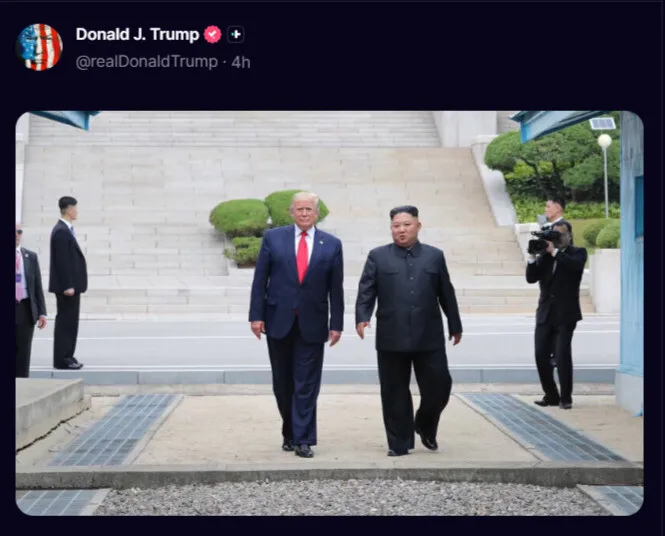
The Photo Op That Rewrites the Rules
Donald Trump posted another set of photographs with Kim Jong-un. This time, they traveled together on Air Force One, waving to crowds in Laos in June 2019 — the summit that collapsed over definitions of denuclearization, not the one in Singapore where the two men shook hands and produced a declaration that said everything and committed to nothing.
The image was designed to signal that dialogue is alive again. That signal carries enormous weight right now. It comes seven years after the Hanoi breakdown, as North Korea’s nuclear arsenal has multiplied from a handful of crude devices to what intelligence estimates place at roughly 50 deliverable warheads, including several mounted on ICBMs capable of striking the continental United States. The geopolitical context around it has hardened into something Trump himself helped create: a North Korea-China-Russia alignment that increasingly functions as a counterweight to US alliances in East Asia.
The dangerous idea is that a well-staged meeting — even without a substantive agreement — could quietly normalize North Korea’s nuclear status. Not through a signed treaty, but through the cumulative optics of handshakes, joint statements that reframe “denuclearization” as a long-term goal rather than a precondition, and the subtle shift in language that treats Pyongyang as a legitimate nuclear power instead of a pariah regime on an unacceptable trajectory.
This is how rollback happens without anyone in Washington realizing they’ve rolled back until it’s done.
Who Wins, Who Loses
Kim Jong-un wins immediately. He gains the one thing North Korea’s leadership has pursued since the 1990s: international recognition of the DPRK as a nuclear state. The meeting itself — the shared photos, the diplomatic theater — becomes the agreement. Any subsequent US administration inherits a world where Pyongyang’s nuclear status is no longer contestable in practice, even if it remains deniable in formal language.
Trump wins politically, at least in the short term. A summit photo is easy to sell. It costs nothing to host, requires no congressional approval, and generates headlines that outlast the moment. The risk is that the political return evaporates if Kim follows the pattern established in 2019: engage, posture, and then accelerate testing while the world watches.
South Korea loses the most, and it doesn’t even know it yet. President Lee Jae-myung’s government entered office in May 2025 after a campaign that prioritized strengthening the ROK-US alliance and rebuilding deterrence credibility. That platform assumes Washington will lead on North Korea with discipline and consistency. A Trump-Kim reset bypasses Seoul entirely. It sidesteps the Alliance Consultative Group. It marginalizes the mechanisms designed to keep Seoul in the loop on decisions that directly affect its security.
Japan is in the same boat. Extended deterrence — the US nuclear umbrella that Tokyo depends on — is not a static guarantee. It is a political commitment that degrades when Washington’s attention shifts. A US-North Korea arrangement that treats Pyongyang’s arsenal as a bargaining chip rather than a strategic threat recalibrates what Tokyo must prepare for on its own.
China and Russia win by default. A distracted Washington is a retreating Washington. The North Korea-China-Russia triangle that analyst Kim Yeon-chul identified as the emerging axis of Northeast Asian order gains further consolidation when the United States appears willing to trade strategic engagement with North Korea for the optics of a deal.
The Structural Problem Nobody Is Talking About
The real obstacle to meaningful negotiations is not North Korea’s refusal to denuclearize. It is the absence of a US negotiating apparatus capable of sustaining a long, technical process against a regime that treats time as an ally.
The Iran deal collapsed under similar conditions — not because the terms were impossible, but because the domestic architecture for sustaining an agreement was missing. The Trump administration’s pattern is clear: impulsive executive action, inconsistent messaging, and a preference for dramatic gestures over institutional follow-through. The sudden cancellation of joint military exercises with South Korea without warning, the daily contradictory statements, the reliance on personal chemistry over policy architecture — these are not negotiation strategies. They are improvisations.
North Korea understands this calculus. The regime has survived three US administrations that treated it as a crisis to manage rather than a structural problem to resolve. It has watched the 2019 Hanoi collapse, the failed Singapore summit follow-through, and the subsequent years of accelerated weapon development proceed without consequence. The lesson is simple: engagement produces photo ops; rigidity produces pressure; and the regime prefers the former’s ambiguity to the latter’s certainty.
Kim Yeon-chul’s analysis, published in Hankook Ilbo, cuts to the core of the problem: North Korea is no longer negotiating from weakness. It is positioning itself as a normal state with nuclear weapons, leveraging its relationship with Beijing and Moscow to insulate itself from American coercion. The question is whether the United States recognizes that the framework it has used for decades — denuclearization as a precondition for engagement — is no longer viable.
The 2026 Window
Late 2026 may be the last opportunity to redirect the trajectory before it hardens. The argument, as Kim frames it, is not to abandon denuclearization entirely but to stop pretending that the old framework still works. When the door to traditional denuclearization negotiations closes — and evidence suggests it already has — the alternative is to open a parallel track on a peace regime: formalizing an end to the Korean War armistice, establishing verification mechanisms for current arsenals (not their elimination), and embedding bilateral and multilateral confidence-building measures that constrain future escalation.
This is not capitulation. It is a realistic assessment of what is achievable. North Korea will not surrender its nuclear weapons through negotiation under current conditions. But it may accept constraints, transparency measures, and security guarantees that reduce the immediate threat to South Korea and Japan while creating a framework that can be expanded later.
The alternative is a staged summit that produces nothing but photographs, followed by another round of North Korean tests that the United States responds to with sanctions and rhetoric — the same cycle that has repeated since 2018, only now with more weapons and less urgency.
Seoul Must Lead or Be Led
The most consequential failure will not be diplomatic. It will be institutional. South Korea’s government has spent months preparing for a North Korea strategy that assumes Washington will be a reliable partner. If the Trump administration pursues a bilateral reset with Pyongyang that bypasses Seoul, the Alliance’s operational coherence fractures.
Kim Yeon-chul’s closing point is blunt: all diplomacy begins domestically. The South Korean government must first clarify its own position, align its bureaucratic apparatus, and define what it is willing to accept before any meeting takes place. Otherwise, it will be reacting to decisions made without it — the same pattern that repeated itself across the Moon Jae-in and Yoon Suk-yeol administrations.
The photo of Trump and Kim waving from Air Force One will look like diplomacy. That is exactly what makes it dangerous.