Trump's Ukraine Pivot Reshapes European Security
Trump is pressuring Zelenskyy while limiting critical U.S. support to Ukraine — a sharp break from decades of American policy that signals a fundamental rewrite of European security architecture.
The Unmasking
The relationship between Washington and Kyiv has always been transactional in the background, but transparently, deliberately, and aggressively so now. President Donald Trump told Sunday talk show viewers that Ukraine gave the U.S. nothing in return for billions in aid, accusing Volodymyr Zelenskyy of obstructing peace rather than facilitating it, and suggesting someone else should represent Kyiv at the negotiating table. This is not the language of a coalition partner. It is the language of a creditor.
On Monday, Trump said he might meet Vladimir Putin and Xi Jinping next month to discuss arms control, and he would not do it primarily for Ukraine. He said Russia had been fine about Ukraine. That remark, whether calculated or careless, stripped away the last pretense that American policy remains anchored to Ukrainian sovereignty.
The timing of these comments is itself significant. They come not during a diplomatic breakthrough but as Russian forces continue their grinding advance through eastern Ukraine. The message is clear: Washington is no longer willing to be the primary guarantor of Kyiv’s territorial integrity. What was once framed as support for a democratic nation under aggression is being recast as an expensive mistake that America must unwind.
Zelenskyy, who once enjoyed near-unanimous bipartisan support in Congress, now finds himself facing the same president who praised Putin’s leadership and questioned the value of NATO. The shift is not subtle. It is a deliberate reorientation of American foreign policy that leaves Ukraine exposed and Europe uncertain.
The Hardware Problem
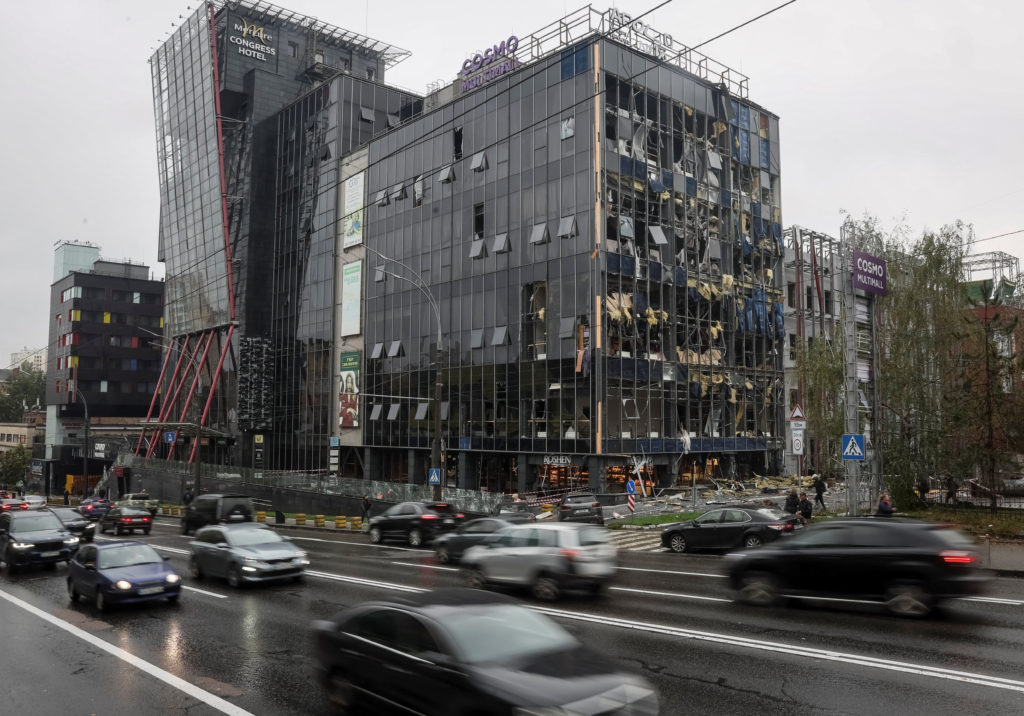
The rhetoric is dramatic, but the real pressure is mechanical. Ukraine is losing access to the very systems that make its defense possible. SpaceX speed caps have forced Kyiv to slow down its drone interceptors and mid- and long-range drone operations. Russian drones and missiles struck Kyiv on Monday, hitting a shopping mall and a school. Ukrainian officials say these attacks are more frequent and less intercepted because U.S. restrictions have degraded their response capability.
The specifics matter. American-made intelligence, surveillance, and reconnaissance systems that once provided Kyiv with early warning of Russian missile launches are now subject to review, delay, or outright denial. Patriot battery ammunition stocks, carefully built over two years of warfare, are being drawn down without the replenishment promises that defined the Biden administration’s approach. Javelin missiles, HIMARS rockets, and the satellite data that guides them are no longer flowing with the urgency that survival demands.
Zelenskyy told Kristen Welker that intelligence sharing had been blocked and then restored. Secretary of State Marco Rubio denied any pause on Monday. Whether or not there was an official cutoff, the effect is the same: Ukraine cannot rely on uninterrupted American intelligence or hardware. The messaging gap itself is a weapon.
Kyiv’s air defenses, which once shot down an estimated sixty percent of incoming Russian drones and missiles, now operate at perhaps forty percent effectiveness. The difference is measured in bodies. Hospitals in Kharkiv and Dnipro report increased casualties from strikes that should have been intercepted. The hardware problem is not abstract. It is written in the rubble and the morgues.
Who Wins, Who Loses
The winner in this dynamic is not Russia, despite what Trump suggested. Putin invaded Ukraine. The war continues because Russia chose to escalate, not because Zelenskyy refused to negotiate. But Trump’s framing shifts the blame onto Kyiv while American systems are systematically restricted. That benefits Moscow without requiring any concession from the Kremlin.
Russia has spent over two years adapting its economy to warfare, building up its defense industrial base, and securing supply chains through China and Iran. The sanctions regime that once seemed crippling has proven leaky. What Russia gains from Trump’s pivot is not territory won on the battlefield but diplomatic cover for continued aggression. The message from Washington is: keep pressing, because America will not stop you.
Zelenskyy loses the most immediately. His credibility with the American public and Congress is eroding. His military position is degrading. A nation that depends on a single ally for intelligence, weapons, and diplomatic cover cannot afford to alienate that ally, yet Trump is making defection impossible and dependence more painful. Every public statement from Kyiv must now walk the razor’s edge between gratitude and desperation.
Europe loses the most structurally. The post-1945 security order rested on the assumption that America would deter aggression in Europe. Trump’s treatment of Ukraine sends a signal that even a declared ally will be abandoned if it no longer serves the transactional calculus of the moment. That changes every calculation in Brussels, Berlin, and Warsaw. The question is no longer whether America will defend Europe but when it will stop.
The Architecture Shift
This is not a disagreement about strategy. It is a restructuring of the U.S.-Ukraine alliance in real time. For two years, American support framed the war as a defensive struggle against Russian expansion. Now the frame is flipped: Ukraine is being asked to bear responsibility for a conflict America no longer wants to fund.
The implications extend far beyond Kyiv. NATO cohesion depends on the credibility of Article 5, which promises collective defense. If the United States will let Ukraine fall to demonstrate independence from its own commitments, allies on the front line — Poland, the Baltics, Romania — will reassess their reliance on Washington. Defense spending will rise. European strategic autonomy will shift from aspiration to urgency. Germany and France may attempt to fill the gap, but they cannot replace American intelligence, ammunition, and naval power overnight.
The European response has been fragmented. Poland is accelerating its own defense industry and requesting additional U.S. troops on its soil. France is calling for a European army. Germany is wrestling with its own historical constraints. None of these moves substitute for the unified deterrence that American leadership provided. The architecture of European security is being dismantled beam by beam.
What Happens Next
Zelenskyy is set to meet with U.S. negotiators this week. Those talks will determine whether Kyiv remains at the center of any settlement or is spoken about by others. Trump has already suggested a three-way meeting with Putin and Xi Jinping. If Ukraine is excluded, the war ends not through Ukrainian resistance but through great-power bargaining over Ukrainian territory.
Russia continues to pound Ukrainian cities. A baby was killed in Kharkiv on Monday. The military situation is deteriorating precisely as American support is constricting. That sequence is not accidental. It is the mechanism of pressure. Moscow knows that time is now on its side, not because its armies are invincible but because its adversary’s patron is withdrawing.
The longer-term consequence may be a Europe forced to defend itself without American leadership. That is a world radically different from the one that existed twelve months ago. Ukraine’s survival depends on whether Europe can move fast enough to compensate. The clock is ticking, and the tools are limited. European defense industries are producing at a fraction of the rate required. Ammunition stocks are thin. Political will is fragile.
The Bottom Line
Trump is not just criticizing Zelenskyy. He is ending an era of American military sponsorship of the war. The question now is what replaces it. If nothing replaces it, Ukraine loses. If Europe attempts to replace it, the transatlantic bond fractures. If Trump trades Ukraine away for a deal with Putin and Xi, the foundation of European security is rewritten by force majeure rather than alliance.
The war of words is the surface. The real story is the dismantling of the post-Cold War order. What emerges may be a multipolar system where great powers divide spheres of influence and smaller nations learn to fend for themselves. Or it may be something worse: a continent where aggression is rewarded because the deterrent that prevented it has been voluntarily dismantled.
Ukraine did not choose this war. Europe did not invite it. But both are now paying the price for an America that has decided its interests no longer include their survival. The question that will define the next decade is whether the rest of the world can hold together the pieces, or whether the unraveling will spread far beyond Ukraine’s borders.
The answer matters for everyone. Not just the citizens of Kyiv, Warsaw, or Tallinn, but every nation that has ever relied on the promise that great powers would not redraw borders by force. That promise is breaking. The question is what, if anything, will take its place.