Trump's Vaccine Order Has a Global Shock Wave
Trump's executive order reshaping the US childhood vaccine schedule is not just a domestic policy shuffle. It sends ripples through COVAX funding, WHO credibility, and the pharma investment logic that underpins vaccine access in the Global South.
The order that reaches farther than the CDC schedule
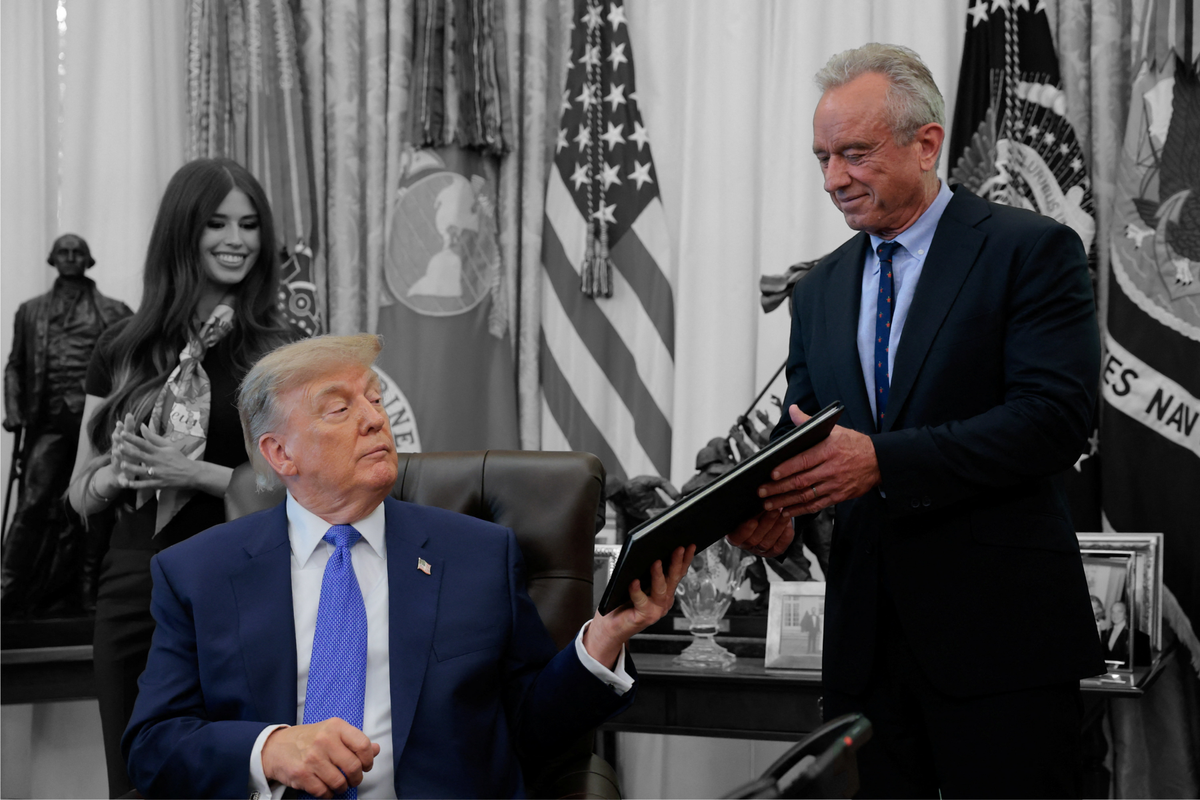
On August 10, Donald Trump signed an executive order restructuring the United States’ recommended childhood immunization schedule. The mechanics are domestic — the federal government does not mandate vaccines; states do — but the signal travels instantly across every health ministry, vaccine manufacturer, and multilateral fund that watches Washington for direction.
The order reduces the number of preventable diseases covered by federal recommendations from 18 to 11. It breaks the measles-mumps-rubella combination shot into three separate injections. It reclassifies hepatitis A, hepatitis B, and meningococcal vaccines from universal recommendations into a category called “shared clinical decision-making” — a bureaucratic phrase that translates for parents into “maybe.” It tasks an HHS task force with producing a plan within 90 days, including a search for alternatives to aluminum, the adjuvant used in nearly every routine vaccine.
The stated rationale echoes a claim Trump repeated at the signing ceremony: that children in earlier decades received fewer vaccines and were healthier, and that rising autism rates coincide with the expanded schedule. No credible evidence links vaccines to autism. The previous 17 members of the Advisory Committee on Immunization Practices were dismissed and replaced with individuals known for vaccine skepticism, including Health and Human Services Secretary Robert F. Kennedy Jr., who has long promoted the discredited notion that vaccines cause autism.
Who wins and who loses inside the United States
The immediate losers are children and the public health infrastructure built around them. Kindergarten vaccination rates already fell during the 2025-2026 school year, according to CDC data cited by critics. Measles is spreading at its highest level in more than three decades. Breaking a single protective shot into three visits increases the chance that a family will miss a dose entirely — a problem well documented in health services research.
The winners are a political coalition that treats vaccine skepticism as a core identity. Kevin Roberts of The American Mind framed the order as courage. Lisa Jarvis at Bloomberg called it a betrayal of Trump’s own Operation Warp Speed legacy. The truth is messier than either framing: Trump is repurchasing a voter base that views institutional medicine with deep suspicion, at the cost of decoupling his second term from the one achievement — rapid vaccine development — that defined his first.
The global chain reaction
Here is what most American coverage omits: vaccine policy is not a sovereign silo. The United States is the largest donor to global health, the largest buyer of vaccine supply, and the benchmark against which the World Health Organization calibrates its own recommendations. When Washington signals that the standard schedule is suspect, the message lands differently in Nairobi, New Delhi, and Jakarta than it does in Atlanta or Boston.
COVAX, the pandemic-era vaccine sharing facility now transitioning into a broader global immunization platform, depends on US political and financial backing. The Trump administration has already shown hostility toward multilateral health bodies. An executive order that officially questions the scientific consensus behind routine childhood vaccines makes continued American support for COVAX politically untenable for any future administration and financially destabilizing for the present one. Donor fatigue is not abstract — it is budgeted.
WHO itself is affected. The agency’s Essential Medicines List and its recommended immunization schedules draw heavily on CDC guidance. When the CDC’s authoritative schedule shifts from 18 disease protections to 11, WHO member states face a dilemma: follow the changed American standard and risk domestic backlash from their own medical establishments, or ignore it and lose access to US technical assistance and procurement channels. Either choice erodes the WHO’s credibility as an independent scientific authority.
The pharma pipeline shudder
Pharmaceutical investment decisions are made with the US market as the anchor. A population of 330 million represents disproportionate revenue relative to R&D costs. When the largest market questions whether a category of products — vaccines — is necessary at its current scale, the investment logic changes.
Consider what happened with the COVID-19 vaccines: massive upfront commitment from the US government through Operation Warp Speed enabled mRNA technology to prove itself, which then unlocked billions in private investment and produced the fastest vaccine development cycle in medical history. The same logic runs in reverse. If the federal government recasts routine childhood vaccines as optional or risky, manufacturers face diminished demand signals. That does not mean研发 stops overnight. But it does mean risk-adjusted returns fall, and companies recalibrate which programs they pursue and where.
The Moderna-Merck mRNA melanoma vaccine, announced recently, illustrates the opposite path — one where US policy enables rather than constrains innovation. The contrast matters. A government that simultaneously celebrates new vaccine platforms while questioning established ones creates a market environment that is hard for investors to price. Capital hates ambiguity more than it hates risk.
The aluminum question
One detail in the order deserves disproportionate attention. The HHS task force has been instructed to identify “alternative substances” to aluminum, the adjuvant used in most vaccines to strengthen immune response. Aluminum salts have been used in immunizations since the 1930s and are among the most studied components in all of medicine. Replacing them is not a technical impossibility — new adjuvant platforms exist — but it is enormously expensive and unproven at scale.
If the United States moves toward aluminum-free vaccines for routine use, the cost per dose rises. For low-income countries that rely on US-donated vaccines through programs like USAID and the Global Fund, the price impact is direct. The Global Polio Eradication Initiative alone distributes hundreds of millions of doses annually. A shift in US policy that devalues the existing vaccine architecture does not just change American school entries. It changes what a child in Punjab or the Democratic Republic of Congo receives from an international donor.
What comes next
The order’s recommendations are not immediately enforceable because states control school mandates. Several lawsuits are already challenging it. But recommendations shape behavior even without legal force. Parents read them. Pediatricians reference them. School boards cite them. The 90-day task force deadline means a concrete plan will emerge before the autumn vaccination season, likely pushing for the fragmented MMR schedule and the aluminum review that dominate the order’s text.
The international consequence is already unfolding in real time. Emerging-market health ministries are watching to see whether the US doubles down or backtracks. Vaccine manufacturers are adjusting procurement forecasts. COVAX partners are calculating the gap between committed and expected funding. The WHO is fielding questions from member states that previously received unambiguous guidance from Atlanta.
The executive order is a domestic policy document. Its reach, however, extends through every supply chain, funding formula, and trust relationship that holds global immunization together. The question for the rest of the world is whether it can afford to lose the United States as a reliable node in that system — and what happens if the answer is no.