Ukraine's drone MedEvac rewrites military doctrine
Ukraine's first aerial drone evacuation of a wounded soldier isn't just a frontline milestone—it's a blueprint that could transform casualty extraction for every military on earth, including those preparing for conflicts in Asia.
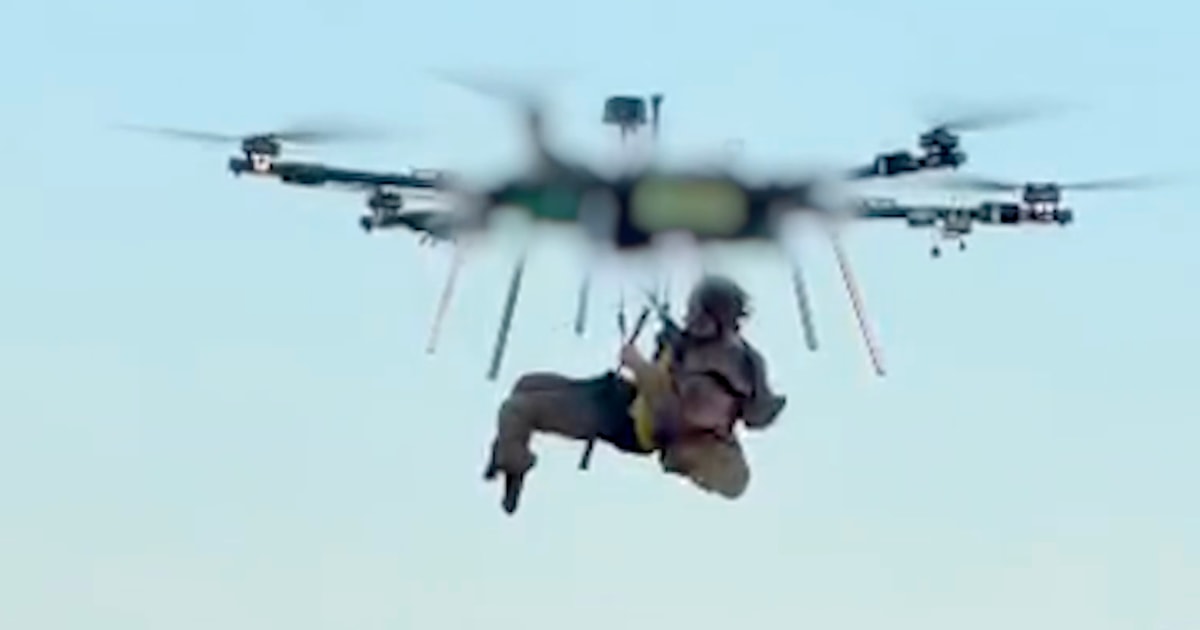
A soldier straps himself into a drone. The world’s first combat MedEvac by air is underway.
The video, posted by Ukraine’s 92nd Separate Assault Brigade on Monday, shows an infantryman lifting himself into a massive hexacopter that looks more like industrial cargo equipment than a medical device. The drone lifts off, hovers low over blurred terrain, and gently lowers the soldier back to the ground. The operator’s voice crackles through: “Welcome back to the ground!”
What happened in that clip matters far beyond the front lines where it unfolded. Kyiv is claiming the world’s first aerial drone evacuation of a wounded soldier from active combat—and if the technology holds, it will force every major military to rethink how it extracts the injured from denied airspace.
Why this wasn’t routine
The wounded soldier had been hit at his position. Standard evacuation routes were blocked: Russian drone activity was intense, and landmines littered the ground. Conventional unmanned ground vehicles—battlefield exoskeletons and tracked carriers that have become staples of Ukrainian logistics—couldn’t reach him. Roads were mined. The ground was watched.
So the unit’s specialists did something untested. They took a heavy-lift hexacopter originally designed as an aerial bomber by a Ukrainian manufacturer, reinforced it, balanced it, and flew a human being out of a kill zone.
The engineering hurdles were real. The drone had to carry a person without flipping or swaying excessively in flight. That’s not a trivial modification to a platform built to drop ordnance, not ferry flesh and bone. The squad leader and programmer behind the mission, known only by the call sign Napalm, called the soldier a hero for agreeing to strap into a machine he could see and hear arriving—a reasonable fear, given what these drones look like in this war.
The rescued infantryman is now undergoing treatment and rehabilitation, according to the brigade. The operators’ faces were blurred in the video, a small but telling detail: this was still an operational matter, not a propaganda flourish, even though the timing and framing suggest both.
What this means for doctrine
The implications cut across three domains: tactical, institutional, and geopolitical.
Tactically, this solves one of the oldest problems in warfare: getting wounded soldiers out of contact when the ground is denied. The “golden hour” of trauma care has always depended on reaching the injured fast. Ground ambulances are vulnerable. Helicopters are even more vulnerable in a dense drone environment. A heavy-lift drone carrying a person removes the crew from the risk equation entirely and can operate in airspace that would down a rotorb.
Institutionally, the U.S. military has spent years developing similar concepts. The Army’s MedEvac UAS program and the Marines’ efforts to create unmanned casualty extraction platforms have produced prototypes and limited fielding. None have been documented in combat under fire the way Ukraine’s has. That gap between program office slides and a video posted by a assault brigade is exactly why NATO defense planners should be paying close attention.
The doctrine shift is stark. Current U.S. and NATO casualty evacuation doctrine assumes either ground extraction under fire or rotary-wing insertion—both of which become dramatically more hazardous as drone density increases. This mission proves that at least one military has already moved past that assumption and found a workaround. That’s not incremental progress. That’s a pivot.
The wider drone logistics pipeline
This evacuation didn’t emerge in isolation. Days before the video was released, Prime Minister Serhii Koretskyi announced an approved experimental program to use drones for medical logistics—carrying medicines, blood samples, and donor organs between hospitals, including from remote areas. The government emphasized coordination with the military and special airborne identification for these flights.
The pattern is clear: Ukraine is building a dual-use drone medical ecosystem. The same hexacopter class that evacuated a soldier can carry plasma. The same flight paths cleared for organ transport can be repurposed for casualty extraction. That kind of infrastructure stacking is exactly what separates improvised wartime innovation from sustainable military capability.
Who wins, who loses, who copies
The winner in the short term is Ukraine’s defensive posture. Every soldier who survives because a drone could reach him instead of a helicopter that couldn’t is a manpower retention gain at a time when Kyiv faces severe recruitment shortages. The 92nd Brigade’s statement that its drone units are conducting operations “recently considered science fiction” is hyperbolic but directionally accurate: this was impossible two years ago and routine in concept today.
Russia loses because its drone and mine density on the ground—factors that blocked conventional evacuation—can no longer serve as a reliable shield against medical extraction. If Kyiv can fly a soldier out, it can fly medics, ammunition, and supplies in. The operational calculus shifts.
Every other military with a contested-airland doctrine stands to copy this. China’s potential operations against Taiwan, India’s mountain warfare scenarios, NATO’s eastern flank—all of them face the same problem Ukraine solved on Tuesday morning: how do you extract the wounded when the ground is mined and the sky is swarming?
The political context complicates everything
Ukraine’s drone advance arrives at an awkward moment in its relationship with Washington. Kyiv is pressing ahead with deep-strike drone operations against Russian oil infrastructure despite U.S. pressure to stand down. Intelligence sharing gaps have surfaced. Restrictions on Starlink—critical for drone operations and battlefield communications—have been reported.
That friction makes this drone MedEvac both more impressive and more fragile. The hexacopter was built by Ukrainian manufacturers using Ukrainian engineering. It doesn’t rely on American supply chains or permission. That independence is a strategic asset, but it also means the next iteration won’t benefit from the scale of U.S. defense procurement if Washington continues to distance itself from Kyiv’s operational choices.
What happens next
The 92nd Brigade’s video is likely the first public example, not the last. Expect similar missions within months as Ukrainian units refine the technique and share it across the force. Expect Russian forces to adapt—jamming heavier lift drone corridors, targeting hexacopter launch zones, developing their own counter-drone MedEvac concepts.
In the longer term, the real test comes when this moves from improvised brigade-level innovation to standardized equipment. That requires certification, reliability data, and probably a different class of aircraft than the bomber-derived hexacopter shown here. But the proof of concept is now on video, broadcast globally, and filed under “what works” rather than “what was tried.”
The soldier who rode out of that kill zone in a drone isn’t just a survivor. He’s the first data point in a new chapter of military medicine—one where the ambulance doesn’t need roads, and the pilot doesn’t need to survive the flight home.