Ukraine's Robot Army: What Japan's Conscription Fight Misses
One operator controlling thousands of autonomous machines is no longer science fiction. As Ukraine builds the world's most advanced robot warfare system, Japan's conscription debate is focusing on the wrong problem.
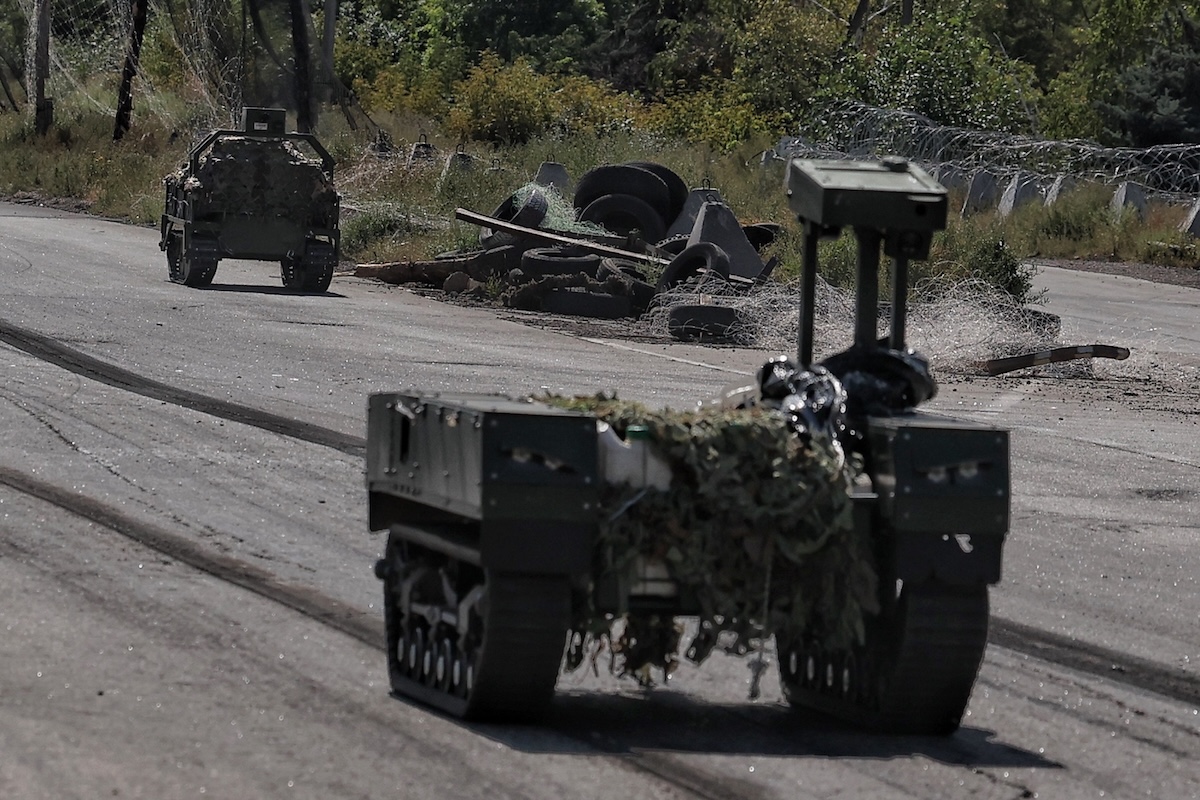
The math has changed in eastern Ukraine
Eight out of every ten personnel casualties on Ukraine’s front lines now come from drones. That figure, verified across multiple combat reports in 2026, is not a temporary spike. It is the new baseline.
What is less widely understood is the next step in that trajectory. A single operator is learning to command not dozens but thousands of autonomous machines simultaneously, across land, sea, and air. The system making that possible is not yet in public military inventory anywhere. But Ukraine is building it, and the implications for Japan’s ongoing conscription and defense modernization debates are far more consequential than most commentators realize.
The Frontier System
Ark Robotics, a Ukrainian-Estonian defense technology company headquartered in Tallinn, is at the center of this shift. Its CEO, Aki Takagama, describes the current phase as an entry into a “technology tunnel” whose exit opens onto a battlefield where one human soldier is paired with thousands of robots and unmanned systems.
Ark’s flagship product is not a specific robot, but rather a unified command platform called the Frontier System. It is designed to let a single operator control a heterogeneous fleet of unmanned ground vehicles, unmanned aerial vehicles, and unmanned surface vessels from anywhere. The hardware it runs on is a custom processing unit capable of mounting on any mobile robot platform, solving the persistent problems of perception and localization that have long limited autonomous movement in contested environments.
The system was demonstrated publicly this month at the MSPO defense exhibition in Poland, where attendees controlled live UGVs operating on Ukrainian soil from the exhibition floor. That feedback loop—less than two seconds of latency across an active combat zone—is itself a technical milestone most Western defense shows have not yet replicated.
Why ground robots matter more than everyone thinks
Most defense commentary around Ukraine has fixated on drones. Ukrainian companies like The Fourth Law have built their reputations on AI-enabled drone targeting. The narrative has been air-centric because the air domain is visible: camera feeds, strike videos, and the dramatic imagery of loitering munitions dominate social media and news cycles.
Ark took a different path. Takagama argues that unmanned ground vehicles are the structural foundation of robot warfare precisely because they can do things drones cannot. UGVs carry heavy payloads. They secure trench lines and fortified positions. They resupply forward units under fire. They persist in environments where aerial platforms face battery limits, weather constraints, and dense air defense coverage.
The Frontier System’s architecture treats UGVs as the anchor platform and layers UAV and USV capabilities on top of that foundation. In practical terms, this means a single operator could direct a ground convoy delivering ammunition while a swarm of reconnaissance drones paints the battlefield and an unmanned boat secures a river crossing—all coordinated through one interface.
The Japanese blind spot
Japan’s conscription debate, renewed in 2025 after years of deliberation, remains overwhelmingly framed around personnel shortages. The argument is binary: either Japan brings back a form of mandatory service to offset its aging and shrinking population, or it does not. Both sides talk about bodies—bodies on the beach, bodies in the bunker, bodies manning the radar.
Ukraine’s trajectory suggests the relevant metric is not how many bodies you have but how many machines each body can command. An 80-percent drone casualty rate does not emerge from having too few soldiers. It emerges from a force structure that has already accepted that unmanned systems will absorb the lethal center of gravity. Ukraine did not choose this; the war chose it. But the direction of travel is unambiguous.
For Japan, which faces a similar demographic crunch without the benefit of an active conventional war to force adaptation, the gap between where it is and where the battlefield is heading is wider than most policymakers acknowledge.
What this means for SDF procurement
The Japan Self-Defense Forces have been moving incrementally toward unmanned systems. The Maritime Self-Defense Force has tested unmanned surface vessels. The Ground Self-Defense Force has experimented with logistics UGVs. But none of these efforts approach the integrated, multi-domain command model that Ark is demonstrating. Japan’s unmanned projects remain organizationally siloed, each tied to a specific service branch and rarely tested against each other in a live feedback loop.
The Frontier System’s approach—a common processing unit that works across all robot types—is fundamentally incompatible with Japan’s current procurement logic, which tends to award contracts along service-specific lines. Adopting even a fraction of Ark’s model would require restructuring how the SDF buys, tests, and deploys unmanned systems.
That is a political question, not a technical one. But the window for making it without crisis driving the decision is narrowing. Ukraine’s system is already fielding live units in an active conflict. Japan’s equivalent capabilities remain largely in the demonstration phase.
Who wins, who loses
If Ukraine’s model spreads, the strategic advantage shifts toward states that can industrialize autonomous systems faster than their adversaries can adapt. Small nations with strong technology sectors—Estonia included—gain disproportionate influence. Large nations with high labor costs and aging populations face the steepest adjustment curve. Japan sits squarely in the second category.
The loser in this dynamic is not any single country but the assumption that manpower remains the primary input for national defense. That assumption still structures Japan’s conscription debate, Europe’s force planning, and much of NATO’s procurement priority list. Ukraine is proving it wrong in real time.
The tunnel ahead
Takagama’s metaphor of a technology tunnel is apt. On one side is the drone-saturated warfare of 2022–2025. On the other is a battlefield architecture where humans issue intent and machines execute at scale. The tunnel is narrow. The transition is already underway. The question for Japan is whether its defense establishment will emerge on the right side of it, or spend the next decade debating conscription while the math it was designed to solve becomes obsolete.
The Frontier System is not yet a mass-produced weapon. Ark is still early. The platform’s combat performance against peer adversaries remains untested. But the direction is clear, and it is faster than Japan’s policy cycle allows.