Starlink Cuts Are Ukraine's New Battlefield Vulnerability
SpaceX throttled Starlink speeds for Ukrainian military drones overnight with no warning — a move that came days after Trump demanded Kyiv halt strikes on Russian energy targets. The implications go far beyond one satellite provider.
A Speed Limit on Survival
Ukraine woke up Wednesday to find its military-grade Starlink terminals capped at 100 Mbps — a restriction that directly affects drone operations and had no warning from SpaceX. The slowdown hit both Kyiv’s central command nodes and forward-deployed terminals across the Zaporizhzhia and Donetsk fronts, where Ukrainian operators depend on high-bandwidth connections for real-time drone control and targeting data.
Serhii Beskrestnov, defense tech adviser to President Volodymyr Zelenskyy, confirmed the overnight speed limits caused “the failure of a number of missions” — language that Ukrainian officials typically reserve for tactical setbacks rather than operational annoyances. The 7th Rapid Reaction Corps reported that drones kept flying but became harder to control at speed. Air defense units tracking Russian jet-powered drones — the kind Moscow has been unleashing on Ukrainian cities with increasing frequency — also rely on those same terminals for early warning and intercept coordination.
The timing is impossible to ignore. This happened days after Trump demanded Kyiv stop striking Russian oil refineries, announced an unilateral “energy ceasefire,” and struck a diesel deal with Russia that upended years of sanctions policy. Musk has echoed Trump’s criticism of Ukraine’s energy attacks on X, calling them “counterproductive.” Two events separated by kilometers and ideology — a policy demand from the former US president and a technical restriction imposed by his ally’s company — colliding in real time on the battlefield.
The Drone Problem
Starlink became critical to Ukraine’s warfighting because it resists signal jamming — something Russian electronic warfare has made increasingly effective since 2023. Ukrainian operators use it for longer-range drone strikes deep into occupied territory, including strikes on Russian fuel depots, ammunition dumps, and command centers that have strained Moscow’s logistics. The 100 Mbps speed cap doesn’t ground the drones, but it degrades control precision at velocity. That matters when you’re trying to hit a moving tank or intercept a fast-moving Iranian-made Shahed drone over Kyiv, where reaction times are measured in seconds rather than minutes.
Musk himself called his terminals “the backbone” of Ukraine’s army in 2023, saying the “entire front line would collapse” without them. He previously shut off thousands of Russian-used Starlink terminals this year, directly handicapping Moscow’s drone operations in Kursk and Belgorod. Now the question is whether selective throttling is the new middle ground — not turning things off entirely, but making them harder to use effectively. The distinction matters legally and tactically. A cutoff is an act of war by proxy; a slowdown is ambiguity, and ambiguity benefits the side with the most to lose from escalation.
Ukrainian drone units have begun experimenting with backup communication systems — terrestrial radio relays, commercial cellular networks routed through encrypted apps, and even fiber-optic tethered drones for short-range missions. None match Starlink’s bandwidth or range, but they represent a hedging strategy that could reshape Ukrainian drone doctrine if the restrictions persist.
The Intelligence Gap
The Starlink restrictions arrived alongside a separate crisis that compounded Ukrainian vulnerabilities: Kyiv suffered two ballistic missile strikes in consecutive days without advance warning from its allies.
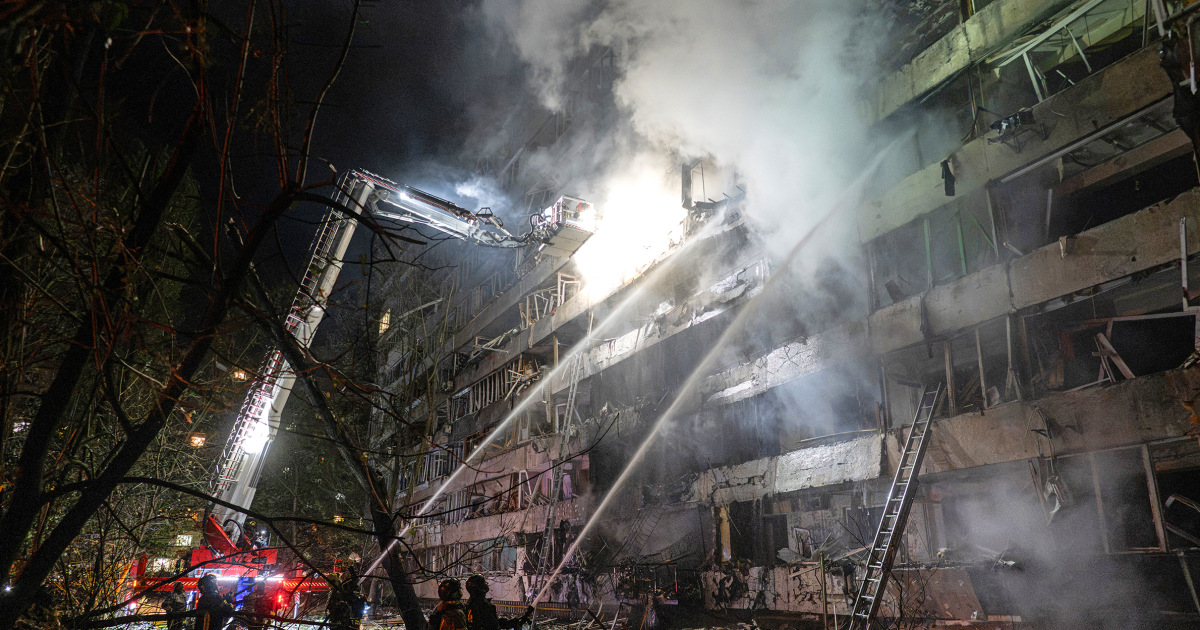
Zelenskyy confirmed both incidents publicly. After the first strike Monday, when five ballistic missiles hit civilian infrastructure in the capital’s Shevchenkivskyi district, Ukrainian officials attributed the lack of alert to a “technical glitch” in US intelligence sharing. Trump insisted Washington was still sharing intelligence and suggested Ukrainian air defense systems were operating inefficiently. After Tuesday’s second attack — which wounded at least eight civilians and damaged a residential high-rise — the explanation grew murkier. Ukrainian air force spokesman Col. Yurii Ihnat noted that warnings resumed during subsequent attack waves, suggesting the issue wasn’t total but that the initial gaps were catastrophic.
European officials told NBC News they were still trying to understand what happened. NATO’s integrated air and missile defense system, which normally provides ballistic missile warnings to partner nations, appeared to have experienced a coordination failure. The Kremlin called it “too early to draw systemic conclusions,” which is diplomatic code for saying nothing while quietly noting the advantage.
Intelligence sharing has been a cornerstone of US-Ukraine support since the 2022 invasion. Satellite imagery, signals intelligence, and early warning data have allowed Ukrainian commanders to anticipate Russian offensives and redirect forces before enemy troops reached their objectives. Its absence during ballistic missile attacks — the exact weapons most likely to cause mass casualties in urban areas — is the scenario every Ukrainian civilian feared and every commander planned for. The fact that it happened twice in four days, coinciding with Starlink restrictions, has generated quiet alarm in Kyiv’s military leadership.
Who Wins, Who Loses
Trump wins politically. The diesel deal with Russia, the energy ceasefire narrative, the pressure on Zelenskyy — all play to his midterm election messaging about lowering gas prices and reducing American entanglements abroad. By aligning SpaceX’s policies with his diplomatic priorities, he creates a feedback loop where private industry reinforces public strategy without requiring congressional approval or public explanation.
Musk wins by keeping Starlink operational everywhere while signaling compliance with his ally’s priorities. The throttling approach avoids the diplomatic incident of a full cutoff while achieving the same strategic effect. Starlink’s revenue from Ukrainian military contracts continues, its reputation as a neutral infrastructure provider is preserved, and it gains leverage over future US policy discussions about the company’s role in conflicts.
Russia wins because Ukraine is distracted, its drone operations degraded, and its capital under missile fire without the early warnings it previously received. Kremlin officials have privately described the Starlink restrictions as “a gift from history” — a phrase that carries more meaning than the formal statements would suggest. Russian electronic warfare units have reportedly adjusted their jamming patterns to account for Ukrainian backup systems, indicating that Moscow is already adapting to the new operational landscape.
Ukraine loses in the clearest sense. Six hundred thousand people were without power Wednesday after the latest Russian attacks. Winter is approaching. The energy infrastructure Trump claims wants to protect remains under bombardment while Kyiv’s ability to respond with long-range drones is subtly constrained. Ukrainian military sources describe a growing sense of isolation — not from abandonment, but from conditional support that shifts based on political conversations in Washington and Twitter feeds from California.
Europe loses strategically. Polish Foreign Minister Radosław Sikorski directly challenged Musk on X: “As your European customers, we are watching you.” The subtext is that European security can no longer assume reliable access to American-owned critical infrastructure during a crisis. If Starlink can be throttled for political reasons today, what happens to undersea cables, cloud data centers, satellite broadband, and other dependencies tomorrow? European defense planners are reportedly accelerating projects to build alternative communication networks — including a European Union satellite constellation that could provide redundancy but won’t be operational before 2027.
Second-Order Effects
The Starlink restrictions have triggered ripple effects beyond the immediate battlefield. Ukrainian drone manufacturers report that orders for alternative communication systems have doubled in the past week, creating supply chain pressure that could delay existing contracts. Several Eastern European NATO members have quietly requested briefings from SpaceX on their own terminal performance, suggesting that American allies are evaluating their exposure to similar restrictions.
Russian military bloggers, who operate as an informal strategic intelligence network, have begun publishing analyses of Ukrainian drone flight patterns that suggest operators are adjusting tactics to cope with degraded connectivity. The observations are imprecise but indicate a shift toward shorter-range missions and increased reliance on pre-programmed autonomous flight paths — a capability that Russian electronic warfare units are reportedly working to counter.
Civilian Starlink users in Ukraine report no changes to their service, which creates a class division in connectivity that Ukrainian officials find uncomfortable. Military terminals are throttled; personal and government emergency communications continue at full speed. The distinction is technically enforced through different service tiers but functionally indistinguishable to users who share the same physical infrastructure.
What Happens Next
The immediate question is whether these restrictions are temporary pressure or permanent policy. Ukraine has reached out to both the US government and SpaceX for clarification with no response. That silence speaks louder than any statement and suggests that the restrictions may be designed to persist without formal acknowledgment.
If the speed limits persist through winter, Ukrainian drone operations in contested zones will degrade further. Air defense coordination over populated areas becomes harder. The military calculus shifts toward shorter-range systems and Eastern European alternatives that don’t depend on a SpaceX terminal. Ukrainian military planners are reportedly evaluating commercial satellite operators from Europe and Asia as backup providers, though none match Starlink’s latency or bandwidth.
If Trump wins re-election and doubles down on pressure, the restrictions could harden into something resembling the intelligence gaps Ukraine experienced this week — not a total cutoff, but enough friction to force concessions at the negotiating table. That is the implicit threat running through every delayed warning and every throttled connection. Ukrainian negotiators would face a dilemma: accept terms that sacrifice territory or sovereignty, or continue fighting with degraded capabilities against an adversary whose own communications remain unrestricted.
If the restrictions lift, Ukraine will still carry the institutional memory. Military planners document every disruption. Future negotiations over aid packages will reference these episodes as evidence that American support carries conditional terms written in code through satellite firmware. The psychological impact — the knowledge that connectivity can be withdrawn without warning — may prove more consequential than the technical impact of any single restriction.
The Broader Implication
The Starlink episode reveals a structural vulnerability in modern warfare: sovereign states now depend on private companies headquartered in allied nations for critical military infrastructure. That dependency worked until it didn’t, and the transition from reliability to conditionality happened overnight without diplomatic consultation or legal framework.
European officials are starting to voice what Ukrainian commanders have known for months — that dependency on a single private company’s infrastructure, controlled by a billionaire aligned with one nation’s politics, is a strategic vulnerability no sovereign state should accept during active conflict. Ukraine is learning that lesson the hard way, under missile fire, with winter approaching and allies watching from a distance.
Sikorski’s message to Musk was clear. The message from Kyiv, still functioning despite the disruptions, is louder: survival depends on alternatives now, not later. The question is whether those alternatives will be ready before the next restriction, the next cutoff, or the next night when Ukraine wakes up to a battlefield that looks different from the one it defended yesterday.