Ukraine's Robot Breakthroughs Are Rewriting Assault Doctrine
Ukraine's latest use of Spike-mounted suicide UGVs in the Vivaldi offensive signals a permanent shift in how fortified positions will be assaulted. The question now is whether Russia can adapt fast enough.
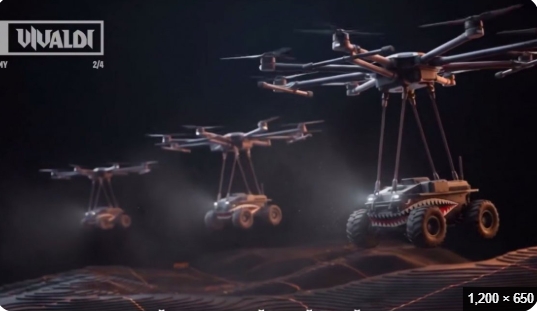
The robots went first. The soldiers followed — or didn’t.
Ukraine’s 3rd Army Corps just demonstrated a tactic that could make the infantry charge an artifact of 20th-century warfare. In the Vivaldi offensive in Donetsk, the unit pushed Spike-launched suicide UGVs into Russian fortified positions, fired grenades, then detonated the remaining payload once inside the wire. The result: 125 square kilometers of reclaimed territory, captured without sending a single infantryman into the initial breach.
This was not a one-off experiment. It was a structured reversal of centuries of assault doctrine. Traditionally, the most dangerous moment in any ground offensive is the final sprint toward enemy trenches — the point where defenders pour rifle fire, machine gun bursts, and artillery fragments into a path that only humans are willing to cross. Ukraine has now replaced that moment with a machine.
How the Vivaldi tactic works
According to Defense Express, each UGV carried two portable Spike launcher tubes and was operated remotely from a position at least 10 kilometers behind the front line. The platform approached the target, fired its grenade launcher to suppress or destroy outer defenses, then surged forward into the fortification and detonated its remaining explosives on command.
Russian forces reacted in a way that may have been exactly what Kyiv expected. Video footage from the operation shows robots approaching fortifications at Ryazansky Sakhar, Chitanka, Tsyhopil, and Beyko. Defenders reportedly treated the incoming machines as infantry infiltrators — identifying the threat incorrectly — and concentrated their defensive fire accordingly. That concentration of fire depleted ammunition and attention that might have been better allocated elsewhere.
Ukraine’s military claims the operation hit three targets simultaneously: direct engagement of Russian positions, physical destruction of fortified structures, and psychological pressure on defending troops. The last one is the hardest to measure but arguably the most consequential.
Who wins and who loses
Ukraine gains the most obvious advantage: reduced personnel casualties in the most lethal phase of any offensive. Breaching fortified lines has always been the bloodiest operation in ground combat. By absorbing that cost into machines, Kyiv preserves the human capital that takes years to train and even longer to replace.
Russia’s loss is less about the immediate tactical damage and more about a strategic vulnerability it has not yet addressed. Russian forces have spent the war building some of the most dense and sophisticated trench networks in modern European history. Those networks were designed to absorb and break conventional infantry assaults. A weapon that approaches, fires, then detonates itself inside the wire without a human on the receiving end of that fire changes the calculus entirely.
The real question is whether Russian doctrine can adapt fast enough. Electronic warfare units, minefields, anti-drone nets, and close-quarters infantry all played roles in blunting previous Ukrainian offensives. None of those systems were designed with kamikaze UGVs as the primary threat.
The limits that still matter
UGVs are not the solution to every problem. They face constraints that drones simply do not encounter. Ground platforms must traverse physical obstacles — craters, trenches, debris, uneven terrain — that airborne systems can easily clear. Radio interference and electronic warfare jamming, both of which Russia deploys extensively, can cut a UGV’s control link at the worst possible moment, leaving a multi-million-dollar machine stranded in no-man’s-land with no way to retrieve it.
Ukraine’s 3rd Army Corps acknowledged these vulnerabilities after Vivaldi. Its operational range of 10 kilometers behind the front line demonstrates reach, but also highlights a gap: what happens when radio silence, terrain, or jamming forces the robot to engage blind? The current spike-launched UGV is a single-purpose tool, not a flexible platform capable of adapting mid-mission.
What comes next
Ukraine is already planning the next phase. Kyiv intends to add communications relay capability to its UGV fleet, which would extend operational range and reduce vulnerability to signal loss. More importantly, the military wants to broaden the mission profile — reconnaissance, base area surveillance, and multi-role tasks — rather than keeping these machines locked to the suicide-breach role.
If those plans materialize, the impact grows exponentially. A UGV that can scout ahead, identify targets, call for fire, and then optionally detonate itself in the breach is a fundamentally different weapon than one that does only the last step. It becomes a persistent presence on the battlefield, a force multiplier rather than a disposable asset.
Western defense establishments are watching this closely. The United States, NATO, and other potential buyers of Ukrainian defense technology are studying whether the lessons from Vivaldi apply to their own force design. The answer likely depends on one factor: can these systems be produced, fielded, and maintained at scale?
Why Korean coverage came first
This story broke in Korean defense media through Global Economy reporter Choi Sam-yeol, with Western outlets still catching up. That sequencing matters. Korean defense publications have built deep expertise tracking Ukrainian battlefield innovation — often faster than their Western counterparts — because South Korea is itself a major arms exporter with commercial stakes in understanding what works. When a Korean outlet reports a Ukrainian tactical shift before Western defense editors, it signals that the information pipeline is no longer单向 from Kyiv to Washington.
The wider picture
Ukraine’s deployment of Spike-launched suicide UGVs in the Vivaldi offensive represents the earliest mature field test of a concept that will define ground combat for the next decade. It proves that mechanized infantry can be replaced by unmanned ground vehicles in the most dangerous phase of an offensive — the breach itself.
The limitation is not the idea. It is the environment: electronic warfare, terrain, and the logistical reality of sustaining these machines under fire. Overcoming those constraints will separate the units that treat UGVs as experimental curiosities from those that integrate them into the core of their assault doctrine.
Russia has spent two years building the most sophisticated trench system in Europe. Ukraine has just shown how to dismantle it with machines. The war’s next chapter will be written by whichever side adapts faster.