Why US Data-Center Zoning Wars Are Choking AI Investment
American local zoning battles over data-center construction are creating an unexpected bottleneck in the global AI supply chain. Korean memory-chip stocks moved first — now the whole sector is paying the price.
The Canary in the Coal Mine Moved First
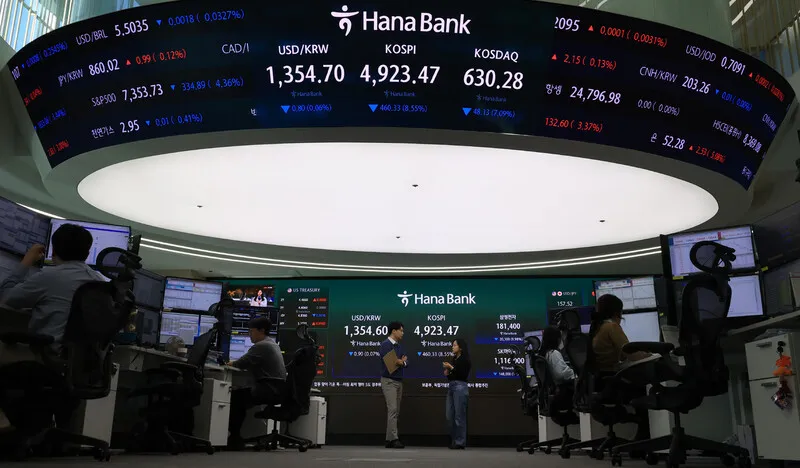
When the KOSPI triggered a circuit breaker on a Tuesday morning in November 2024, the story wasn’t about Seoul. It was about Texas. And Iowa. And a dozen suburban counties across the American Midwest that had never thought about server farms until residents started fighting them in zoning hearings.
Samsung Electronics fell 5 percent. SK Hynix dropped 7.4 percent. Korean memory-chip stocks — the companies that supply the bulk of the world’s AI training hardware — were the first to sell. Within hours, the panic had spread to Nvidia, AMD, Broadcom, and Intel. The Nasdaq composite shed 5.5 percent. The market capitalization of the Magnificent Seven evaporated by more than $1 trillion in a single session.
The trigger was not a earnings miss, a Fed announcement, or a geopolitical escalation. It was a political outcome: Democratic gains in the US midterm elections that brought to power a coalition of local activists, progressive politicians, and utility-skeptical regulators who were suddenly willing to say no to data-center construction on a scale that had not been seen before.
The Real Chokepoint Is Not Chips. It’s Land.
Every analysis of the AI supply chain focuses on the wrong constraint. The world has more than enough design talent. It has enough capital flowing into the sector — $300 billion in global data-center spending projected for 2025 alone. It even has enough silicon capacity, if you ignore the three-month lead time on HBM memory.
The bottleneck is something far more mundane and far more immovable: local zoning law.
In Texas, the newly elected governor-elect defended the pause, telling CNN that data-center operations should stop until protections for local communities are in place. In Washington state, Senator Bernie Sanders — normally associated with domestic spending programs — took to X and called for a national data-center moratorium. These were not fringe positions. They were the opening salvo of a political realignment that treats AI infrastructure as a public-good problem rather than an economic opportunity.
The market understood immediately what this meant for memory-chip demand. Data-center construction timelines determine when hyperscalers order their next round of HBM3e and DDR5. Every month of delay pushes procurement into the next fiscal year. Every cancellation reorders the capex cycle for Samsung, SK Hynix, and Micron.
Big Tech Already Knows It’s Harder Now
Before the stocks started falling, the executives were already talking among themselves about what had changed.
Microsoft told Bloomberg it was reviewing the construction sites of several neo-cloud providers and considering pulling back from high-risk projects entirely. Meta’s president, Dina Powell McCormick, told the Wall Street Journal that new data-center construction would face far more scrutiny, and predicted that building in the United States would become significantly harder going forward.
These are not the words of companies facing a temporary permitting delay. They are the words of companies recalibrating multi-year capital plans against a new political reality.
The neo-cloud segment — CoreWeave, in particular — was already trading at a premium that assumed uninterrupted expansion. When its CDS premium hit a record high on the same day as the selloff, it signaled that bond markets saw the risk differently than equity markets had been pricing it. SpaceX faced the same dynamic: the company had spent months reassuring investors that its Starlink and satellite-data operations would fund its AI infrastructure ambitions. That reassurance evaporated when credit spreads widened to levels that made borrowing for new facilities prohibitively expensive.
The Korean Memory-Chip Story You Should Be Watching
Korean semiconductor stocks are not just exposed to AI capex. They are the most sensitive barometer for it. Samsung and SK Hynix together account for roughly two-thirds of global DRAM output and a dominant share of HBM production. When data-center builders delay a project, they do not cancel it — they push it. The orders get bumped from Q2 to Q3, from Q3 to Q4, from this year to next. Memory-chip demand is therefore a leading indicator of infrastructure conviction, not a lagging one.
That is why the Korean stocks moved first. They are the canary. And the canary is not just sick — it is being used as a thermometer.
Micron, meanwhile, added fuel to the fire. The company announced it was halting construction on a new memory fab in Taiwan because of a labor dispute between management and workers over wages. This was not a policy problem. It was a operational one, but it came at the worst possible moment and reinforced the narrative that AI infrastructure expansion faced resistance on every front — political, regulatory, and now labor.
Qualcomm reported weak earnings. AMD posted a dismal result. The sector-wide deterioration had moved beyond data-center anxieties into general profit-taking and re-pricing of growth assumptions.
Who Wins. Who Loses. What Happens Next.
The winners in this environment are not obvious, which is precisely why the market is confused. Companies with existing data-center capacity — especially those outside the United States — gain leverage. European and Middle Eastern hyperscale operators can offer certainty that American builders cannot. Sovereign wealth funds in places like Saudi Arabia and Singapore are watching American zoning battles and realizing that their own infrastructure pipelines face fewer obstacles.
The losers are the neo-cloud providers who relied on US-based construction to differentiate themselves. CoreWeave’s stock dropped nearly 10 percent. Its credit metrics deteriorated. The premium it commanded for speed-to-market has vanished if the market cannot build fast enough to justify the valuation.
For Korean memory-chip manufacturers, the implication is less immediate but structurally significant. Samsung and SK Hynix have been pricing their 2025 outlook on the assumption that hyperscaler demand will continue accelerating. If every major US project faces a six-to-eight-month delay, that assumption breaks. Inventory builds. Prices soften. The memory cycle turns earlier than the bulls expected.
What happens next depends on whether the political opposition to data-center construction coalesces into policy or remains a series of local grievances. A national moratorium is unlikely — the administrative process would be too contentious, and the economic benefits of AI infrastructure are too well understood by Republican leadership. But localized delays, environmental reviews, and community impact assessments will multiply. Every county that requires a power-grid impact study adds weeks. Every utility that demands infrastructure upgrades before connection adds millions.
The KOSPI’s circuit-breaker day was not a correction. It was a repricing of a structural risk that English-language markets had been ignoring. The chokepoint in the AI supply chain is not silicon. It is land use. And until that becomes clear to every investor, the next wave of volatility will catch the same people off guard.