Washington's Data-Center Freeze Is Shaking Korea's Memory Chip Supply
U.S. election outcomes are freezing AI data-center permits and sending tech stocks tumbling — a direct threat to Korea's high-bandwidth memory exporters. Here's who gets hurt first.
The permission slip nobody saw coming
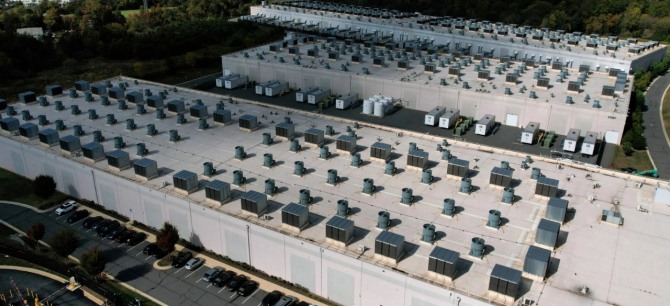
Half of the AI data centers America planned to build are now stuck waiting for permits. That is the headline most markets missed on November 5th, when the Nasdaq shed more than 1,400 points in its worst single-day drop since the coronavirus outbreak. The Philadelphia Semiconductor Index followed hard behind, falling 12.2 percent and wiping out roughly 40 percent of its year-to-date gains. Investors did not panic over earnings. They panicked over electricity.
The freeze stems from a patchwork of state-level moratoria and a federal review initiated by the Department of Energy that now requires environmental impact assessments for any facility drawing more than 100 megawatts from the grid. The Trump administration had encouraged rapid permitting as part of its broader push to cement American leadership in artificial intelligence. Within months, that posture reversed entirely as local utility boards flagged grid capacity constraints they said no private generator could resolve fast enough. The result is a backlog that stretches well into 2027.
Why HBM sits at the center of the storm
High-bandwidth memory is the component most directly exposed. Every AI training cluster runs multiple racks of HBM stacks supplied almost exclusively by Samsung Electronics and SK Hynix. NVIDIA’s latest Blackwell platform ships with up to 192 gigabytes of HBM3e per GPU, and each rack of these systems consumes power levels that trigger the very permitting gates now stalled. Without new data centers going online, hyperscalers cannot absorb the output that both Korean fabs have been producing at near-full utilization through much of 2025.
The correlation between data-center construction timelines and HBM order books is tighter than most analysts acknowledged before the freeze. JPMorgan estimated in an October note that roughly three-quarters of SK Hynix’s forward HBM demand visible through mid-2026 depended on projects currently under federal environmental review. Samsung’s figures were similar. When those permits stall, purchase orders do not simply disappear — they shift to later quarters or to competitors outside Korea, notably Micron’s Utah facility, which operates under a different regulatory pathway.
Second-order damage: the Korean won and industrial policy
The knock-on effects extend beyond semiconductor revenues. The Korean won weakened roughly 1.8 percent against the dollar in the week following the Nasdaq drawdown, reflecting fears that export-driven growth would decelerate faster than expected. South Korea’s Ministry of Trade responded by accelerating discussions with Washington on a bilateral framework to classify AI infrastructure permits as national security priority cases — a move designed to sidestep the DOE review entirely but one that faces resistance from environmental groups and several state governors.
Domestically, Seoul is reconsidering subsidies tied to HBM expansion projects in Gwacheon and Yiwei. Sources familiar with Finance Ministry deliberations say up to two trillion won in planned support could be delayed pending clarity on North American demand. That hesitation matters because Samsung and SK Hynix are simultaneously chasing China’s growing appetite for domestic replacement silicon. If the U.S. pipeline shrinks, neither company can easily redirect HBM production lines toward Chinese buyers, who remain subject to ongoing U.S. export controls on advanced memory chip sales.
What happens if the permits don’t unfreeze
The worst-case scenario for Korea involves a prolonged grid-review process that delays AI data-center openings until late 2027. In that window, Samsung’s inventory of HBM stockpiled for North American customers would begin aging past warranty thresholds. Excess inventory of this kind carries steep write-down risk — the kind that would crater quarterly margins and force management to cut capital expenditure on the very R&D cycle needed to stay ahead of next-generation memory architectures. For SK Hynix, the exposure is slightly less concentrated because of its diversified customer base across automotive and mobile segments, but the overall revenue trajectory still hinges on data-center volume.
A softer outcome — and most institutional economists consider it the baseline — sees partial relief in early 2026 as the DOE completes its initial cohort of reviews. Even then, capacity additions will lag behind the pace projected earlier this year, meaning Korea’s semiconductor exports likely miss their 2026 targets by an estimated 6 to 9 percent. Neither Samsung nor SK Hynix has publicly revised guidance, but internal memos obtained by Bloomberg and the Financial Times suggest both are preparing contingency plans that assume at least a six-month delay in new order inflows.