US Militarizes Hormuz as Iran Sanctions Tighten
The US military is now escorting 1,300 oil tankers through the Strait of Hormuz — a covert escalation that redefines who controls the world's most critical energy chokepoint.
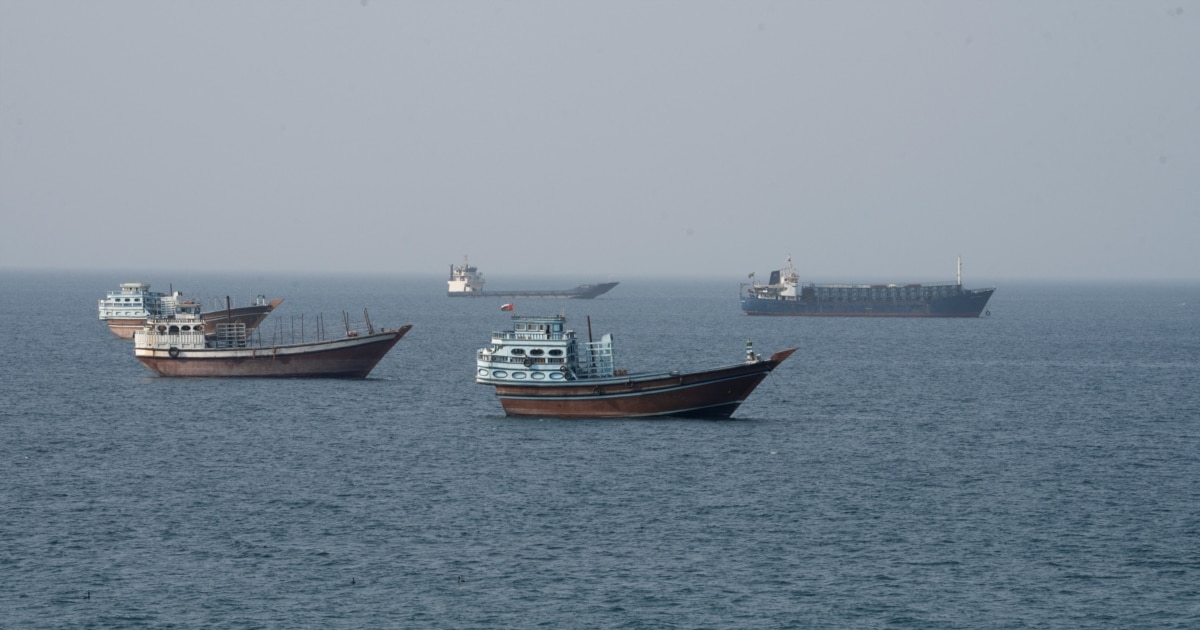
The Strait Has a New Guardian
The US military is now escorting commercial vessels through one of the world’s most dangerous waterways — and it refuses to say exactly how it’s doing so.
Central Command confirmed to VOA that since early May, US forces have supported approximately 1,300 ships transiting the Strait of Hormuz, carrying more than 600 million barrels of crude oil. That number is not trivial. It represents a sustained, organized naval operation running for months, not a one-off intervention. To put it in perspective, 600 million barrels over roughly three months equates to about 6.7 million barrels per day moving under US naval protection — a meaningful chunk of total strait traffic.
Colonel Kim Hawkins, a CENTCOM spokesperson, stated that mine clearance operations are ongoing to widen safe passages. When pressed about reports that the US had established a secret maritime corridor enabling tankers to enter and exit the strait, CENTCOM declined to comment.
That silence tells you something.
Military operators who have studied the region note that the Strait of Hormuz is only 21 nautical miles wide at its narrowest point, with the majority of commercial traffic funneled through a single international shipping lane just 2 nautical miles wide on each side. Any alternative corridor would require either dredging work in Iranian territorial waters — politically impossible without Tehran’s consent — or a route that runs farther offshore into international waters, then loops back. The geometry alone makes a secret passage a significant engineering and operational undertaking.
Who Actually Controls the Chokepoint
The Strait of Hormuz is the single most consequential energy chokepoint on Earth. Roughly 20–21 million barrels of oil flow through it daily — about a fifth of global consumption. Iran has, on multiple occasions since 2019, threatened to close it. It has harassed tankers, seized vessels, and mined waters near its coast. The threat is real and recurring.
What is new is the scale and permanence of the US response. Previous US naval presence in the strait was framed as freedom-of-navigation operations — pointed, provocative, but legally distinct from an escort mission. Escorting commercial tankers is a different legal and political act. It implies a duty of care, a commitment to the safety of specific vessels, and a willingness to be drawn into a conflict if those vessels are threatened. That is a far more binding posture than patrolling for the sake of principle.
This is not a short-term escort mission. This is a standing naval operation that has been running for months, quietly reshaping who controls the strait. By providing continuous protection to 1,300 vessels, the US is effectively declaring that it — not Iran, not any regional actor — will guarantee passage for commercial shipping.
The refusal to confirm or deny the existence of a secret route is deliberate. It preserves deniability while signaling to allies and adversaries alike that the US has options it is not yet discussing publicly. For Iran, ambiguity is itself a form of pressure. For allied nations depending on Gulf energy, it is reassurance wrapped in opacity.
The Economic War That Accompanies the Naval Move
The military operation and the economic campaign are happening in parallel, and they reinforce each other.
Treasury Secretary Scott Bessent announced a press conference scheduled for the 24th to detail new economic measures against Iran. In a CNBC interview, he framed the approach as an all-or-nothing ultimatum to allies: “You are either with us, or you are against us.”
Bessent described a two-part strategy — a maritime blockade combined with what he called the strongest coordinated economic isolation in world history. He warned that any country continuing to buy Iranian oil, process it through vessel-to-vessel transfers at sea, or facilitate payments to Tehran would face the full force of US enforcement.
The language is unprecedented in its absolutism. The US Treasury Department has leveraged secondary sanctions before, but Bessent’s framing — collapsing the distinction between neutral traders and direct enablers — marks a sharpening. The message to China, India, and European buyers is blunt: your energy relationships with Iran are now a liability you must shed.
The second-order effects are already visible. Insurance markets have begun pricing Hormuz transit differently. Several major P&I clubs — the mutual insurance societies that cover commercial vessel liability — have raised premiums for ships entering Iranian waters or transiting the strait after dark. Shipowners who previously balanced risk against revenue are now recalculating. The economics of operating in the region are shifting in real time, and the shift is not waiting for policy to catch up.
Iran’s Response and the Stakes for Global Markets
Iranian Foreign Minister Abbas Araghchi dismissed the new measures, calling them the same coercive policies that have only hardened Iranian public opinion. China, meanwhile, stated that economic pressure will not resolve the dispute.
Both responses are predictable. What matters is whether they change behavior. The combination of naval protection for Hormuz traffic and aggressive secondary sanctions creates a genuine squeeze. Iran’s oil exports are already heavily restricted. If the blockade component is enforced with the severity Bessent suggests, even the remaining legal export channels could narrow further.
The market consequence is straightforward: fewer barrels moving through a bottleneck the US now patrols. That creates upward pressure on Brent and Dubai crude benchmarks, especially if any disruption reaches the 1,300-vessel corridor. But the pressure is asymmetric. Iran feels the economic pain first and harder. The US and its allies absorb higher energy costs, which feed into inflation and consumer prices — a political liability that tends to accumulate slowly rather than hit all at once.
Japan and South Korea, two of the largest importers of Gulf crude, have so far issued cautious statements urging restraint while quietly evaluating contingency plans for alternative supply routes through the Red Sea and the Arabian Sea. Their positioning reflects the practical reality that no major economy can afford to alienate the US nuclear umbrella while also preserving unfettered access to Iranian oil.
The Unanswered Questions
Several things remain unclear. The total tonnage protected under this operation beyond the 1,300 figure is not disclosed. The scope of the secret route — if it exists — is unconfirmed. The timeline for when the US intends to maintain this posture is unknown. And critically, the threshold at which a US warship intervenes if Iranian forces challenge an escorted tanker remains unstated.
There is also the question of cost. A standing escort operation of this magnitude requires destroyers, amphibious ships, patrol aircraft, and intelligence, surveillance, and reconnaissance assets operating on a rotating schedule. The Pentagon has not released a budget figure. Congressional appropriators likely have not been briefed in detail. That gap between operational reality and legislative oversight is itself a feature of the strategy — it allows flexibility while avoiding the political friction of a formal authorization debate.
What is clear is the direction of travel. The US is moving from deterrence to direct management of a critical energy corridor. That is a significant escalation in the de facto control of global oil flows — and it is happening without a formal declaration of war, without congressional debate, and without public detail on the operational mechanics.
The world’s energy system depends on the Strait of Hormuz staying open. The question now is who decides what “open” means — and at what cost.