US Tech Giants Pour $2B Into Korea as Tariff Talks Stall
Four US tech firms are committing $2 billion to South Korea across semiconductors, advanced materials, and offshore wind — even as tariff negotiations between the two governments remain deadlocked. Supply chains are moving faster than trade policy.
The Deals Outpace the Diplomacy
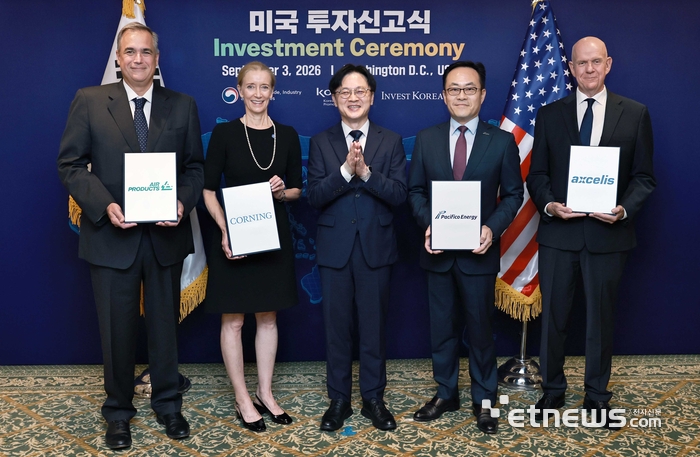
While US-Korea tariff negotiations flounder in Washington, four American technology companies have quietly committed $2 billion in direct investment to South Korea. The announcement, made at a Foreign Direct Investment declaration ceremony on September 3 at the US capital, signals something important: the realignment of critical supply chains is being driven by corporate strategy, not trade policy.
The four investors — Air Products, Axcelis Technologies, Corning, and Pacifico Energy — represent three distinct sectors: semiconductor materials and equipment, advanced display materials, and offshore wind energy. Their combined footprint will reshape how these industries cluster in South Korea, and it will do so largely independent of whatever framework (or lack thereof) emerges from bilateral trade talks.
Pyeongtaek Becomes a Second Silicon Heartland
The largest concentration of investment lands in Pyeongtaek, where Samsung Electronics is building its next-generation semiconductor production base. This is no accident. Pyeongtaek already hosts Samsung’s most advanced fabrication plants, and the arrival of dedicated US suppliers turns it into a full-stack ecosystem — not just a place where wafers are processed, but where the gases, equipment, and materials that make modern chip manufacturing possible are produced within a 30-minute radius.
Air Products is building the most significant project of its Korean operations to date. The company will construct dedicated gas supply infrastructure for Samsung’s advanced nodes, including ultra-high-purity process gases, rare gases for fine patterning, and on-site hydrogen production facilities. For a facility like Samsung’s Giga Fab, gas purity isn’t a nice-to-have — it is the difference between yield and scrap. Air Products’ decision to locate this infrastructure in Pyeongtaek rather than relying on imports or distant regional hubs tells you everything about how seriously these companies are committing to South Korea’s semiconductor corridor.
Axcelis is doing something structurally different. Since 2021, Pyeongtaek has been the company’s only ion implanter manufacturing site outside the United States. Ion implanters are among the most capital-intensive pieces of front-of-line semiconductor equipment, and Axcelis is now expanding production capacity there while adding R&D, prototyping, and technician training functions. The Korean government’s language is expansive: they want to position South Korea as an Asia-Pacific technology innovation and export hub. That ambition is concrete when your sole non-US manufacturing base for a critical process tool is sitting in a city of 500,000 people an hour from Incheon Airport.
Corning Turns Half a Century Into a Capability Leap
Corning entered South Korea in 1973. Five decades of continuous investment might sound incremental, but the company is now accelerating its capital spending in Asan, introducing next-generation process equipment for mobile and semiconductor materials. What makes Corning’s move noteworthy isn’t the dollar amount — it’s the direction. The company is betting that Korean manufacturing will be the locus of its next wave of advanced substrate and cover glass production, not just a cost-effective extension of its existing operations.
The Wind Project That Changes the Energy Calculus
Pacifico Energy’s 3.2 GW fixed-bottom offshore wind project near Jindo is the outlier in this group — not because it’s less significant, but because it reveals the full logic of the investment cluster. Fixed-bottom offshore wind is a different animal from the floating installations that have dominated Korean energy discussions. Jindo sits 44 to 78 kilometers from shore in waters suitable for bottom-fixed turbines, and the project is explicitly designed to supply clean electricity to AI data centers and other energy-intensive advanced industries.
This is where the narrative that this is just a semiconductor story breaks down. South Korea has a well-known energy constraint: its power grid was not designed for the load profiles of massive semiconductor fabs or AI data centers. Pacifico’s project addresses that gap directly. If the wind farm comes online as planned, it provides a dedicated clean energy source that could unlock additional semiconductor and computing capacity that would otherwise be blocked by grid congestion or carbon compliance requirements.
What This Means Beyond the Headlines
The timing of these announcements carries a message. The investment declaration occurred in Washington, not Seoul, and was attended by Industry Minister Kim Jeong-gwan and KOTRA President Kang Kyung-seong alongside the CEOs of all four companies. That location choice is deliberate — it positions these deals as part of a US-Korea industrial partnership that transcends the trade negotiation table.
For the Korean government, these commitments are a liftoff for its three mega-projects, which have faced headwinds from uncertainty about US trade policy and the broader geopolitical environment. The investments also reinforce what some analysts have called the “Pyeongtaek model”: a cluster strategy where equipment, materials, and fabrication co-locate to reduce cycle time and increase supply chain resilience. In an era where chip making is increasingly viewed through a national security lens, that model has strategic value beyond economics.
For the American companies, the gamble is that South Korea will remain the preferred location for advanced semiconductor and clean energy manufacturing even as tariff questions linger. Their capital commitments suggest they believe it will. Air Products, Axcelis, and Corning have all bet heavily on Samsung and the wider Korean fab ecosystem. Pacifico is betting on Korea’s energy transition.
The unresolved tariff negotiations between Washington and Seoul remain a background risk. But corporate capital has already moved. The question now is whether policy will catch up — or whether these investments will continue to set the agenda independently.