Water Is the New Semiconductor Battleground
Samsung and SK Hynix are converging on a single realization: the next edge in chip making won't come from smaller transistors alone, but from who controls the water they require. A look at why that changes everything.
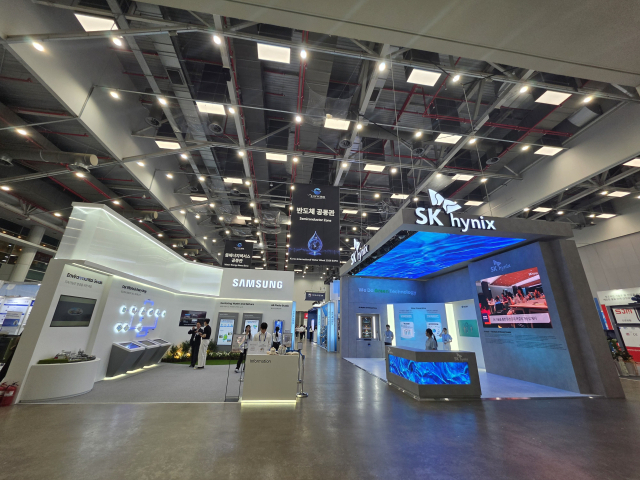
The Quiet Resource That Could Redefine Who Wins in Chips
At the International Water Week 2026 in Daegu, Samsung Electronics and SK Hynix stood side by side at exhibition booths for the first time. Organizers of the event — historically dominated by municipal water, wastewater, and desalination players — had never seen the two semiconductor giants commit before. Their presence signaled something bigger than corporate sponsorship.
Water is no longer just an input for chip factories. It is the constraint that will determine whether they expand, where they expand, and who can out-invest their rivals on infrastructure when water runs short.
The scale of demand is hard to overstate. Yoo Cheol-sang, president of the Korean Water Resources Society, put it plainly at a special session: a single semiconductor cluster in Yongin consumes as much water as a mid-sized city the size of nearby Incheon. The sprawling Honam semiconductor cluster near Gwangju requires even more. These are not marginal additions to local water systems. They are new urban-scale demands layered on top of existing municipal supply, in a country where per-capita water availability has been falling for two decades.
The Infrastructure Math No One Is Discussing in Silicon Valley
The conventional narrative around semiconductor competition focuses on transistor density, packaging, and AI workload allocation. Water is nowhere in those conversations. But at International Water Week, speakers made clear the logic is shifting fast.
Bang Sang-ho, a senior fellow at Ecolab, argued that future competitiveness in chips will hinge less on process nodes and more on whether a company can sustainably power a fab’s water and electricity needs. His point was specific: data centers consuming AI chips need water and power simultaneously. A fab and a data center are now part of the same resource equation. Build one without planning for the other, and you build a bottleneck.
The industry’s response to this constraint is already visible in Korean company strategy. Samsung projected its water demand will more than double by 2030 compared to 2021 levels, driven by advanced process expansion. At the same time, the company set a target to hold natural water withdrawals flat at 2021 levels. That gap — rising demand against capped extraction — has to be closed through recycled water, wastewater reuse, and alternative sources.
SK Hynix is approaching the problem from the opposite direction: it now builds wastewater treatment and water-supply facilities before it breaks ground on new fabs. The company’s engineer Ahn Se-hyeok summarized the logic during the same Daegu session with a sentence that captured the industry’s turning point: “We can generate electricity, but we cannot generate water.”
The Ultrapure Water Blind Spot
Here is where the story gets geopolitical in ways few analysts are tracking.
Despite being home to the world’s two largest memory-chip producers, Korea still does not dominate the supply of ultrapure water — the ultra-clean water required for advanced lithography and etching steps. The industry remains structurally dependent on foreign suppliers. That dependency creates a strategic vulnerability: if ultrapure water capacity is constrained, Korean fabs cannot simply source it domestically the way they can source silicon or helium.
Lee Doo-jin, director general at K-water, pressed this point directly at the conference. He argued Korea must move from being a rule-taker to a rule-maker in ultrapure water — building domestic technical capability, accumulating real-world validation data from local fabs, and eventually setting the quality standards that other countries follow.
That is a long trajectory. But the urgency is real. If a fab cannot get ultrapure water at scale, it sits idle. No amount of design talent or equipment procurement matters if the water isn’t there.
What This Means for Global Supply Chains
The water-半导体 linkage has implications that extend well beyond Korea.
First, it raises the cost of entry for new fabs in water-stressed regions. Texas, Arizona, and parts of India are all pursuing semiconductor investment booms. Each new facility adds millions of cubic meters of annual demand to local water systems. Cities like Phoenix and Austin are already facing drought stress. The question of whether these projects are sustainable on water alone will surface faster than most investors realize.
Second, it changes the geography of competitive advantage. A fab in a water-rich region with strong recycling infrastructure may ultimately out-compete a fab on a superior node in a water-scarce location, especially as AI workloads push both chip production and data-center growth simultaneously. The firms that solve the water problem cheaply — through closed-loop recycling, industrial wastewater reuse, and ultrapure water efficiency — gain a structural cost advantage that node shrinkage alone cannot replicate.
Third, it introduces a new dimension of supply-chain risk. Water disruptions at a single advanced fab can ripple through memory and logic supply chains globally. The 2021 Taiwan drought, which forced TSMC to reduce output, was an early warning. The Korean clusters mentioned in the source — Yongin, Honam, Pyeongtaek, Hwaseong — are similarly concentrated. Any regional water shortage there would affect a disproportionate share of global memory supply.
The Stewardship Pivot
Samsung’s internal water-management leader, Koo Tae-wan, noted that the company has been raising water issues in international forums since 2022, but that the intensity of attention has accelerated dramatically. The shift is from internal conservation targets to what he called “water stewardship” — a framework that considers the broader community and ecosystem around a fab, not just the factory fence line.
This is not PR. It is operational reality. Fabs are negotiating with local municipalities over shared water resources. They are co-investing in wastewater treatment plants that serve surrounding communities. They are redesigning processes to reduce freshwater intake per wafer. The companies that treat water as a stewardship problem rather than a utility bill will be the ones that avoid conflicts, secure social license to expand, and build resilience against climate-driven supply shocks.
The International Water Week 2026 attendance by Samsung and SK Hynix is a symptom of a larger transition. Semiconductor strategy is expanding from lithography to hydrology. Whoever masters water — who can deliver ultrapure water at scale, recycle at low cost, and integrate water planning with energy and facility planning from day one — will hold an advantage that no process node specification can capture.
The question for investors and policymakers is whether they are looking hard enough at the resource underneath the silicon.