What Putin's 1.55-Million Army Means for Ukraine and NATO
Putin quietly raised Russia's active-duty troop ceiling to 1.55 million — the highest since the Soviet era. The move signals a deepening manpower commitment that could reshape Ukraine's defense calculus and accelerate European rearmament.
The Number That Changes Everything
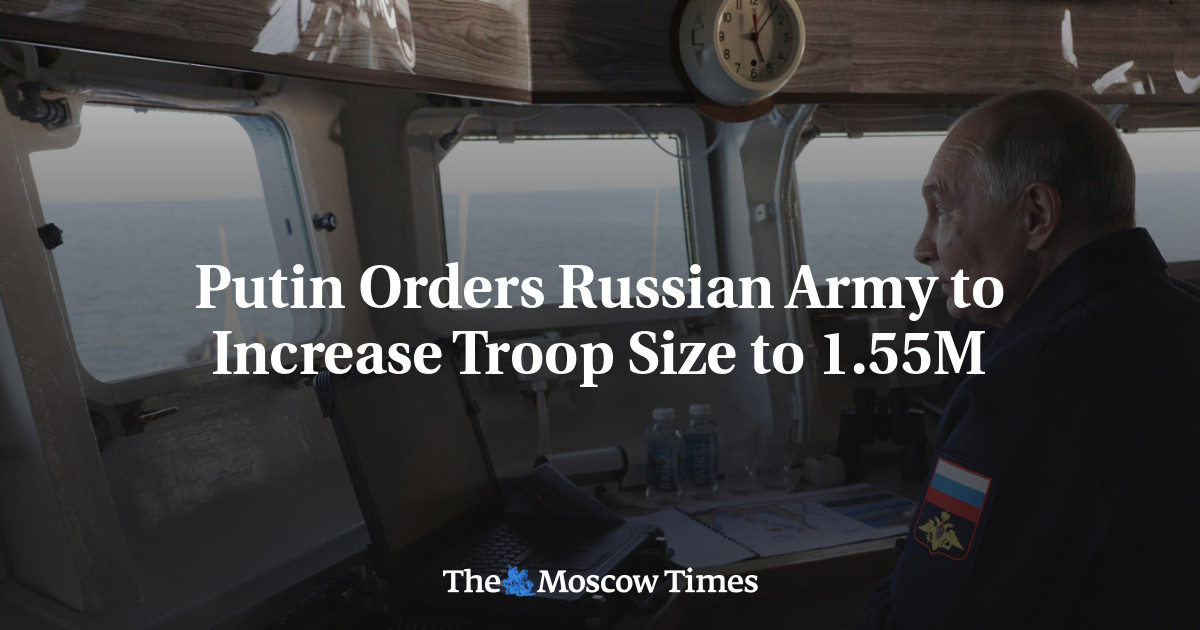
On Monday, Vladimir Putin signed an executive order raising Russia’s active-duty military strength by 15,500 personnel to a total of 1.55 million. No justification was offered. The Kremlin did not frame it as preparation for escalation, a response to any specific development, or a consequence of battlefield losses. That silence is itself a signal.
The figure matters because it is not incremental in any meaningful sense. It is the highest ceiling for Russian active forces since the collapse of the Soviet Union. And it follows a pattern: Putin has raised the cap four times since the full-scale invasion began in February 2022, each time pushing the number higher with the steady patience of a state betting its future on sustained attrition.
According to the exiled outlet Meduza, 52,500 new positions have been created this year alone, the vast majority of them active-duty military slots rather than civilian support roles. This is not a paper exercise in budget line items. Someone has to fill those uniforms.
Who Is Being Counted, and Why It Matters
The Russian military’s total personnel count — including civilians, contractors, and reserve structures — now stands at roughly 2.44 million. The active-duty slice is what commands attention in Kyiv, Brussels, and Washington because it is the force that can be deployed. Every increment represents boots on the ground, and every increment represents a choice to absorb casualties rather than withdraw.
Ukrainian President Volodymyr Zelensky has accused Russia of preparing for a new mass mobilization after last week’s parliamentary elections, claiming Moscow has “in effect” begun surging recruitment through various channels. He offered no specifics. Putin dismissed the claims as disinformation. Some analysts argue that a second mobilization order is unnecessary while the partial mobilization from September 2022 remains technically in force. Others counter that logistical bottlenecks and recruitment fatigue could blunt any further call-up regardless of legal authority.
The truth likely sits somewhere in between. Putin does not need a new mobilization decree to grow the army — the executive order is sufficient. What he needs is men willing to sign contracts and machines capable of training them. Both are harder to conjure than budget figures suggest.
The Ukrainian Dilemma
For Kyiv, the expansion reframes the war around a question that has haunted Ukrainian strategy since the first Ukrainian counteroffensive stalled in 2023: can a smaller force holding defensive positions sustain itself against an enemy that can absorb losses and keep feeding numbers into the line?
Russia’s approach has always been numerical. Ukraine’s has been technological and qualitative — better weapons, better training, better targeting. But quality has limits when quantity creates multiple simultaneous pressure points. A 1.55-million-strong army can rotate fresh units into contested sectors more frequently, sustain longer offensives, and tolerate higher casualty rates without triggering political fracture at home.
Ukraine is now fighting a war of endurance against a economy partially remobilized for total war. The question for Kyiv is no longer whether Russia can field more troops but whether it will spend them faster than the West can replace Western equipment sent to Kyiv. That is a far more uncomfortable calculus, and it is one that may force Ukraine to reconsider how it deploys its own limited manpower rather than trying to match Russia force-for-force.
NATO’s Uncomfortable Arithmetic
The ripple effects across the Atlantic will be felt most acutely in two domains: defense spending and industrial capacity.
European rearmament programs, already underway, will face renewed pressure to accelerate. Germany’s pledge to reach 2 million active personnel by 2031 looks modest against a Russia that has just committed to 1.55 million this year. France, Poland, and the Baltic states will recalibrate their own force structures accordingly. The conversation in Brussels shifts from whether to rearm to how fast it can be done without collapsing public consent.
NATO’s eastern flank faces a concrete problem: the alliance has spent decades designing forces built for high-intensity deterrence against a peer adversary, not for absorbing a gradual, multi-year increase in Russian deployment capacity. The current posture assumes rapid reinforcement in a crisis. Putin’s order suggests the crisis may be less acute but infinitely longer.
There is also a strategic communication dimension. The Kremlin does not need to explain the increase publicly. By simply signing the order and letting it sink in, Moscow sends a message to both adversaries and neutrals: Russia is prepared to outlast. The ambiguity is tactical. It denies analysts a clear pivot point while establishing a new baseline of expectation.
What Happens Next
Expect continued creeping expansion rather than sudden shocks. Putin has demonstrated a preference for small, unannounced increments that compound over time. Each raise of the cap tests domestic capacity and international attention simultaneously. If the Kremlin can absorb 15,500 new contracts without public backlash and without disrupting existing units, it will likely do it again.
For Ukraine, the implication is stark: defensive strategy must evolve from holding lines to managing attrition across a wider front. That means dispersing forces, deepening fortifications, and relying even more heavily on remote warfare capabilities that do not require matching manpower.
For Europe, it means accepting that rearmament timelines measured in years are insufficient. Supply chains for ammunition, air defense interceptors, and armored vehicles cannot be rushed without quality compromises — and rushing them is precisely what the next several years demand.
Putin did not announce an invasion. He did not declare a new offensive. He signed a paper and let the number speak for itself. That is how modern attrition works.
The 1.55-million figure is not just a statistic. It is a bet that Russia can outproduce, outlast, and outwait everyone else. The question for Kyiv and NATO is whether they still believe they can win by being right rather than by being numerous — or whether they are already forced into the harder arithmetic of matching quantity with their own.