Who Owns the Robot's Mind
American companies control roughly two-thirds of the world's top humanoid robot intelligence platforms, and a new architecture of dependence is forming — one that could lock manufacturers from Seoul to Shenzhen into decades-long tech tolls.
The New Layer of Dependence
Walk through any robotics trade show in 2026 and you will see robots that look nothing alike. The American units from Agility Robotics have a different posture than the Korean models from LG or Rainbow Robotics. The Chinese machines from Unitree and Agibot move with their own cadence. The German robots from Neural Robotics carry yet another design philosophy.
But beneath every one of them runs the same intelligence layer, designed in Silicon Valley. That is the story nobody is telling loudly enough about the next phase of global robotics competition.
Who Makes the Brains
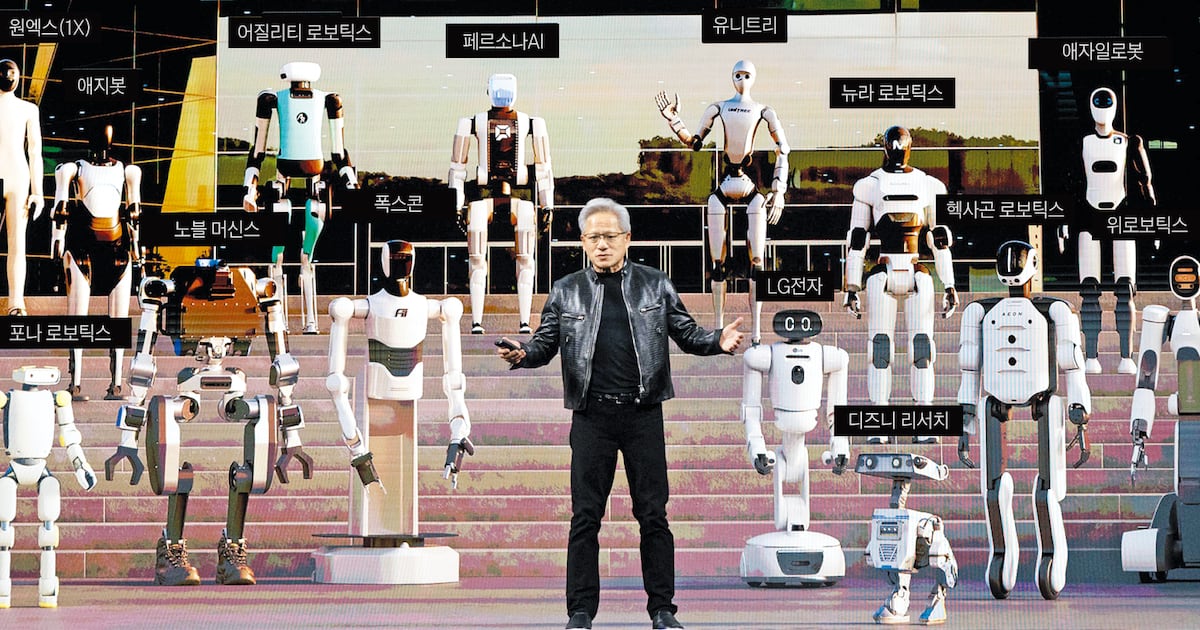
At GTC Taipei on June 1st, NVIDIA CEO Jensen Huang stood in front of a stage screen showing over twenty humanoid robots lined up in a group photo. They came from the United States, China, Germany, Korea, and elsewhere. Huang said the company works with almost everyone building robot systems in the world. He did not say who makes the robots. That distinction mattered.
NVIDIA builds neither bodies nor arms. It builds the reasoning systems inside them. Its GROOT foundation model, introduced in March 2024, was the first public statement of a vision: a general-purpose robot brain that any manufacturer could use. Since then, the company has layered on a virtual training environment, robotics-specific chips, and a full stack that lets a factory build a robot body without ever writing its own operating system for the mind.
Market research firm ABI Research estimates that more than 80 percent of the world’s humanoids now run on NVIDIA’s platform. In practical terms, that means a Korean engineer in Seoul and a Chinese developer in Shenzhen are using the same training simulators, the same inference chips, and the same foundational models, even when their products target entirely different markets.
The Numbers Behind the Architecture
A 2025 Morgan Stanley report on the “humanoid 100” found that ten of the fifteen most important companies developing robot intelligence are American. Only one — Baidu — represents China. The remaining four slots went to firms in Europe and other regions.
That 67 percent share may not sound like a monopoly at first. But consider what it means in practice. The American firms are not just building individual models. They are setting the curriculum. Google DeepMind released Gemini Robotics 2, which controls whole-body movement including walking, balance, and hand manipulation. Its Pi 0.7 system teaches robots to recombine learned motions to handle unfamiliar tasks. A company in Busan or Beijing that wants its robot to pick up an object it has never seen must learn that capability through an American-defined framework.
The pattern mirrors the IT industry’s decades-old success formula: design the core technology in high-cost countries, manufacture and assemble it where labor is cheaper. The difference now is that the hardware layer — the actual robot bodies — is moving into production across Asia, while the intellectual layer remains anchored in California.
What China Is Trying to Escape
Chinese manufacturers are aware of this dependency. Agibot and Unitree have both announced programs to develop proprietary robot brains. But even when Chinese firms build their own intelligence software, they still depend on American chips and virtual training tools to operate it. KIM Ik-jae, director of the AI and robotics lab at Korea’s KIST research institute, put it plainly: China is deploying AI into robotics at scale, but the gap in cutting-edge robot intelligence remains wide, and China is trying to close it through massive industrial datasets and field testing rather than through a direct technological lead.
This is not a new form of technological asymmetry. It is a familiar one, repeated with different components. The semiconductor industry spent twenty years trying to escape dependence on American design software and Japanese manufacturing equipment. China spent the 2010s building its own chip fabs to escape American semiconductor restrictions. Now the frontier has shifted again, and the bottleneck is no longer silicon alone — it is the models that tell silicon what to do.
Why Korea and Japan Should Care
Korean manufacturers are among the most visible adopters of the NVIDIA stack. LG Electronics and Rainbow Robotics have both showcased humanoids at international events, and both machines have carried NVIDIA branding prominently. That visibility reflects a strategic choice: enter the market fast, use proven infrastructure, and iterate from there.
The risk is that speed comes with a long-term cost. Every generation of robot trained on an American platform embeds that platform’s assumptions about how a machine should perceive, reason, and act. When the next competitive moat opens up — and it will — the companies that spent years learning inside someone else’s architecture will find it harder to pivot than the companies that built their own. This is not speculation. It is the story of mobile operating systems, cloud computing, and semiconductor design tools all rolled into one.
Japanese manufacturers face a similar dynamic, though with additional complications. Japan’s robotics heritage is deeper and more diversified than Korea’s, spanning industrial automation, medical devices, and service robots. But the foundation model race is happening at a scale and speed that favors well-funded, data-rich organizations — precisely the kind of ecosystem that American companies already control. Sony, Toyota, and Honda are investing heavily, but none of them currently sit inside the dominant intelligence layer.
The Geopolitical Calculus
There is a political dimension that goes beyond market share. Control of the robot intelligence stack means control over a pipeline that will shape how machines interact with physical space for the next thirty years. Every safety standard, every training regime, every capability threshold gets coded into those models. The country that sets the default shapes the behavior of machines that will work in hospitals, factories, homes, and streets around the world.
American policymakers have spent years watching China’s rise in manufacturing and infrastructure. The blind spot is less obvious: the AI infrastructure that will make those robots useful is almost entirely American-origin. When Chinese factories deploy thousands of humanoid workers, those workers will think using American-designed reasoning systems running on American chips in American-trained simulation environments. That is not an accident of business strategy. It is the outcome of a technology architecture built over a decade of venture investment, government research funding, and academic publication cycles concentrated in one country.
What Comes Next
The most likely scenario over the next three to five years is entrenchment, not disruption. NVIDIA’s platform will keep expanding its features and deepening its integration with robot manufacturers worldwide. American foundation model competitors will keep publishing incremental improvements. Chinese and Korean firms will keep adapting their hardware designs to the latest software capabilities without fundamentally changing the dependency structure.
A less likely but more consequential scenario would be a breakout. If a non-American firm built a foundation model competitive with GROOT, or if a major manufacturer decided to build its own stack despite the cost, the architecture could shift faster than most observers expect. The conditions for that would include a sufficiently large domestic dataset, a chip supply chain that does not require American hardware, and enough capital to absorb years of unprofitable development. China has two of those three. The third is harder to quantify but essential.
The Real Competition
The headline story in robotics right now is about how many fingers a robot hand has or how fast it can walk. The quieter story, and the more important one, is about who decides what the robot understands when it encounters something it has never seen before. That decision is being made in laboratories in Mountain View, Boston, and London, and it will echo through every factory, hospital, and warehouse on Earth for decades to come.