Why Korea's Semiconductor Surge Is Reshaping Global Trade Flows
The OECD just gave South Korea the biggest upward growth revision among G20 nations — a sharp pivot from its own February forecast. The driver isn't broad-based recovery; it's semiconductors. And that has implications reaching far beyond Seoul.
The Number That Changes Everything
The OECD raised South Korea’s growth forecast to 3.7 percent this year — a full 1.1 percentage point jump in three months. That is the single largest upward revision among all G20 economies. The next closest was the United States, Britain, the eurozone, and Japan, each revised up by just 0.2 percentage points.
To put that gap in perspective: Korea’s upgrade was five times larger than any other major economy’s. This is not a marginal recalibration. It is a regime change in how the world’s most influential economic institution views one of Asia’s critical economies.
And the driver is almost entirely narrow.
AI Demand Is the Engine
The OECD cited strong export and production growth, specifically pointing to semiconductors. The implication is unmistakable: artificial intelligence investment is flowing through Korean foundries and memory makers at a scale that is lifting national accounts.
This is not abstract. Korean semiconductor companies — primarily Samsung Electronics and SK Hynix — are the world’s dominant suppliers of high-bandwidth memory and advanced logic chips used in AI data centers. When AI capex accelerates globally, Korea’s export numbers move first and hardest.
The OECD itself noted that global growth was revised up to 2.9 percent, explicitly citing AI-driven increases in investment, production, and trade. Korea is simply the most exposed node in that circuit.
The March Reversal Was Extreme
What makes this upgrade striking is how far it came from.
In March, the OECD slashed Korea’s forecast to 1.7 percent, citing fallout from the Middle East conflict and oil price disruption. The March projection implied near-stagnation. In September, the same institution is calling for 3.7 percent growth.
That is a 2 percentage point swing in six months — a more dramatic reversal than any other G20 economy experienced. Korea went from being the OECD’s pessimistic case to its most optimistic one.
Domestic institutions are more muted. The Bank of Korea projects 3.3 percent. The Korea Development Institute is at 3.2 percent. The government forecast sits at 3.0 percent. The OECD is running well ahead of all of them, which suggests it is pricing in a semiconductor cycle that Korean institutions may be underweighting.
The Inflation Problem Nobody Is Discussing
While growth surged, the OECD simultaneously raised Korea’s inflation forecast to 3.0 percent — up 0.4 percentage points from June. That is higher than the central bank’s 2.7 percent projection and the government’s 2.6 percent estimate.
This matters because growth and inflation moving in the same direction creates a policy squeeze. The Bank of Korea faces a harder path: raising rates to combat inflation risks slowing the very export engine driving growth, while holding rates steady risks letting price pressures embed.
The OECD acknowledged the tension, recommending targeted energy support and structural reforms to boost potential growth. But it did not offer a clear path out of the dilemma.
Who Wins, Who Loses
Winners are straightforward. Korean semiconductor exporters are reaping the AI boom. Global AI infrastructure builders who depend on HBM and advanced NAND are getting supply from the cheapest geography. The won has likely strengthened against regional peers on capital inflows tied to Korea’s outperformance.
Losers are less visible but real. Korean consumers face a 3 percent inflation rate with stagnant real wage growth — a classic squeeze. The household sector, which the OECD expects to drive only a “moderate” recovery next year, is bearing the cost of an export-led boom. Small and medium manufacturers that do not supply the chip ecosystem are largely outside the growth story.
Regional trading partners feel the distortion too. When Korea’s exports surge on semiconductor demand, they displace Chinese and Taiwanese shipments in certain segments. Taiwan’s TSMC is insulated by its foundry focus, but Chinese memory manufacturers face compressed margins as Korean output scales.
What This Means for Global Supply Chains
The most important implication of this forecast is not about Korea. It is about where global semiconductor supply is concentrating.
Korea’s 3.7 percent growth is essentially a proxy measure for AI hardware demand. If the OECD is correct, it means the AI buildout is not slowing — it is accelerating, and Korea is the primary beneficiary among commodity-producing economies.
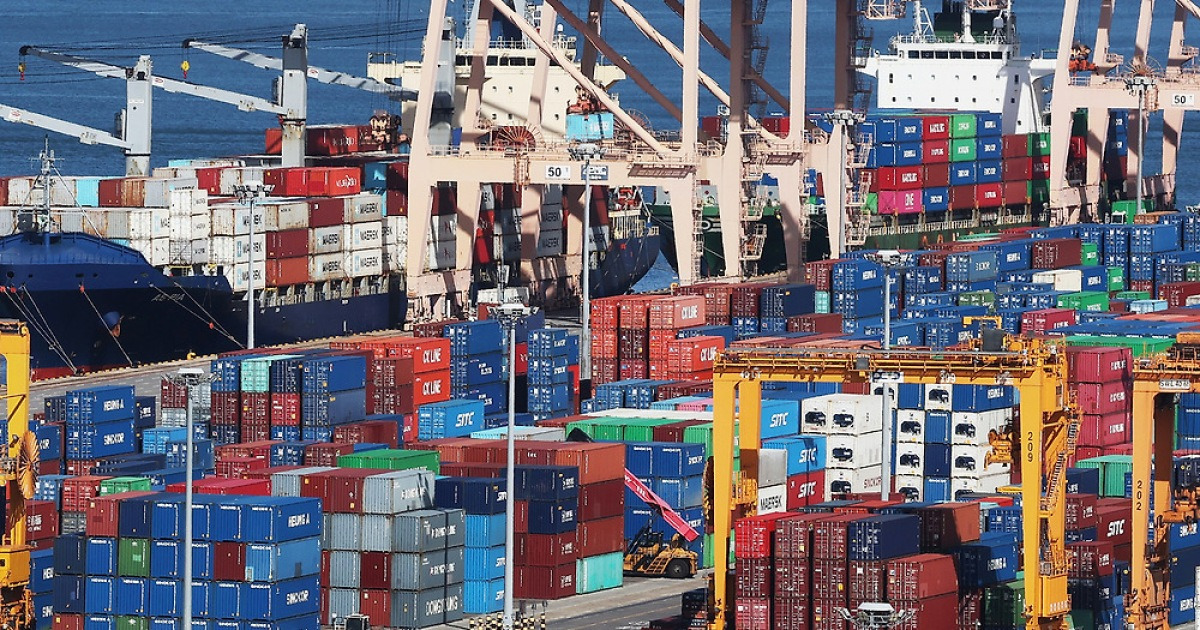
That has second-order effects. Shipping routes through Busan and Pyeongtaek are busier. Energy demand in Korean industrial zones is rising. The global trade imbalances that the Middle East conflict briefly disrupted are re-forming around a new center of gravity: AI-capable memory and logic.
Emerging-market capital flows are already reacting. Portfolio investors are rotating into Korean equities on the back of this growth surprise. The question is whether that rotation is sustainable or a temporary position built on a single-sector bet.
The Downside Risks Are Real
The OECD flagged three specific risks: sustained energy price increases, weather-related supply shocks, and further rises in long-term bond yields. All three are plausible.
Energy prices remain volatile. The OECD noted that global oil price forecasts were revised higher since June. If Middle East tensions persist or escalate, Korea — which imports nearly all its energy — faces a direct hit to both inflation and growth simultaneously.
Bond yields are already climbing. The OECD’s warning about rising long-term rates is significant for a country where corporate debt levels are high and the won-dependent export model relies on stable financing costs.
The Bigger Picture
The OECD’s upgrade of Korea’s growth is the largest in the G20 because Korea’s economy is uniquely exposed to the AI hardware cycle. That exposure is a double edge: it generates outsized growth when demand is strong, but it leaves the economy vulnerable when it shifts.
For global investors, the signal is clear. Korea is no longer a balanced Asian economy — it is an AI supply chain proxy. The growth story is real, but it is concentrated. And concentrated stories carry concentrated risk.
The 3.7 percent forecast is not a forecast about diversification. It is a forecast about dependency. The question for the next six months is whether dependency becomes a advantage or a liability when the AI investment cycle eventually pauses.