Why the Trump-Xi Meeting This Week Is a Stress Test for Global Order
With the Trump-Xi summit converging on the same week as the UNGA, Iran escalation risks, and North Korea's nuclear rhetoric, the real question is whether two aging leaders can manage their rivalry—or whether domestic politics forces them into a sharper confrontation.
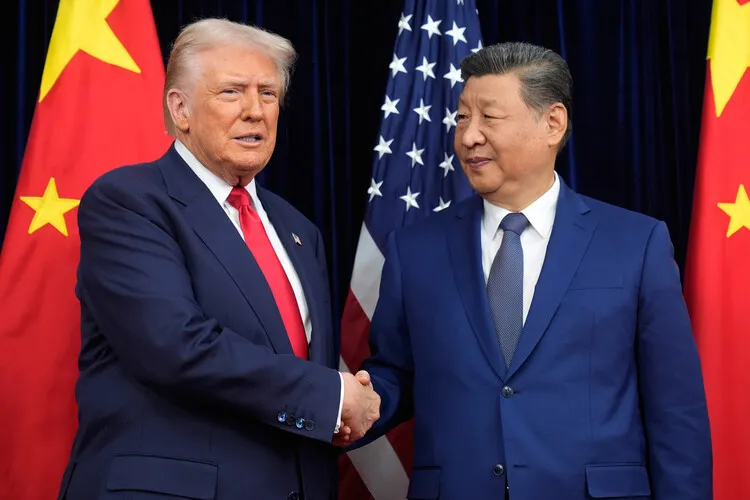
The Meeting That Isn’t Really About Meeting
Xi Jinping is skipping the United Nations General Assembly this year. He arrives in Washington on October 24 for a bilateral summit with Donald Trump—his third face-to-face meeting in ten months, after stops in Busan last October and Beijing this past May. On paper, this is routine high-level diplomacy. In practice, it is something far more consequential: a live experiment in whether two rival superpowers can keep their differences from detonating while both leaders are simultaneously racing toward domestic deadlines.
Trump is four weeks from midterm elections. Xi is positioning for a fourth term in the fall of 2026. Neither man has political runway for a new crisis with the other. But neither can afford to look soft either. The summit is therefore structured around one question: how do you de-escalate a rivalry without surrendering?
The Tariff Truce Is the Real Agenda
The visible flashpoints are familiar. US tariffs on Chinese goods, Beijing’s response through rare-earth export controls and allegations of industrial overproduction, and the increasingly fraught dialogue on AI safety. But the practical heart of this meeting is narrower and more urgent: the tariff truce that expires in November.
Treasury Secretary Scott Bessent and Chinese Vice Premier He Lifeng are holding economic and trade talks in New York on the 20th, just days before the summit. Their job is to carve out an extension framework that lets both sides claim a victory at home. Extending the truce buys time. It does not resolve the underlying contest over semiconductor access, green-tech subsidies, or who gets to set the rules for critical minerals.
Scott Kennedy of the Council on Strategic Risks (formerly CSIS) noted the structural constraints plainly: the US economy carries persistent inflation, rising unemployment, and a debt trajectory that makes a new trade confrontation politically toxic heading into November. For Trump, the calculus is straightforward—no crisis he doesn’t control. For Xi, the calculation is equally clear: stability buys breathing room for China’s own growth challenges.
The Iran Shadow
While Washington and Beijing negotiate tariffs, Trump is juggling a far messier problem. The Iran war has produced no clean exit. Oil prices have risen, domestic approval has dipped, and the electoral math for November is becoming uncomfortable. Trump told Axios on October 17 that he wants to hear directly from Gulf leaders before deciding whether to resume large-scale military operations against Iran.
That is why the UNGA week includes a clustered series of meetings with the six Gulf Cooperation Council states—Saudi Arabia, the UAE, Qatar, Bahrain, Kuwait, and Oman. These are not courtesy calls. They are intelligence-gathering and coalition-mapping sessions. Trump needs regional backing, or at least regional silence, if he escalates. He needs an off-ramp, or at least plausible deniability, if he does not.
Iranian President Masoud Pezeshkian is scheduled to address the General Assembly on October 23, one day after Trump’s own speech. The sequence is deliberate: Trump sets the American position, Pezeshkian responds, and everyone watches to see whether the gap between them narrows or widens. The GCC meetings in between will determine whether Washington has enough regional cover to act unilaterally—or enough pressure from allies to restrain itself.
North Korea’s Nuclear Rhetoric
The Korean Peninsula issue arrives at the UN wrapped in sharper language than usual. North Korea’s Vice Minister of Foreign Affairs Kim Sun-hyong is expected to attend and speak, and Pyongyang has been publicly reclassifying its nuclear status as an “irreversible position” rather than a bargaining chip. That wording shift is not accidental. It signals a strategic decision to lock in nuclear capability as a permanent feature of the regime’s legitimacy, removing it from the table of future negotiations.
This matters for Seoul directly. A North Korea that treats denuclearization as off the table changes the entire architecture of South Korea’s defense planning, its alliance calculations with Washington, and its own nuclear debate. The question for President Yoon Suk Yeol’s successors—or whoever holds office by the time the next crisis hits—is whether to adapt to a nuclear North Korea or continue spending resources trying to reverse a situation Pyongyang has declared irreversible.
Trump has also floated the possibility of meeting North Korean leader Kim Jong Un again. If the Trump-Xi summit produces any opening on the Korean front, it would likely come through Beijing’s leverage over Pyongyang—a leverage that is real but diminishing, not structural.
What This Reveals About Mid-Power Diplomacy
For South Korea, the week is a stress test in a different register. Busan hosted Trump and Xi ten months ago. That summit was staged on Korean soil and framed as a moment of mid-power bridge-building. The reality this week is less flattering and more instructive.
When the two most powerful nations in the world choose to meet in Washington rather than Seoul, it is a quiet reminder that Korea’s diplomatic value lies in hosting, not steering. The US-China truce will be brokered in Washington and Beijing, not in a third-party capital. Seoul’s role is to absorb the fallout and position itself between two gravitational centers that are pulling in opposite directions.
This is the mid-power condition in a fragmenting order: you gain relevance by being useful, but usefulness does not translate into agenda control. Korea can host summits, facilitate backchannels, and offer itself as a model of democratic-industrial adaptation. But when tariffs are negotiated or military options discussed, the table is set elsewhere.
What Happens Next
The most likely outcome of the Trump-Xi summit is not a breakthrough but a managed pause. An extended tariff truce. A reaffirmation of the “constructive and stable strategic relationship” language first agreed in Beijing. Some procedural arrangements on AI governance dialogue. These are not nothing. They are the diplomatic equivalent of a ceasefire line—stable enough to function, fragile enough to rupture.
The risk scenario is harder to predict but easier to name. If Trump feels electoral pressure to demonstrate toughness, he may push for concessions on rare earths or semiconductors that Beijing refuses to make. If Xi reads Trump’s Iran weakness as general American overstretch, he may take a harder line on Taiwan or the South China Sea, betting that Trump cannot afford another front.
Either way, the week’s diplomatic architecture reveals something honest about the current world order: great-power competition has not been resolved. It has been temporarily managed, and the management depends on two leaders who both have domestic reasons to avoid escalation and both have domestic reasons to appear strong. That is a narrow corridor. This week’s meetings are an exercise in walking it.
Korea’s task is to stay inside the room even when it is not hosting the table.