Why a Sharp Won Rally Could Reshape Samsung and SK Hynix's Global Grip
The won's 10% surge in two months has already trimmed Samsung and SK Hynix's combined profit forecasts by 21 trillion won. But the real question is what the currency move signals for Korea's export engine—and the global chip supply chain heading into year-end.
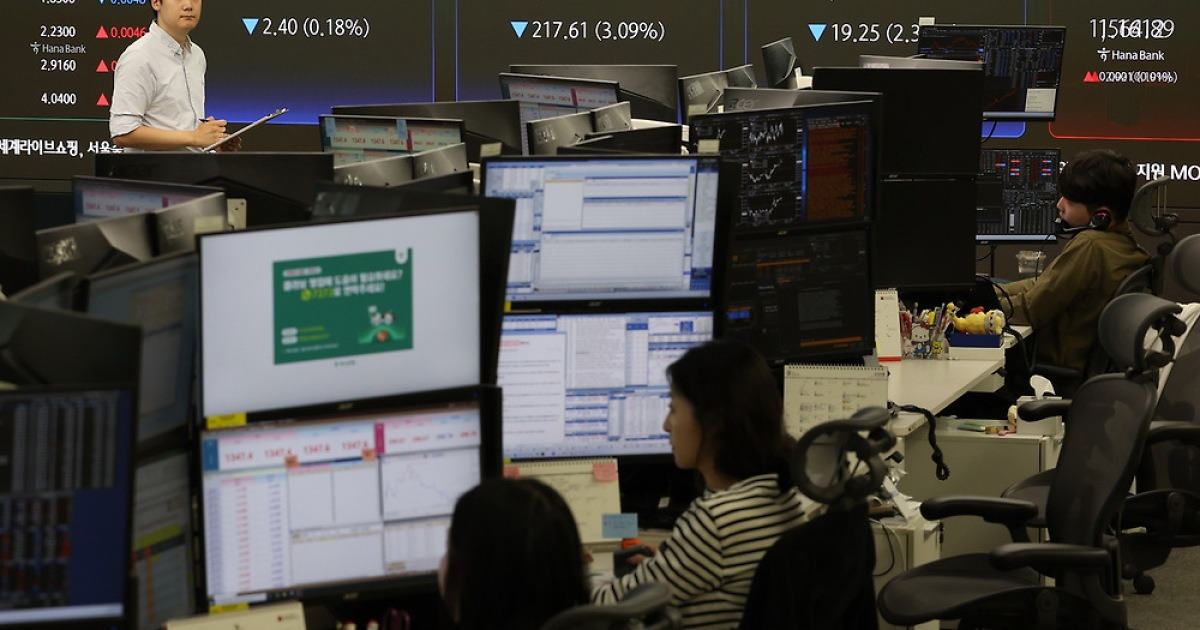
The won surged 10% in eight weeks. That number sounds like macro noise until you apply it to two companies that matter for every server, smartphone, and AI cluster on Earth.
From July 10 to September 11, the dollar-won rate fell from 1,501.4 to 1,345.9 — a 10.4 percent slide that would be routine in most currencies but lands like a punch for South Korea’s export-dependent economy. Samsung Electronics and SK Hynix, which together account for the bulk of the country’s manufacturing output, saw their combined operating profit consensus drop by 21 trillion won in the same window.
The direction is almost comically predictable: the won appreciates, dollar-denominated revenues convert into fewer wons, and earnings estimates get trimmed. But the scale of the revision tells a story that goes beyond mechanical accounting. This isn’t a gentle drift. It’s a steep, fast-moving reversal that caught both companies off guard.
Twenty-one trillion won is not a rounding error
The combined operating profit forecast for Samsung and SK Hynix dropped from 661 trillion won to 640 trillion won between July and September, according to Union Investment Intelligence data cited by Herald Economy. The third-quarter consensus slid too, from 199 trillion won to 188 trillion won.
SK Hynix itself laid out the mechanics in its semiannual report. Assuming foreign-currency assets and liabilities remained at June-end levels, a 10 percent appreciation of the won would cut pre-tax profit by roughly 4.75 trillion won. That’s a single variable — the exchange rate — carrying the weight of a mid-tier Korean corporation’s entire annual earnings profile.
Samsung’s exposure is even more concentrated. Over half its first-half sales of 258.6 trillion won came from exports, amounting to 245.7 trillion won — 95 percent of total revenue. When the dollar weakens against the won, that 95 percent gets retranslated downward, and there’s no operational buffer to absorb it.
Who wins, who loses, and who gets squeezed in the middle
Investors holding won-denominated shares in Korean semiconductors take the immediate hit. The market priced in the won’s weakness for months as a tailwind for export earnings, and the reversal unprices that premium in real time. Korean equities already trade at a discount relative to peers; a currency reversal narrows that discount further.
Global customers of Samsung and SK Hynix — the data center builders, the AI infrastructure funds, the OEMs ordering HBM — face a different dynamic. A stronger won doesn’t make their chips more expensive overnight. Long-term contracts and dollar invoicing dampen the direct pass-through. But it does compress the margins those chipmakers can offer, which eventually affects pricing discipline across the memory market.
The winners in this scenario are harder to identify cleanly. A stronger won benefits Korean importers and consumers holding domestic currency. It signals capital inflows or reduced risk premia — both potentially healthy. But for an economy where exports account for roughly 45 percent of GDP, a rapid appreciation is more signal of financial stress elsewhere than of structural strength.
The AI demand floor, and why it isn’t enough
The silver lining everyone leans on is real: memory demand is structurally growing. TrendForce projects that inventory levels across memory makers remain at historically low levels, with Q3 shipment growth constrained and price momentum intact. The launch of OpenAI’s GPT-6 Astra and a wave of Chinese high-efficiency AI models are keeping the demand narrative alive.
KB Securities’ Kim Dong-won expects HBM4 demand to surge next year alongside server DDR5 and enterprise SSD growth, calling it a “twin engine” that could push HBM’s market growth to record levels. The US-China AI competition ensures that demand shock won’t fade.
But demand growth and currency drag are different equations. Even if HBM volumes expand 30 percent next year, a 10 percent won appreciation erases roughly a third of that upside in won terms before you factor in capex, R&D, and the cost of maintaining technological leadership. The math doesn’t cancel out neatly.
What’s happening to the won, and what it might mean
The won’s drop from 1,500 to 1,340 over two months deserves more scrutiny than it’s getting. Currency moves of that magnitude in that timeframe don’t happen from trading flow alone. They reflect shifts in interest rate differentials, capital flows out of emerging Asian markets, or a combination of both.
Historically, the won has oscillated between 1,100 and 1,600 against the dollar over the past decade, with spikes above 1,400 usually coinciding with regional risk events or Fed tightening cycles. The current trajectory from 1,500 down to 1,340 suggests the dollar is weakening globally, not just against the won. But if the dollar stabilizes or reverses, the won could give back some of those gains — and the damage to profit forecasts would lock in for FY2026 results.
Both Samsung and SK Hynix are reportedly reviewing their investment and cost plans for this year and next in light of the currency movement. That’s the quiet signal: when two of the world’s largest chipmakers are pausing to reconsider their spending plans over a currency move, it’s not a quarterly blip. It’s a strategic recalibration.
The signal for global supply chains
For the rest of the world watching from Silicon Valley, Taiwan, or Germany, the takeaway is straightforward. A stronger won is a modest headwind for the cost structure of the two companies that dominate HBM and DRAM supply. It doesn’t break the supply chain — the demand fundamentals are too strong — but it does compress margins and raises the stakes for operational efficiency.
Samsung’s MX division, already underperforming market expectations according to DB Securities, faces the double hit of weak finished-product demand and unfavorable currency translation. That’s the fragile point. If the won continues to strengthen while memory volumes flatten, the margin squeeze becomes visible in quarterly results, not just consensus forecasts.
The memory market’s structural growth story remains intact. But the won’s sudden reversal is a reminder that currency risk is real risk, not a footnote in an earnings report. And for the global AI buildout that depends on Korean chipmakers to deliver HBM at scale, understanding that risk is as important as understanding the technology.